
The Housing Market Is Shifting — And Buyers Are Finally Winning
If you've been sitting on the sidelines waiting for the right moment to buy a home, the latest data suggests that moment may be arriving. A meaningful convergence of rising inventory, stalling asking prices, and relatively stable mortgage rates is quietly handing power back to buyers across much of the United States. Understanding what's driving this shift — and how to use it to your advantage — could save you tens of thousands of dollars on your next home purchase.
According to the most recent weekly data from Realtor.com®, the U.S. housing market is undergoing a notable transformation. Supply is climbing, price growth has ground nearly to a halt, and sellers in many regions are increasingly willing to negotiate. Here's a comprehensive breakdown of everything you need to know before you make your move.
Mortgage Rates: Stable but Still Elevated
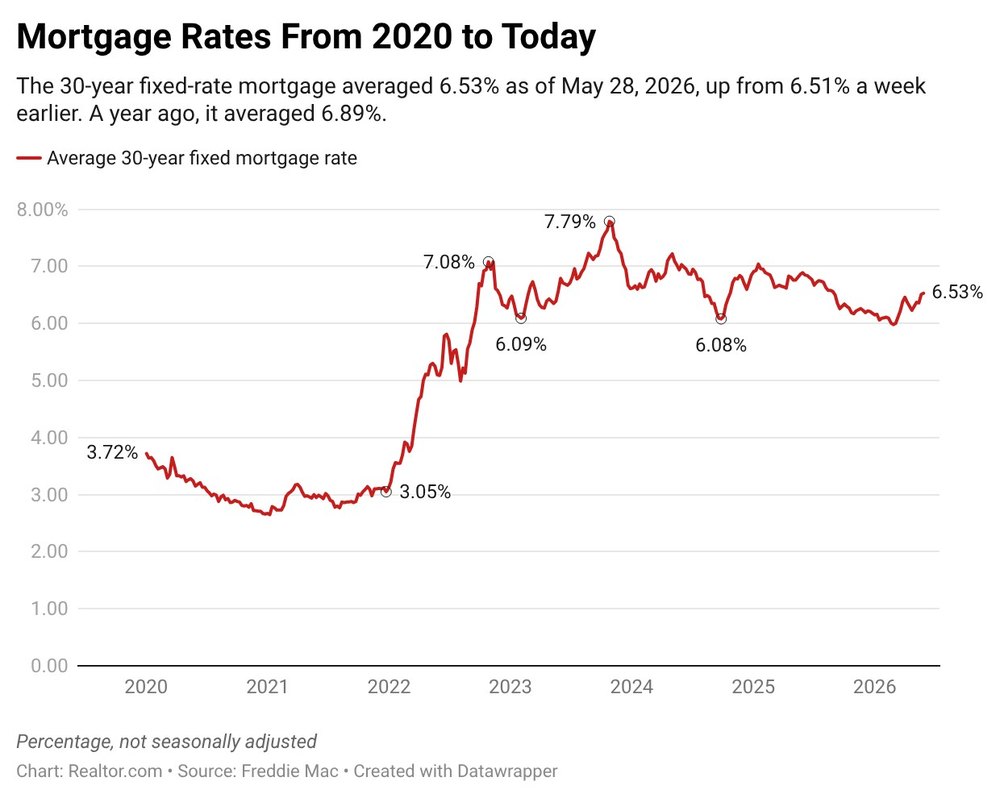
The Freddie Mac 30-year fixed-rate mortgage ticked up just slightly by 2 basis points during the week ending May 28, landing at 6.53%. While that number may sound discouraging to buyers who remember the historic lows of 2021, context matters enormously here.
Rates have largely flattened in recent weeks, a trend partly supported by bond market stability following renewed ceasefire optimism in the Middle East. Geopolitical calm tends to keep Treasury yields — and therefore mortgage rates — from spiking, which is a quiet but significant tailwind for anyone looking to lock in a rate right now.
More importantly, current rates sit 36 basis points below where they were at this same time in 2024. That's a meaningful improvement for buyers who were priced out last year. Yes, rates remain 55 basis points above the multiyear lows observed in late February, but the overall trajectory offers a degree of breathing room that simply didn't exist twelve months ago.
Financial experts generally caution that waiting for rates to drop dramatically before buying can be a costly strategy. If rates fall significantly, demand tends to surge, pushing prices back up. The current window of moderate rates combined with softening prices may represent a rare sweet spot.
Home Price Growth Has Nearly Stalled Nationwide
Perhaps the most striking headline from the latest data comes from the S&P Cotality Case-Shiller Index, which tracks national home price trends with precision. According to that index, national home prices rose just 0.7% year over year through the first quarter of 2025. That figure is just barely above flat — and in real, inflation-adjusted terms, it actually represents a price decline.
For context, home prices were surging at double-digit annual growth rates as recently as 2022. The deceleration has been dramatic and sustained. More than half of the 20 tracked metro areas in the Case-Shiller index posted outright annual price declines, and this marks the tenth consecutive month of that trend. A pattern that persists for ten months is not a blip — it is a structural shift in market dynamics.
What this means in practice is that sellers in many markets can no longer simply list a home at an ambitious price and expect multiple offers within days. Homes are sitting longer. Price reductions are becoming more common. And buyers are regaining the ability to negotiate — on price, on contingencies, and on closing costs.
Rising Inventory: More Choices, More Negotiating Power
One of the most powerful forces reshaping the housing market right now is the steady increase in available homes for sale. Inventory has been climbing consistently, giving buyers options they simply did not have during the frenzied pandemic-era market. More supply relative to demand means less competition for each individual listing, and that translates directly into leverage at the negotiating table.
The regional picture is nuanced but important. Markets in the South and parts of the Southwest have seen the sharpest inventory increases and the most pronounced price softening. Cities like Tampa, Austin, and Nashville, which saw explosive price growth during the pandemic years, are now among the markets where buyers are finding the most favorable conditions.
Meanwhile, markets in the Northeast and Midwest remain tighter, with inventory still relatively constrained and prices holding more firmly. If you're flexible on location, researching which specific markets offer the best buyer conditions right now can make an enormous difference in what you ultimately pay.
How to Use This Leverage as a Buyer
Understanding that conditions have shifted in your favor is only the first step. Actually capturing that advantage requires strategy. Here are concrete ways to make the current market work for you:
- Request seller concessions. In a balanced or buyer-friendly market, it's entirely reasonable to ask sellers to cover closing costs, buy down your mortgage rate, or make repairs before closing. These concessions were nearly impossible to secure in 2021 and 2022 but are increasingly common today.
- Don't skip the inspection contingency. When inventory was scarce, many buyers waived inspections to compete. With less competition, you can protect yourself by including this critical safeguard.
- Make lower initial offers. With homes sitting longer and price cuts becoming routine, your first offer doesn't need to be your best offer. Research comparable sales carefully and come in with a number that reflects current, not peak, market conditions.
- Get pre-approved, not just pre-qualified. In a normalizing market, sellers still prefer certainty. A strong pre-approval letter demonstrates you're a serious buyer and strengthens your negotiating position even as you push for a lower price.
- Watch for price reduction patterns. Listings that have already had one price reduction are statistically more likely to accept a below-asking offer. Target these homes first to maximize your negotiating leverage.
What to Watch in the Weeks Ahead
The housing market does not move in a straight line, and conditions can shift faster than weekly data reports can capture. Several key variables are worth monitoring closely. Federal Reserve policy remains a wildcard — any signal of rate cuts would likely reignite buyer demand and reduce the window of opportunity currently available. Employment data also matters, since a weakening labor market can suppress both buyer demand and seller confidence simultaneously, creating additional pricing pressure.
On the supply side, watch whether new construction completions continue to add inventory to the market. Builders who ramped up production in 2023 and 2024 are now delivering finished homes, and that added supply is a structural factor that should continue to moderate prices in many regions through the remainder of 2025.
The Bottom Line
The U.S. housing market in mid-2025 looks meaningfully different from the seller's paradise of the pandemic years. Rising inventory, near-flat national home prices, a regional trend of outright price declines, and mortgage rates that are lower than a year ago are all combining to create genuine buyer leverage for the first time in years. If you've been waiting for conditions to improve before making your move, the data suggests you may not need to wait much longer. The window is open — and the tools to negotiate a better deal are firmly in your hands.