
The Housing Affordability Crisis of 2026—And the States Bucking the Trend
For millions of Americans, the dream of homeownership has never felt further away. Elevated mortgage rates, stubbornly high home prices, and broader economic headwinds have turned what was once a straightforward financial milestone into a stressful, high-stakes calculation. Yet while most of the country struggles, a select group of states continues to offer something increasingly rare: genuine affordability.
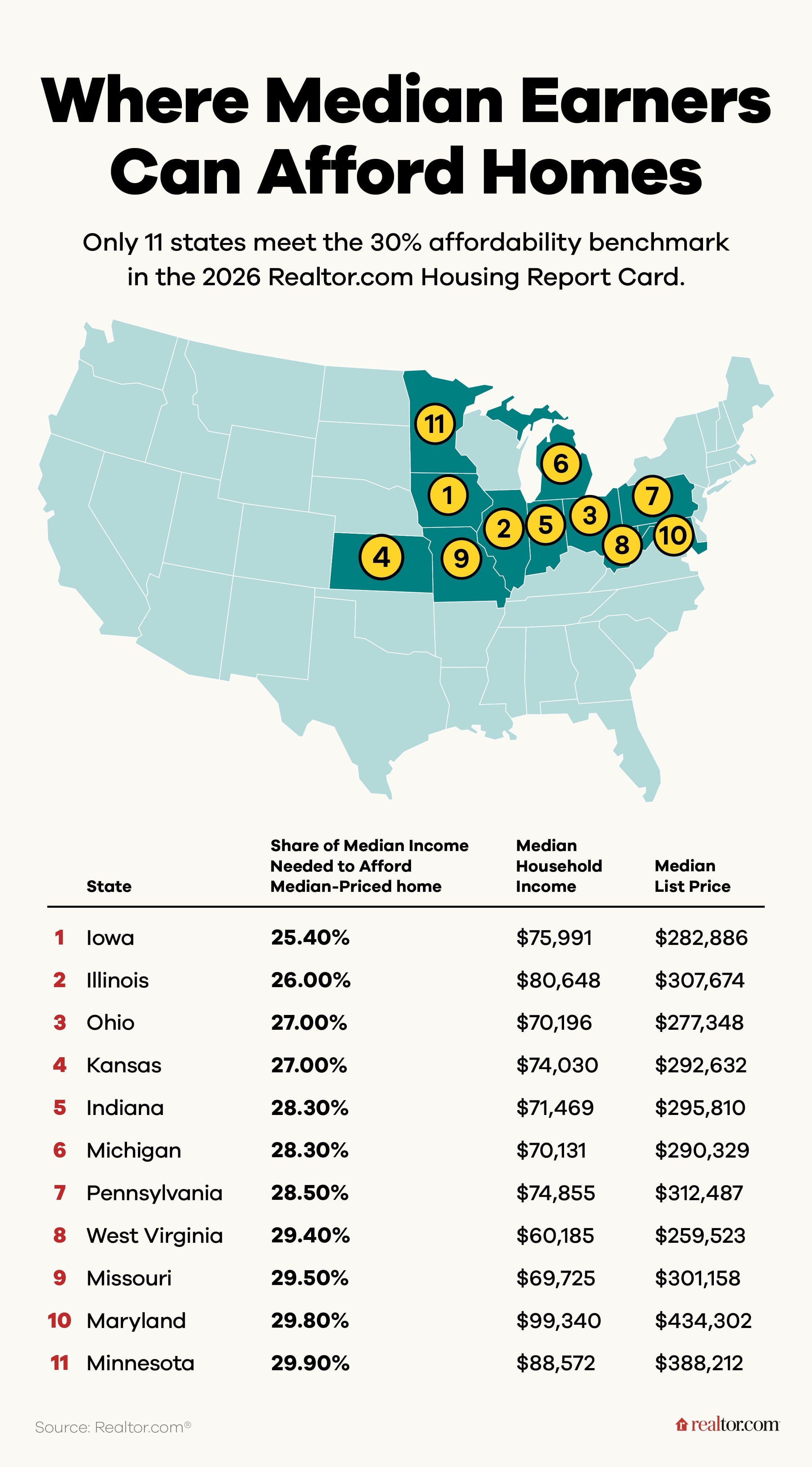
According to the 2026 Realtor.com® Housing Report Card, a household earning the median income can comfortably afford a median-priced home in fewer than a quarter of all U.S. states and the District of Columbia. That means only 11 states—most of them clustered in the American heartland—give everyday buyers a fighting chance at purchasing a home without stretching their finances to the breaking point.
If you're serious about buying a home in 2026 without going house-poor, these are the markets you need to know about.
What Does "House-Poor" Actually Mean?
Before diving into the list, it's worth understanding the financial benchmark at the center of this conversation: the 30% rule. Personal finance experts have long recommended that households spend no more than 30% of their gross monthly income on housing costs. This includes your mortgage payment, property taxes, homeowner's insurance, and any applicable HOA fees.
When housing costs push past that 30% threshold, buyers are considered "cost-burdened"—a polite way of saying they're house-poor. Being house-poor means that even though you own a home, you have little money left over for savings, emergencies, retirement contributions, or simply enjoying your life. It's a trap that ensnares buyers who overextend in expensive markets, and it's exactly what the 30% rule is designed to prevent.
In today's market, with mortgage rates still elevated compared to the historic lows of just a few years ago, staying within that 30% guideline has become extraordinarily difficult in high-cost coastal cities and popular Sun Belt metros. But in the heartland, the numbers still add up.
Iowa Leads the Pack: America's Heartland Affordability Champion
At the top of the affordability rankings sits Iowa, earning the distinction of being the most affordable state for homebuyers in 2026. Iowa's combination of relatively low median home prices, a reasonable cost of living, and competitive local economies means that a median-income household doesn't have to sacrifice financial security just to put a roof over their head.
Iowa's housing market has remained insulated from the speculative price surges that inflated values in coastal markets over the past several years. Cities like Des Moines, Cedar Rapids, and Davenport offer genuine urban amenities—growing job markets, cultural attractions, strong school systems—without the sticker shock that comes with living in Austin, Denver, or Miami.
For buyers who have been priced out of more glamorous markets, Iowa represents a real opportunity to build wealth through homeownership rather than simply treading water as a renter.
The Full List: 11 States Where Affordability Still Exists
Iowa may headline the list, but it's far from alone. Illinois also makes a notable appearance, which may surprise buyers who associate the state primarily with the high costs of Chicago living. However, Illinois's vast geographic diversity means that outside of the Chicago metro area, home prices drop considerably while incomes remain competitive—particularly in cities like Peoria, Springfield, and Champaign.
The broader list of 11 affordable states reflects a clear geographic pattern: the American heartland and parts of the South and Midwest consistently outperform coastal regions on affordability metrics. These states tend to share a few common characteristics:
- Lower median home prices that don't require jumbo loan territory to finance a family-sized property.
- Stable local economies driven by agriculture, manufacturing, healthcare, and education sectors that offer steady employment without the boom-and-bust volatility of tech-heavy markets.
- Reasonable property taxes and cost of living that keep total monthly housing expenses within the 30% guideline even when mortgage rates are elevated.
- Less competition from investors and remote workers who flooded into high-profile secondary markets and drove up prices in cities like Boise, Nashville, and Phoenix.
Why This Matters More Than Ever in 2026
The fact that only 11 states—out of 50 plus the District of Columbia—meet the basic affordability threshold is a striking indicator of just how strained the national housing market has become. For buyers who have flexibility in where they live and work, especially those who work remotely or are willing to relocate for opportunity, these 11 states represent a genuine path to homeownership that simply doesn't exist in more expensive parts of the country.
It's also worth noting that affordability in these markets isn't just about buying a home—it's about buying financial stability. When your housing payment stays within the 30% rule, you have room to build an emergency fund, contribute to your retirement accounts, pay down other debts, and actually enjoy your life. That kind of financial breathing room is increasingly rare in 2026, and it shouldn't be underestimated.
Is Relocating to an Affordable State Right for You?
Choosing where to buy a home involves far more than just housing prices. Quality of schools, proximity to family, job market strength, climate, and community culture all play into the decision. But for buyers who are currently renting in an expensive market and watching homeownership drift further out of reach with each passing month, it's worth seriously evaluating whether one of these 11 heartland states could offer a better quality of life—not just a lower mortgage payment.
The data is clear: in Iowa and its peer states, median-income households can still follow the rules of sound personal finance and come out the other side as homeowners rather than as permanently cost-burdened renters. That's not a small thing. In the housing market of 2026, it's actually quite extraordinary.
Bottom Line: Affordability Is Out There—If You Know Where to Look
The national housing affordability crisis is real, and it isn't going away overnight. But the 2026 Realtor.com® Housing Report Card makes one thing abundantly clear: opportunity still exists. Eleven states—led by Iowa and anchored primarily in the American heartland—are giving median-income buyers the chance to achieve homeownership without becoming house-poor.
Whether you're a first-time buyer frustrated by your local market or an experienced homeowner considering a move, these states deserve a serious look. Affordability may be scarce in 2026, but it hasn't disappeared entirely. You just need to know where to find it.