
Where Architecture Meets Mindfulness: Align Studio by Talo Atelier
In a city as dynamic and visually overwhelming as Mexico City, finding a space that genuinely invites stillness is no small achievement. Yet that is precisely what local design firm Talo Atelier has accomplished with Align Studio, a new yoga and wellness destination whose architecture functions less as decoration and more as a carefully orchestrated experience. Every surface, curve, and material choice has been made with a single guiding philosophy in mind: let the building itself lead visitors toward a calmer, more intentional state of being.
The result is a studio that design publications and wellness communities alike are calling one of the most thoughtfully conceived fitness interiors in Latin America. From the moment you step inside, the space quietly communicates what it expects of you — slow down, breathe, pay attention.
The Central Design Element: Light-Oak Tambour Panelling
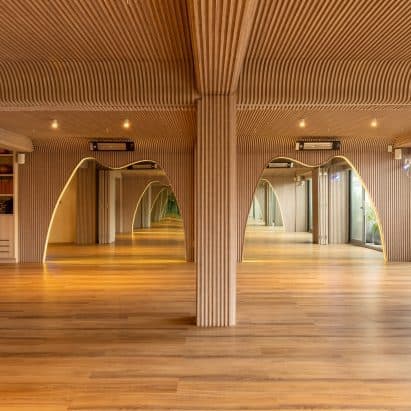
The most immediately striking feature of Align Studio is the light-oak tambour panelling that sheathes its interior walls and flows, almost seamlessly, up onto the ceiling. Tambour panelling — a technique involving narrow strips of wood mounted on a flexible backing — has a long history in furniture design, but its application across entire architectural surfaces is a more recent and increasingly compelling trend in high-end interiors.
Talo Atelier's decision to carry the panelling from vertical wall planes onto the ceiling dissolves the boundary between the two surfaces, creating an enveloping, cocoon-like atmosphere. Rather than feeling boxed in, practitioners moving through yoga sequences or pilates exercises find themselves surrounded by a continuous warm texture that softens the room acoustically as well as visually. The light oak tone avoids the heaviness that darker timbers might impose, keeping the palette airy and reflective of natural light.
This material continuity is not merely aesthetic. By removing hard visual interruptions — sharp corners, contrasting finishes, abrupt transitions — the architecture reduces the number of micro-decisions the eye and brain must process. That reduction in visual noise directly supports the meditative and restorative goals of the activities happening within the space.
Architecture as a "Silent Guide"
Talo Atelier has described their design approach for Align Studio using a compelling phrase: the architecture acts as a "silent guide." This concept sits at the intersection of environmental psychology and spatial design, and it is worth unpacking what it means in practical terms.
A silent guide does not instruct through signage, barriers, or explicit cues. Instead, it shapes behaviour through sensory suggestion. The curve where the wall meets the ceiling draws the eye upward and inward simultaneously, encouraging a posture of openness. The warmth of the oak material signals safety and natural comfort. The absence of harsh angles or industrial finishes removes the subconscious associations people carry with commercial or utilitarian spaces.
For a wellness studio, this approach is especially powerful. Yoga and pilates both require participants to quiet internal mental chatter and become present in their bodies. When an environment actively supports that transition — rather than fighting it with stimulating visuals or chaotic spatial arrangements — practitioners can move more quickly into a focused, productive state. The studio, in essence, does part of the instructor's work before a single class has begun.
A Flexible Space for Multiple Wellness Disciplines
Align Studio is not limited to a single modality. The space accommodates yoga sessions, pilates classes, and a range of other wellness-focused activities, which means the architectural design had to be flexible enough to serve varied movement patterns, equipment arrangements, and group sizes without losing its cohesive identity.
Talo Atelier addressed this challenge through considered spatial planning that allows the studio floor to be reconfigured while the envelope — those enveloping tambour walls and ceiling — remains constant. This consistency means the sensory experience of the space does not change dramatically whether a guest is attending a restorative yin yoga class or a more dynamic pilates reformer session. The architecture holds the mood steady even as the activity shifts.
Mexico City as Context
Locating a project like this within Mexico City adds meaningful layers of context. The city's design scene has been gaining significant international attention over the past decade, with a generation of local architects and interior designers drawing on both pre-Columbian material traditions and contemporary global influences. Talo Atelier fits comfortably within this emerging cohort, producing work that feels rooted in craft and material honesty without being nostalgic or derivative.
The choice of light oak — a material with European associations — might seem at odds with a locally grounded practice, but the warmth and organic quality of wood transcends cultural geography. In Mexico City's colonia neighbourhoods, where beautiful old buildings sit alongside ambitious new interventions, a studio that prioritises material quality and sensory experience over visual novelty feels entirely appropriate.
Why Wellness Architecture Matters More Than Ever
The growing field of wellness architecture recognises what practitioners of yoga and meditation have long understood: the spaces we inhabit shape our mental and physical states in profound ways. As demand for wellness services continues to rise globally, the studios, spas, and retreat centres that will distinguish themselves are not those with the longest class schedules or the most Instagram-worthy colour palettes, but those whose physical environments genuinely support healing, focus, and restoration.
- Thoughtful material choices reduce sensory overstimulation and support focus during practice.
- Spatial continuity — such as the wall-to-ceiling tambour transition at Align — creates psychological comfort and reduces subconscious anxiety.
- Flexible layouts allow a single well-designed envelope to serve multiple wellness disciplines without compromising the sensory experience.
- Architecture that functions as a silent guide lowers the cognitive load on visitors before a session even begins, accelerating the transition into mindful movement.
A New Benchmark for Studio Design
Align Studio by Talo Atelier represents a meaningful step forward in how wellness spaces are conceived and executed. By treating architecture not as a backdrop but as an active participant in the wellness journey, the firm has created an environment where the building itself becomes part of the practice. The light-oak tambour panelling that wraps the walls and ceiling is not simply a beautiful finish — it is a carefully considered instrument, tuned to the specific frequency of calm, focus, and physical awareness that every person who walks through Align's doors is seeking.
For designers, studio owners, and wellness practitioners interested in how physical environments can amplify the benefits of mindful movement, this project offers both inspiration and a practical framework worth studying closely.