
A Nation That Couldn't House Its Heroes
When the guns finally fell silent in 1945, millions of American veterans began making their way home. They had crossed oceans, stormed beaches, and endured years of sacrifice with one promise quietly held in their hearts: a life worth living on the other side. What they found instead was a country that simply could not house them.
By federal estimates at the time, the United States needed more than 2.5 million new housing units in 1946 for veterans and their families alone. The U.S. population then stood at just 151 million—less than half of today's 331 million—yet the shortage was so severe that families were crammed into trailers, tents, and makeshift shelters. A bitter protest slogan of the era said it all: "From foxholes to shacks!! We had more room in the foxholes."
The crisis was real, urgent, and nationally humiliating. But what happened next was one of the most remarkable acts of domestic mobilization in American history—and its echoes are urgently relevant today.
How America Built Its Way Out
The postwar housing boom didn't happen by accident. It was the product of deliberate policy, financial innovation, and private-sector energy converging at a singular moment in history.
The GI Bill and the Rise of Mortgage Finance
The Servicemen's Readjustment Act of 1944, better known as the GI Bill, was the engine that powered a generation of homeownership. It guaranteed low-interest, zero-down-payment mortgages for eligible veterans, dramatically lowering the barrier to entry for millions of working-class families who had never imagined owning a home. The Federal Housing Administration, established a decade earlier, standardized mortgage terms and insured lenders against default, unlocking capital that had previously sat on the sidelines.
The result was a financial system suddenly willing—and able—to fund mass homeownership at a scale the country had never seen.
Levittown and the Starter Home Revolution
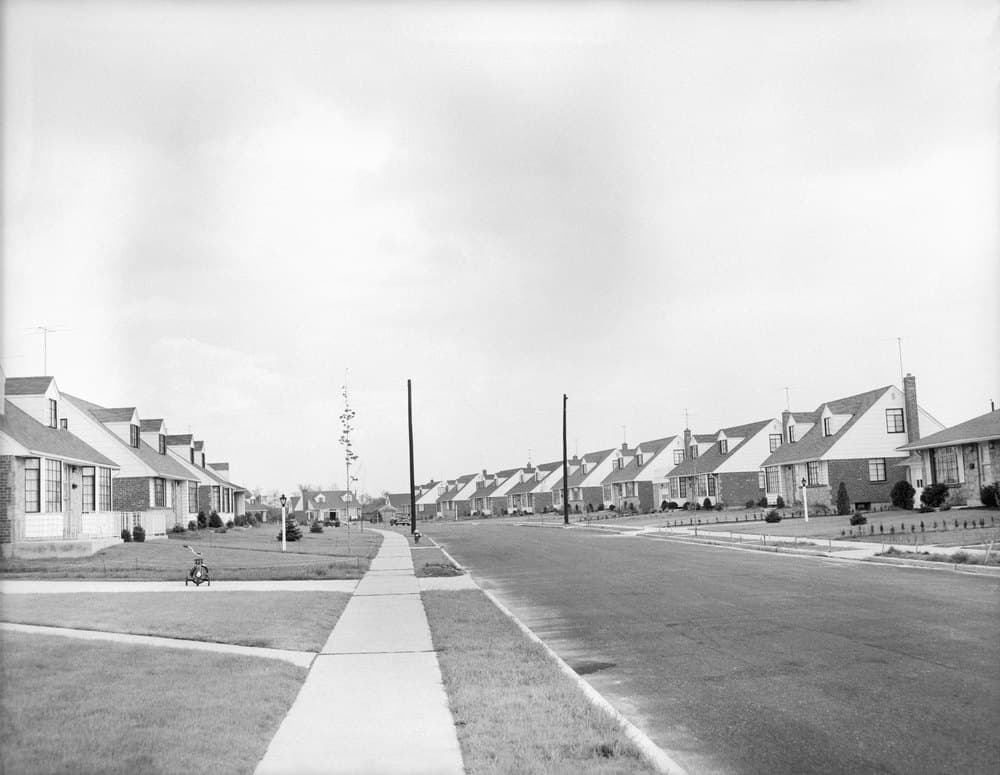
Into that financial opening stepped builders like William Levitt, whose firm constructed entire communities from scratch using assembly-line construction techniques borrowed from wartime manufacturing. Levittown, New York, built in 1947, became the symbol of this era: modest, affordable, and mass-produced. These were not dream homes in the traditional sense—they were small, simple, and standardized. But they were homes, and they were attainable.
The starter home was born. And with it came a new vision of the American dream: not inherited wealth or urban apartments, but a detached house in the suburbs, a yard, and a mortgage you could actually pay off.
The Broader Economic Impact
The housing boom of the late 1940s and 1950s didn't just put roofs over heads—it restructured American society. It fueled the growth of the middle class, anchored household wealth in real estate, drove demand for consumer goods from refrigerators to lawnmowers, and accelerated the development of highway infrastructure. Homeownership became the cornerstone of financial stability for generations of American families.
Today's Crisis: Different in Scale, Familiar in Pain
Seventy-five years later, America is facing a housing crisis that, while different in its origins, rhymes disturbingly with the postwar era.
- Starter homes—once the entry point to the housing market for working families—have crossed the $1 million mark in more than half of U.S. markets, according to recent data.
- The median age of a first-time homebuyer has risen to 40 years old, up dramatically from previous decades, as younger generations find themselves locked out of the market well into their adult lives.
- A persistent shortage of housing inventory, driven by decades of underbuilding, zoning restrictions, and rising construction costs, has made affordability a crisis in virtually every major metropolitan area.
- Rental costs have surged alongside purchase prices, leaving renters with fewer resources to save for a down payment even as they spend more each month on housing.
The causes are structurally different from 1946—this is not a sudden demand shock from returning soldiers, but the accumulated result of decades of policy failures, NIMBYism, and supply constraints. Yet the human experience is strikingly similar: a generation of Americans who did everything right, finding themselves unable to access the stability that homeownership once reliably provided.
What the Postwar Era Can Teach Us
The postwar housing boom offers several lessons that remain applicable, even in a vastly more complex modern environment.
Supply Is the Foundation
The postwar solution was, at its core, a supply solution. America built—aggressively, quickly, and at scale. The current crisis will not be solved by demand-side subsidies alone. Expanding the housing supply, particularly at the affordable and entry-level end of the market, must be the central priority of any serious policy response.
Zoning Reform Is Not Optional
Levitt could build Levittown in part because the regulatory environment permitted it. Today, restrictive single-family zoning in high-demand areas is one of the primary brakes on new construction. Cities and states that have moved to allow duplexes, accessory dwelling units, and higher-density development have seen early signs of relief. Scaling that reform nationally is essential.
Financial Innovation Must Serve Buyers, Not Just Markets
The GI Bill worked because it made the financial system accessible to people who were previously excluded. Today's equivalent challenge is rebuilding a pathway to homeownership for first-time buyers who face not only high prices but also high interest rates, stringent lending standards, and stagnant wages relative to housing costs. Creative approaches to down payment assistance, shared-equity models, and community land trusts deserve serious attention.
Political Will Is the Real Variable
Perhaps the most important lesson from the postwar era is that the problem was treated as a national emergency deserving a national response. Policymakers, builders, and financial institutions aligned around a shared goal. That alignment is harder to achieve today in a more polarized, fragmented political environment—but it is not impossible.
Can We Do It Again?
The postwar housing boom was not inevitable. It required vision, investment, and the willingness to act at scale. The same is true today. America has faced acute housing crises before and found its way through them. The tools available today—technology, data, modern construction methods, and a deeper understanding of what went wrong in past cycles—are arguably more powerful than those available in 1946.
What remains to be seen is whether the political and social will exists to use them. The veterans of 1945 didn't wait for a perfect solution. They demanded action, and eventually, action came. The question for today's generation of aspiring homeowners is whether their moment of mobilization is at hand—and whether those in power are ready to answer it.