
Why Capital Gains Taxes Are Quietly Freezing the Housing Market
If you've wondered why so few homes are hitting the market even as buyer demand remains strong, part of the answer may lie in the tax code. The U.S. Senate recently heard testimony suggesting that federal capital gains taxes on home sale profits are actively discouraging millions of homeowners from listing their properties — and a growing coalition of real estate industry leaders wants Congress to act.
On Tuesday, the Senate Committee on Banking, Housing and Urban Affairs took up the issue directly, hearing from top real estate officials who argued that outdated tax thresholds are contributing to one of the most stubborn housing supply problems in recent memory. The proposed solution: double the capital gains exclusion limits that home sellers can claim when they sell their primary residence.
What Are Capital Gains Exclusions on Home Sales?
When you sell your home for more than you paid for it, the profit — known as a capital gain — is generally subject to federal taxation. However, the IRS does allow homeowners to exclude a portion of that gain from their taxable income, provided they meet certain ownership and residency requirements.
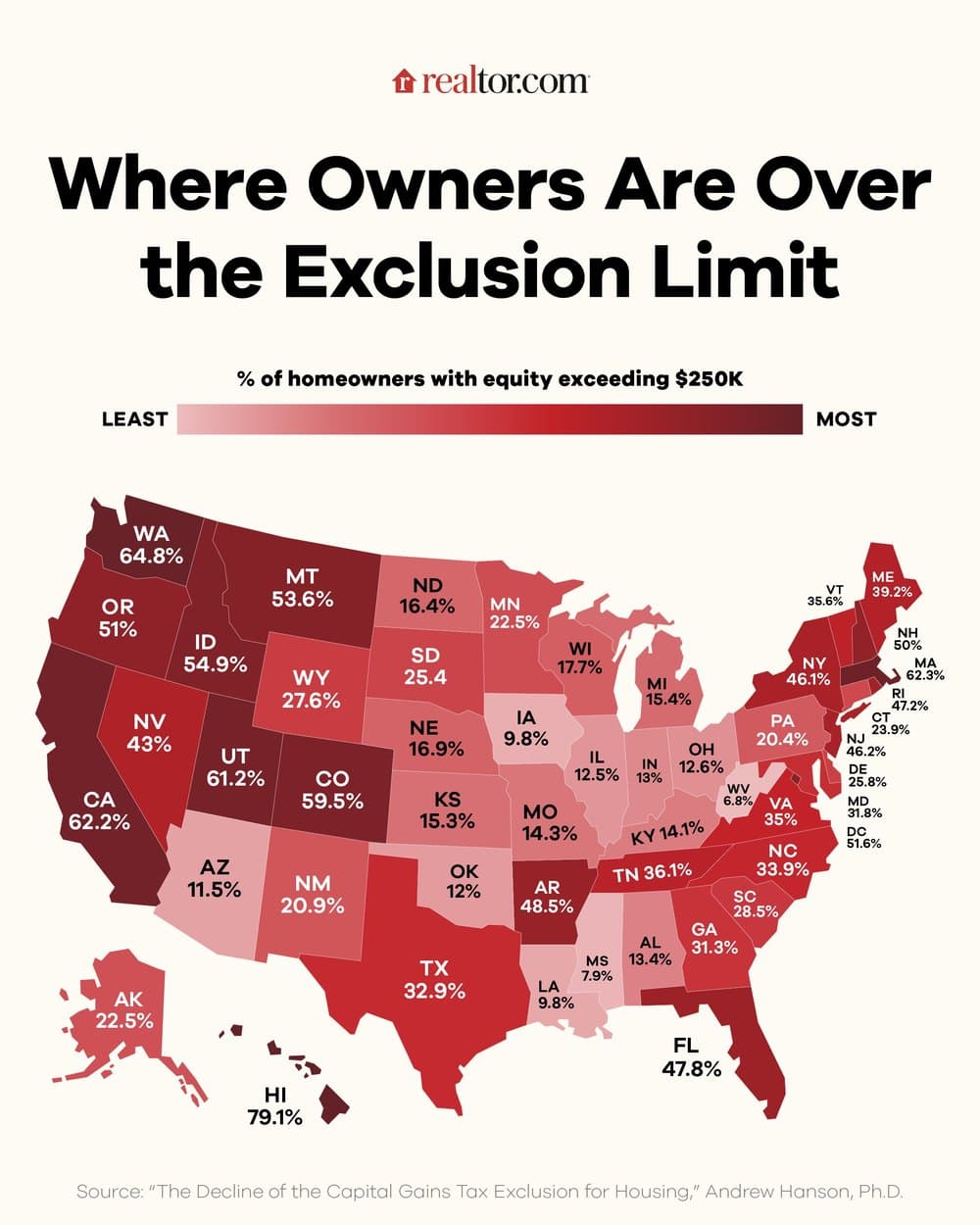
Under current law, single filers can exclude up to $250,000 in home sale profits from capital gains taxes. Married couples filing jointly can exclude up to $500,000. These thresholds were established by the Taxpayer Relief Act of 1997 and have never been adjusted for inflation — a fact that critics say is long overdue for a correction.
In 1997, a $250,000 gain on a home sale was relatively uncommon. Today, after decades of home price appreciation — and especially following the dramatic run-up in values seen during and after the COVID-19 pandemic — many ordinary homeowners find themselves sitting on gains that far exceed these limits, even in mid-sized markets.
Senate Testimony: NAR Calls for Doubling the Exclusion
Kevin Brown, president of the National Association of Realtors® (NAR), testified before the Senate committee and made a direct case for raising the exclusion thresholds. NAR is advocating for limits to be doubled — meaning single filers could exclude up to $500,000 in profits, and married couples could exclude up to $1 million.
Brown framed the issue not just as a matter of tax fairness, but as a direct contributor to the housing inventory crisis gripping much of the country. "Just like people were locked into their homes at lower interest rates, seniors are often locked in because of the home equity penalty," he told senators. "This legislation expands existing housing stock and gives seniors the opportunity to tap equity that they have counted on for retirement."
He went on to explain the ripple effect that freeing up these homeowners could have across the broader market: "In turn, move-up buyers can then buy homes, thus freeing up houses for first-time homebuyers." It's a chain reaction that, if set in motion, could meaningfully ease pressure on a market where entry-level inventory has been especially scarce.
The "Lock-In" Effect: More Than Just Interest Rates
Much of the public conversation around housing supply has focused on the so-called mortgage rate lock-in effect — the phenomenon where homeowners who locked in ultra-low interest rates during 2020 and 2021 are reluctant to sell because doing so would mean taking on a new mortgage at significantly higher rates.
But the Senate testimony highlights a separate, less-discussed form of lock-in: the tax lock-in effect. For long-term homeowners, particularly retirees and seniors who have owned their homes for decades, the prospect of owing a substantial tax bill on their home equity gain can be a powerful deterrent to selling — even when selling would otherwise make sense for their lifestyle or financial needs.
Consider a homeowner who purchased their house in 1990 for $150,000. If that home is now worth $750,000, they're sitting on a $600,000 gain. A married couple could shelter $500,000 of that under current law, but the remaining $100,000 would be taxable. For a single seller, the tax exposure would be even greater. That tax burden can easily amount to tens of thousands of dollars, making the decision to downsize or relocate far more complicated than it would otherwise be.
What This Means for First-Time Homebuyers
The downstream effects of the capital gains lock-in reach well beyond current homeowners. When move-up or downsizing sellers stay put to avoid a tax bill, they remove an entry-level or mid-tier home from the available supply. This directly impacts first-time buyers who are already competing in a market with limited options and elevated prices.
- Fewer existing homeowners selling means fewer homes available for buyers at every price point.
- Limited supply keeps prices elevated, making affordability even harder for younger and first-time buyers.
- Retirees who can't afford the tax consequences of selling may stay in homes larger than their needs, reducing turnover in desirable neighborhoods.
Raising the exclusion thresholds could unlock a meaningful wave of new inventory by giving homeowners the financial freedom to sell without a prohibitive tax penalty hanging over the transaction.
The Legislative Path Forward
The proposal to double capital gains exclusions for home sellers has been gaining attention on Capitol Hill. The Nest Egg Protection Act, introduced by Representative Nicole Malliotakis, is one legislative vehicle designed to address this issue. The bill reflects a bipartisan recognition that tax policy is playing a meaningful role in shaping housing supply dynamics.
NAR's public push, combined with direct Senate testimony, signals that the real estate industry is committed to keeping this issue at the forefront of the broader housing policy debate. Whether Congress acts in the near term remains to be seen, but the pressure is clearly building.
What Homeowners Should Know Right Now
If you're a homeowner who has been hesitant to sell because of potential capital gains exposure, it may be worth consulting with a tax professional or financial advisor to understand your current liability and what potential legislative changes could mean for your situation. While the exclusion thresholds have not yet been raised, the political momentum around the issue is real.
In the meantime, there are existing strategies — such as timing a sale to qualify for the exclusion, understanding your cost basis, and accounting for capital improvements — that can help reduce your taxable gain under current law.
The broader takeaway is clear: tax policy and housing policy are deeply intertwined, and the decisions Congress makes in the months ahead could meaningfully reshape who sells, who buys, and how accessible the housing market becomes for millions of Americans.