
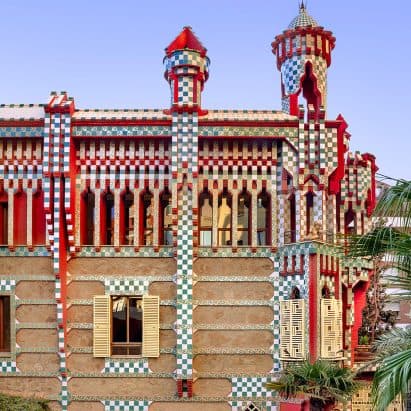
Casa Vicens: The House Where Antoni Gaudí Announced Himself to the World
When most people think of Antoni Gaudí, their minds jump immediately to the soaring spires of the Sagrada Família or the mosaic-covered terraces of Park Güell. Yet long before those iconic landmarks were even imagined, a modest summer house in the Gràcia district of Barcelona quietly declared the arrival of one of the greatest architectural minds the world has ever seen. Casa Vicens, completed around 1885, was Gaudí's first major commission — and, as historians and architects increasingly argue, it served as his "manifesto home": a single building in which the young architect laid out virtually every principle that would define his extraordinary career.
As we mark the centenary of Gaudí's death in 2026, there has never been a better moment to revisit this foundational work, understand what made it so radical, and appreciate why it continues to captivate architects, designers, and travelers from around the globe.
The Origins of Casa Vicens
Casa Vicens was commissioned in 1878 by Manuel Vicens i Montaner, a tile and brick manufacturer, as a summer residence for his family. The site sat in what was then the semi-rural outskirts of Barcelona, before Gràcia was absorbed into the expanding city. Gaudí was just 26 years old and had recently graduated from the Barcelona School of Architecture. The commission was, by any measure, a remarkable opportunity for a young graduate — and he seized it with extraordinary ambition.
Construction took place between 1883 and 1885, and the finished building bore almost no resemblance to the Neo-Gothic or Historicist styles fashionable in Catalonia at the time. Instead, Gaudí produced something that synthesized Moorish, Orientalist, and vernacular Catalan influences into a wholly original architectural language. In doing so, he essentially wrote the opening chapter of Catalan Modernisme before the movement even had a name.
An Architectural Manifesto in Brick and Tile
The term "manifesto home" is apt for several reasons. A manifesto, after all, is a public declaration of beliefs, intentions, and methods. Every surface of Casa Vicens communicates Gaudí's design philosophy with the confidence of a young artist who has found his voice entirely formed.
The exterior is immediately striking. Gaudí covered the facade with green-and-white ceramic tiles featuring marigold and checkerboard patterns — a direct nod to the client's profession as a tile manufacturer, but also a demonstration of Gaudí's lifelong commitment to integrating ornament with structure. The tiles are not decorative afterthoughts; they are the building's skin, giving it texture, rhythm, and identity. Alongside the tilework, the facade incorporates exposed brick, wrought iron, and richly carved stonework, weaving together multiple materials into a cohesive whole.
The wrought-iron gates and fencing deserve particular attention. Gaudí designed them in the form of palm leaves — a motif he reportedly drew from a fan palm tree he discovered growing on the site before construction began. That detail reveals something essential about his working method: nature was always his primary source material. He did not impose abstract geometry onto a site; he listened to what was already there and amplified it.
Interior Spaces That Prefigure a Career
Stepping inside Casa Vicens is to enter a world of sensory abundance. The interiors are a dazzling catalogue of the ideas Gaudí would spend the rest of his life developing and refining.
- The smoking room, or Arab Room, features a muqarnas-style ceiling — a honeycomb of plaster stalactites inspired by Islamic architecture — that demonstrates Gaudí's deep study of the Alhambra and Moorish design traditions.
- Hand-painted ceramic tiles cover walls and floors throughout, each room with its own distinct palette and botanical motifs including birds, flowers, and climbing vines.
- The dining room ceiling is painted with a trompe l'oeil sky populated with birds in mid-flight, blurring the boundary between interior and exterior — a theme Gaudí would return to again and again.
- Structural elements such as columns and arches are shaped organically, hinting at the parabolic and catenary forms that would later become his structural signature.
The building also shows Gaudí thinking carefully about climate and comfort in ways that were ahead of his time. Deep overhanging eaves, strategically placed windows, and shaded gallery spaces were all designed to manage the Barcelona heat, making Casa Vicens not only beautiful but functionally intelligent.
From Private Residence to Public Landmark
For most of its history, Casa Vicens remained a private home, largely unseen by the public eye. The house changed hands several times after the Vicens family sold it, and it was modified in the early twentieth century — a wing was added, and some original garden space was lost to urban development. Despite these changes, the core of Gaudí's vision survived intact.
In 2005, Casa Vicens was included in the UNESCO World Heritage Sites listing for "Works of Antoni Gaudí," joining the Sagrada Família, Casa Batlló, Casa Milà, Park Güell, and four other buildings in a collective designation that recognized Gaudí's "exceptional and outstanding universal value" to world architecture.
The house opened to the public for the first time in 2017, following a careful restoration by the architectural firm Actar Arquitectura. Since then, it has welcomed hundreds of thousands of visitors annually, finally taking its rightful place in the popular imagination alongside Gaudí's more celebrated works.
Why Casa Vicens Matters More Than Ever in 2026
The year 2026 marks the centenary of Gaudí's death — he was struck by a tram in Barcelona on June 7, 1926, and died three days later, three days before his 74th birthday. Centenary events taking place across Barcelona have prompted a fresh wave of critical and popular interest in his entire body of work, and Casa Vicens has emerged as a particular focus of that renewed attention.
Scholars are now reading the house not merely as a precocious student work but as a fully realized artistic statement. Every element — the tilework, the ironwork, the muqarnas ceilings, the nature-derived ornament, the concern for climatic comfort, the insistence on handcraft — maps directly onto the mature work Gaudí would produce over the following four decades. In this sense, Casa Vicens is less a rehearsal than a revelation: a young architect arriving fully formed, laying down his terms, and inviting the world to keep up.
Planning Your Visit to Casa Vicens
Casa Vicens is located at Carrer de les Carolines 20-26 in the Gràcia neighborhood of Barcelona, a short walk from the Fontana metro station on Line 3. The museum is open year-round, with extended hours during summer months. Timed entry tickets are available online, and advance booking is strongly recommended, particularly during peak travel season and throughout 2026's centenary celebrations.
Unlike the Sagrada Família or Park Güell, Casa Vicens remains comparatively uncrowded, offering visitors a more intimate encounter with Gaudí's genius. The experience of moving through its rooms — tracing the hand-painted tiles, gazing up at that extraordinary smoking room ceiling, peering through the iron palm-leaf gates — is as close as anyone can come to standing inside the mind of one of architecture's most extraordinary visionaries at the very moment he first found his voice.
For architecture lovers, design enthusiasts, and curious travelers alike, Casa Vicens is not a footnote to the Gaudí story. It is, as its best interpreters have always known, where that story truly begins.