
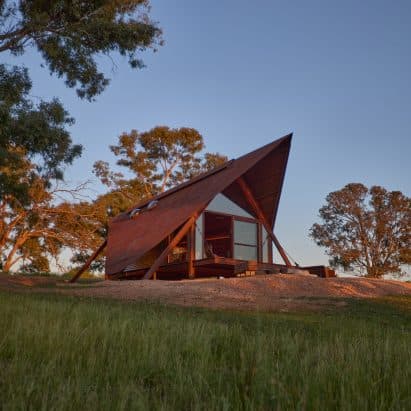
Casey Brown Architecture's Permanent Camping 3: Corten Steel Tents Meet the Australian Wilderness
In the rolling pastoral landscape of Orange, New South Wales, a bold architectural experiment is quietly unfolding. Sydney-based practice Casey Brown Architecture has unveiled its latest project, Permanent Camping 3 — a series of tent-shaped structures clad in weathering Corten steel that appear to grow naturally from the earth beneath them. Equal parts sculpture and shelter, these structures challenge what it means to live in and with the Australian landscape.
The project is the third iteration of the firm's ongoing "Permanent Camping" series, a body of work that has consistently explored the tension between permanence and transience, between sophisticated architecture and the raw simplicity of sleeping under canvas. With this latest chapter, Casey Brown Architecture pushes that exploration further than ever before, both in material ambition and in the poetic depth of its design language.
What Is the Permanent Camping Series?
The Permanent Camping series began as a conceptual and architectural inquiry: what would it look like if a campsite became a home? Not glamping in the popular, luxurious sense, but something more philosophically rigorous — a structure that honors the transient spirit of camping while providing the durability and comfort of permanent architecture.
Casey Brown Architecture has long been recognized for its sensitivity to the Australian environment. The firm's work tends to resist the urge to impose urban language onto rural settings, instead seeking forms that feel discovered rather than imposed. The Permanent Camping series is perhaps the purest expression of this ethos. Each iteration has refined the language of shelter-as-tent, and Permanent Camping 3 represents the most resolved version yet.
The Role of Corten Steel in the Design
At the heart of Permanent Camping 3's visual and material identity is Corten steel — a high-strength, weathering steel alloy that develops a stable, rust-like patina when exposed to the elements. Rather than fighting oxidation, Corten steel embraces it, forming a self-protecting outer skin that deepens in color over time and bonds the structure visually to its surroundings.
In the context of the Orange countryside, where ochres, burnt oranges, and deep earthy reds define the palette of the land, the choice of Corten is not merely practical — it is profoundly expressive. As the seasons change and rainfall alternates with dry heat, the steel shifts in tone, ensuring that the structures are never static objects in the landscape but living, aging presences that grow more rooted with each passing year.
The tent-like form of each structure, with its pitched silhouette and angled planes, amplifies this material choice. From a distance, the Corten surfaces catch light in ways that mimic the worn canvas of an old field tent, taut and familiar yet unmistakably permanent. Up close, the texture and warmth of the steel invite touch and contemplation in equal measure.
Architectural Form and Spatial Experience
Beyond their striking exterior, the structures of Permanent Camping 3 offer a considered interior experience. Casey Brown Architecture has always been attentive to the relationship between shelter and landscape, and the spatial sequencing of these tent-forms reflects that care.
- Generous glazing at key elevations frames carefully curated views of the surrounding pastoral terrain, allowing the landscape to flow visually through the interior.
- The pitched rooflines echo the geometry of traditional tent structures, creating interior volumes that feel intimate at the periphery and soaring at the ridge — much like the internal experience of a well-designed canvas tent.
- Material continuity between interior and exterior reinforces the sense that these shelters belong to the land rather than sitting upon it as foreign objects.
- The placement of structures on the site responds to topography, sun orientation, and prevailing winds, ensuring passive comfort without sacrificing the elemental connection to the outdoors that defines the entire series.
The result is a series of spaces that feel simultaneously rugged and refined. Spending time inside Permanent Camping 3 is said to produce the particular contentment of camping — the closeness of the sky, the sounds of the surrounding land, the sense of exposure held in careful balance with shelter — without any of camping's inconveniences.
Sustainability and Longevity by Design
One of the quiet strengths of Permanent Camping 3 lies in its long-term thinking. Corten steel requires no painting, minimal maintenance, and performs durably across extreme temperature variations — a significant advantage in the New South Wales interior, where summers can be intense and winters sharp. The material's longevity means the structures are designed to age gracefully rather than degrade, becoming more beautiful as they weather rather than less.
This commitment to durability also reflects a broader philosophy within Casey Brown Architecture's practice: that good design is inherently sustainable design. Buildings that last, that require little intervention, and that integrate with their environment over time have a lower cumulative environmental footprint than those that demand constant upkeep or replacement.
Why Permanent Camping 3 Matters for Australian Architecture
Projects like Permanent Camping 3 matter because they expand the conversation about what Australian residential architecture can be. In a country where the relationship between dwelling and landscape has always been charged — shaped by extreme climate, vast distances, and a complex cultural relationship with the bush — architecture that genuinely grapples with those conditions deserves recognition and study.
Casey Brown Architecture's Corten tent structures in Orange are not simply visually arresting; they are intellectually honest. They ask meaningful questions about belonging, shelter, impermanence, and beauty in the Australian context, and they answer those questions with materials and forms that are rigorous, poetic, and deeply site-specific.
A New Benchmark for Landscape-Sensitive Design
As awareness of context-driven, environmentally responsive architecture continues to grow globally, Permanent Camping 3 arrives as a timely reminder that some of the most compelling answers to contemporary design questions are found not in urban centers but in the quiet, demanding landscapes of rural Australia. Casey Brown Architecture has once again demonstrated that the best architecture doesn't shout — it settles, weathers, and belongs.
For architects, designers, and anyone drawn to the intersection of material craft and landscape sensitivity, Permanent Camping 3 is essential viewing — a project that will only improve with time, much like the Corten steel that gives it life.