
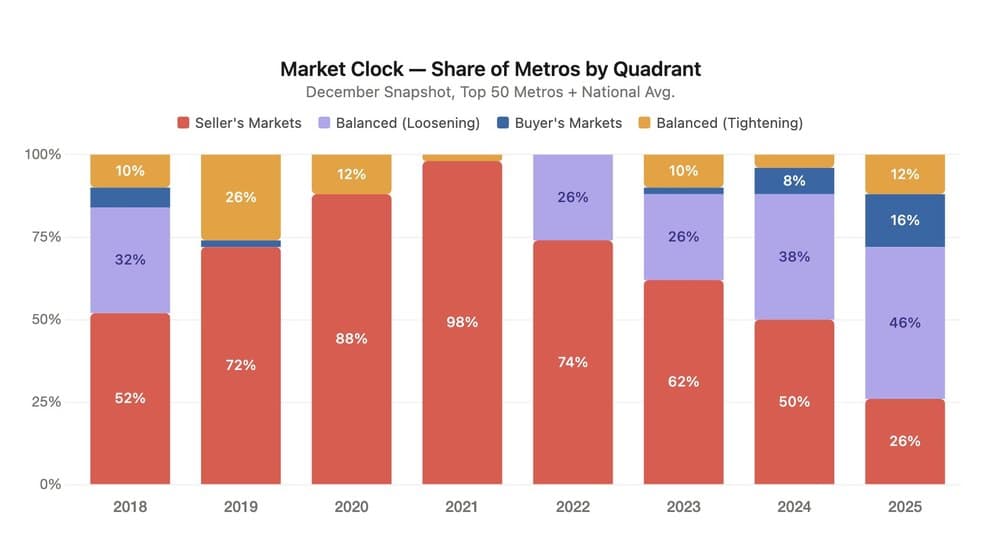
Understanding the Realtor.com Market Clock
The U.S. housing market has rarely been easy to read, and 2026 is no exception. With interest rates still commanding attention, inventory levels shifting, and buyer sentiment evolving week by week, knowing where your local market stands has become one of the most valuable pieces of intelligence a buyer or seller can possess. That is exactly why the debut of the Realtor.com Market Clock quarterly report is generating so much attention among real estate professionals and homeowners alike.
The Market Clock is a diagnostic tool designed to cut through the noise. Rather than relying on a single data point like median home price or days on market, it synthesizes a broad range of housing indicators — inventory levels, listing activity, price trends, and demand signals — to place each of the nation's 50 largest markets on a 12-hour clock face. The further clockwise the hand moves, the more leverage buyers hold. The further counterclockwise, the more sellers dominate. It is a deceptively simple framework that delivers genuinely actionable insight.
Heading into spring 2026, the national market sits at 3 o'clock, signaling a balanced environment that is gradually loosening its grip on sellers. But averages, as always, tell only part of the story. The real value of the Market Clock lies in how dramatically local conditions can diverge from that national midpoint — and few cities illustrate this better than Cincinnati, Ohio.
Where Cincinnati Stands on the Market Clock
Cincinnati's housing market is currently positioned at 3 o'clock on the Realtor.com Market Clock for the first quarter of 2026, placing it squarely in the "Balanced – Loosening" category. In practical terms, this is one of the healthiest designations a local market can receive, because it reflects equilibrium — a state in which neither buyers nor sellers hold a commanding advantage, but the tide is quietly shifting in favor of buyers.
According to Realtor.com's analysis, markets in this phase are characterized by increasing inventory, moderating competition, and realistic pricing expectations on both sides of the transaction. Sellers who enter the market with well-priced, well-presented homes can still expect solid results. Buyers, meanwhile, are discovering a negotiating environment that would have felt almost foreign just two or three years ago, when bidding wars and waived contingencies were the norm rather than the exception.
For Cincinnati specifically, the data backing this classification is telling. The market has recorded a 22.40% year-over-year increase in active listing count, a substantial jump that meaningfully expands the pool of available homes. At the same time, new listing count has risen by 4.10%, confirming that sellers are continuing to enter the market with confidence, even as overall conditions become less frenetic. This combination of growing inventory and steady new supply is the engine driving the loosening dynamic that makes Cincinnati's current moment so distinctive.
What "Balanced – Loosening" Actually Means in Practice
Labels like "balanced market" can sometimes feel abstract, so it is worth translating the data into concrete, on-the-ground realities for both buyers and sellers navigating Cincinnati's neighborhoods today.
For Buyers
If you have been sitting on the sidelines in Cincinnati — waiting for the right home, the right price, or simply the right moment — the spring of 2026 may represent the clearest buying window the market has offered in years. The 22.40% surge in active listings means you are no longer scrolling through a handful of options before homes vanish. You have time to tour multiple properties, conduct thorough due diligence, and negotiate terms rather than simply accepting whatever a seller offers.
Contingencies for inspections and financing, once routinely waived in hotter markets, are increasingly viable again. This protects buyers from costly surprises and restores a degree of normalcy to the transaction process. Additionally, as selling timelines extend, sellers become more motivated to engage with serious buyers, creating room for price adjustments or closing cost concessions that were virtually unthinkable during peak seller's market conditions.
For Sellers
A loosening market does not spell bad news for sellers — it simply demands a recalibration of expectations and strategy. Cincinnati sellers who price their homes accurately from day one, invest in proper staging and presentation, and work with experienced local agents are still achieving strong outcomes. The key distinction is that overpricing a property in hopes of triggering a bidding war is a riskier strategy than it once was.
Sellers should also prepare for moderate selling times that are likely to grow as the year progresses. Building that timeline into financial and logistical planning — particularly for those buying and selling simultaneously — is essential. The good news is that Cincinnati's underlying economic fundamentals remain sound, supporting home values even as market conditions become more buyer-friendly.
Cincinnati's Broader Economic Context
The Market Clock reading does not exist in a vacuum. Cincinnati has long been recognized as one of the Midwest's most resilient and livable metros, with a diversified economy anchored by major corporate headquarters, a growing healthcare sector, and a vibrant downtown that continues to attract young professionals. Population growth and steady employment have kept housing demand relatively durable, which is precisely why the city's market is loosening gradually rather than experiencing the kind of sharp corrections seen in some coastal markets.
This measured pace of change is actually a feature, not a bug. It gives both buyers and sellers adequate time to make informed decisions rather than reacting to panic or euphoria. Real estate professionals and economists watching Cincinnati's trajectory tend to view the current phase as a healthy normalization after several years of extraordinary seller dominance.
Key Takeaways for Cincinnati Buyers and Sellers in 2026
- The Realtor.com Market Clock places Cincinnati at 3 o'clock — "Balanced – Loosening" — for Q1 2026, aligning it with the national average while reflecting meaningful local momentum toward buyers.
- Active listings are up 22.40% year-over-year, giving buyers significantly more choice and reducing competitive pressure compared to recent years.
- New listing count has grown by 4.10%, indicating that sellers remain engaged and confident in the market's stability.
- Buyers should act with informed confidence, using restored contingencies and extended timelines to their advantage without assuming prices will fall sharply.
- Sellers should prioritize accurate pricing, quality presentation, and realistic timeline expectations to maximize outcomes in a more competitive landscape.
- Cincinnati's strong economic fundamentals provide a durable floor for home values, making drastic price corrections unlikely even as the market loosens further.
The Bottom Line
The Cincinnati housing market in spring 2026 is, in many ways, the market that both buyers and sellers deserve after years of imbalance. It is a market where preparation, realistic expectations, and good local knowledge matter more than speed and desperation. The Realtor.com Market Clock's "Balanced – Loosening" designation is not a warning sign — it is an invitation to engage thoughtfully with one of the Midwest's most compelling real estate markets. Whether you are looking to plant roots in Cincinnati for the first time or leverage your existing equity to move up, the clock, for once, is working in everyone's favor.