
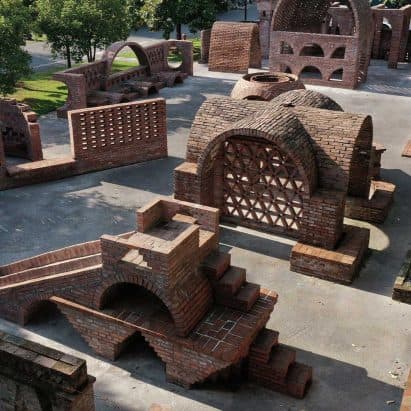
Vietnam's Đạo Mẫu Temple and Museum Takes Home the 2026 Brick Award Grand Prize
In a world increasingly focused on sustainability and circular design, one project has risen above the rest to capture global attention and the architecture industry's highest honor for masonry. The Đạo Mẫu Temple and Museum in Vietnam has been awarded the grand prize at the prestigious Wienerberger Brick Awards 2026, widely regarded as the most celebrated recognition for outstanding use of brick and clay-based materials in architecture. What makes this win particularly remarkable is the building's staggering use of more than six million reclaimed clay tiles, turning discarded materials into a breathtaking monument of cultural and architectural significance.
What Is the Wienerberger Brick Award?
The Wienerberger Brick Award is a biennial international architecture competition organized by Wienerberger, one of the world's leading producers of brick and clay products. The award celebrates innovative, responsible, and aesthetically exceptional uses of brick, tiles, and clay-based building materials in architecture and urban design. Since its founding, the Brick Award has recognized projects from around the world that push the boundaries of what masonry can achieve — from structural innovation to environmental responsibility.
The 2026 edition drew entries from architects across dozens of countries, making the competition more global and more competitive than ever. Projects were evaluated on a range of criteria including design quality, sustainability, cultural relevance, and the creative use of materials. Against this backdrop, the Đạo Mẫu Temple and Museum stood out not only for its visual impact but for the deeply meaningful story embedded in every one of its six million tiles.
The Story Behind Đạo Mẫu Temple and Museum
Located in Vietnam, the Đạo Mẫu Temple and Museum is a project that fuses cultural heritage, spiritual identity, and sustainable construction in a way that feels both ancient and urgently modern. The building is dedicated to Đạo Mẫu, a Vietnamese mother goddess religion rooted in the worship of natural forces and feminine spiritual power — one of the country's most significant indigenous belief systems.
The choice to construct the temple and museum using reclaimed clay tiles was not merely a stylistic decision. It carries deep symbolic weight. Clay tiles have been used in Vietnamese architecture for centuries, and by sourcing and reusing millions of these tiles from demolished or derelict structures, the architects gave new life to materials that would otherwise have been discarded. This act of upcycling is as much a spiritual gesture as it is an environmental one — breathing continuity and memory into a new sacred space.
Six Million Reclaimed Clay Tiles: A Construction Marvel
The sheer scale of the tile reclamation effort is extraordinary. Sourcing, sorting, cleaning, and integrating more than six million individual clay tiles into a coherent, structurally sound, and visually unified building represents an enormous logistical and creative challenge. The project required close collaboration between the design team, craftspeople, and local communities to gather tiles from across the region.
Rather than hiding or minimizing the age and imperfection of the reclaimed tiles, the architects embraced these qualities. The variation in color, texture, and patina across millions of individual pieces creates a surface that is rich with visual depth and historical resonance. Light plays across the building's surfaces differently throughout the day, giving the structure a living, breathing quality that no factory-fresh material could replicate.
From a sustainability standpoint, the approach is equally impressive. Reusing six million tiles dramatically reduces the demand for new material production, cutting down on the energy, water, and carbon emissions associated with firing new ceramics. It also diverts enormous quantities of material from landfill, demonstrating that construction waste can be reimagined as a resource.
Why This Project Represents the Future of Sustainable Architecture
The Đạo Mẫu Temple and Museum's Brick Award win arrives at a pivotal moment for the construction industry. Buildings are responsible for a significant share of global carbon emissions — both through the energy used to operate them and through the embodied carbon locked into their materials. Architects, developers, and policymakers are under growing pressure to find more responsible ways to build.
This project offers a compelling answer. By treating reclaimed materials not as a compromise but as a design opportunity, the architects have shown that sustainability and beauty are not in conflict. In fact, the constraints of working with millions of mismatched, secondhand tiles appear to have driven the design team toward greater creativity rather than limiting it.
- The project demonstrates that upcycled and reclaimed materials can achieve world-class architectural outcomes.
- It shows that cultural heritage and environmental responsibility can reinforce rather than compete with each other.
- It proves that large-scale sustainable construction is viable even with traditional, handcrafted materials.
- It sets a meaningful precedent for how architects across Southeast Asia and beyond might approach the circular economy in construction.
A Cultural Landmark as Well as an Architectural Achievement
Beyond its environmental credentials, the Đạo Mẫu Temple and Museum is a deeply important cultural institution. As a space dedicated to Vietnam's mother goddess religion, it serves thousands of worshippers and visitors who come to engage with one of the country's most enduring spiritual traditions. The museum component of the building works to educate the public about Đạo Mẫu beliefs, rituals, and history, ensuring that this rich cultural heritage is preserved and shared with future generations.
The architecture of the building reflects this dual purpose. Sacred spaces and exhibition spaces are woven together in a design that respects the religious significance of the site while welcoming the curious visitor. The use of traditional materials reinforces the connection between past and present, between the physical act of building and the spiritual intentions behind it.
Recognition That Reaches Beyond Architecture
Winning the grand prize at the Wienerberger Brick Award 2026 brings international attention to a project that might otherwise have remained known primarily to audiences in Vietnam and within specialist architectural circles. The award, and the Dezeen-produced video showcasing the project, ensure that the Đạo Mẫu Temple and Museum now serves as a source of inspiration for architects, designers, and sustainability advocates worldwide.
It is a reminder that the most powerful architecture often emerges not from unlimited budgets or cutting-edge synthetic materials, but from deep engagement with place, culture, community, and the materials already at hand. In choosing to build with six million tiles that already held a history, the team behind the Đạo Mẫu Temple and Museum has created something that will itself become history — a landmark that honors the past while pointing confidently toward a more sustainable future for architecture everywhere.