
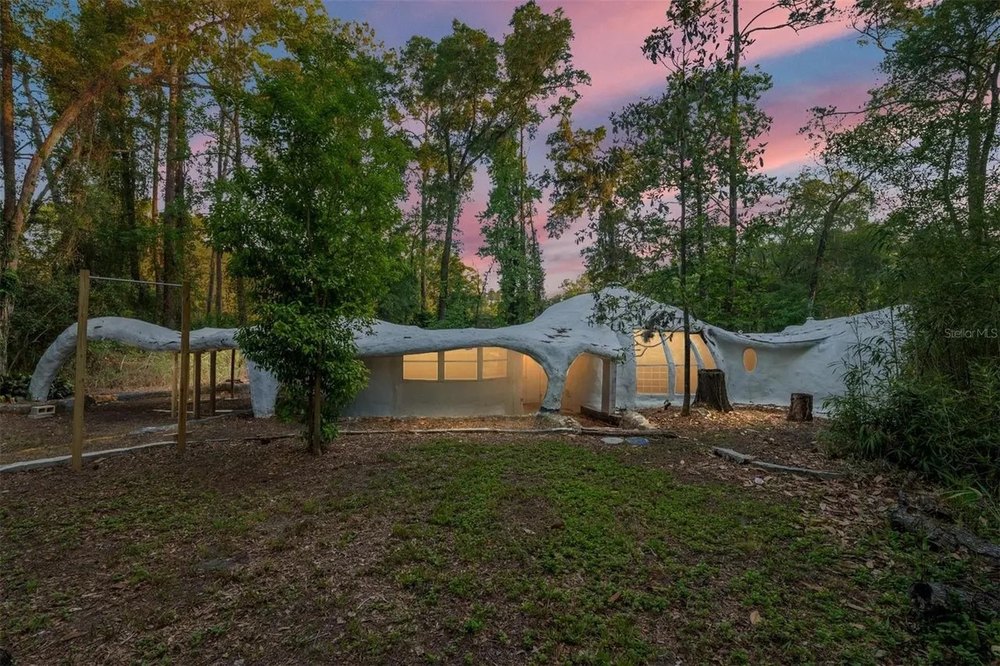
A Truly One-of-a-Kind Home: Florida's Foam Dome Hits the Market for $249,000
In a real estate market crowded with cookie-cutter floor plans and predictable subdivisions, a remarkable property has emerged in Gainesville, Florida, that is guaranteed to stop even the most seasoned home buyer in their tracks. A four-bedroom, two-bathroom foam dome home — hand-built in 1972 using sprayed polyurethane foam over a rebar frame — has officially hit the market for $249,000. With not a single straight line in its entire structure, this 1,700-square-foot dwelling is being called exactly what it is: a genuine original.
The Story Behind the Foam Dome: A Vision Born in 1972
The origins of this extraordinary home trace back over five decades to a University of Florida landscape architecture student with a bold vision for the future of sustainable living. In 1972, armed with ambition, a steel rebar frame, and canisters of sprayed polyurethane foam, he set out to prove that eco-conscious, affordable housing was not just possible — it was buildable by hand.
The result was a sprawling, organically shaped structure that seems less like a conventional house and more like something that grew naturally from the Florida earth itself. Every curve, every contour, and every interior surface flows seamlessly into the next, creating a living space that feels as much sculptural as it does functional.
"The construction is one of one," said listing agent Jordan Fennell of Portal Realty. "He thought it was going to be the new way of building sustainable homes."
That prediction did not quite come to pass in the broader housing industry, but the foam dome has more than made its case as a durable, resilient, and deeply fascinating way to build. Decades of Florida storms, humidity, and the relentless subtropical sun have done nothing to compromise its integrity. The home has survived every weather event thrown at it without a single leak or structural failure — a testament to the ingenuity of its original design.
What Makes Polyurethane Foam Construction So Unique?
For most home buyers, the term "foam construction" might raise eyebrows or questions. But sprayed polyurethane foam — the same material used extensively in modern insulation — is a remarkably strong and versatile building medium when applied correctly and at scale.
When sprayed over a rebar skeleton, polyurethane foam expands, hardens, and bonds to itself and the underlying structure, creating a monolithic shell that is highly resistant to moisture, pests, and thermal transfer. Homes built this way often boast superior energy efficiency compared to traditionally framed houses because the foam acts as both a structural element and an insulating barrier simultaneously.
- Energy Efficiency: The continuous foam envelope dramatically reduces heating and cooling costs, which is a significant advantage in Florida's hot climate.
- Durability: The monolithic structure resists cracking, warping, and the kind of storm damage that frequently affects wood-framed homes in hurricane-prone regions.
- Pest Resistance: Unlike wood framing, foam does not provide a food source or habitat for termites and other wood-boring insects — a critical concern in Florida.
- Design Freedom: Without the constraints of lumber dimensions or drywall panels, a foam-sprayed rebar form can take virtually any shape the builder imagines, as this Gainesville home so vividly demonstrates.
Inside the Dome: Living Without Straight Lines
Stepping inside the Gainesville foam dome home is described as a completely immersive architectural experience. The absence of straight lines is not merely a design flourish — it defines every aspect of the space. Walls curve into ceilings without a visible seam. Doorways arch organically. Rooms transition into one another with a fluidity that feels almost biological in nature, evoking comparisons to the interior of a seashell or a natural cave.
The property spans 1,700 square feet across four bedrooms and two bathrooms, providing enough space for a family while retaining that intimate, cocoon-like atmosphere that makes dome architecture so psychologically comforting to many people. Natural light plays differently inside a dome than it does in a rectangular room — bouncing and diffusing across curved surfaces in ways that change throughout the day and create a living environment that feels constantly, subtly alive.
The home's exterior mirrors the landscape around it with equal organic grace. Set in Gainesville — a city known for its lush tree canopy, progressive culture, and proximity to the University of Florida — the foam dome appears to emerge from its surroundings rather than impose upon them. It is precisely the kind of low-impact, site-sensitive design philosophy that the original builder was trying to champion.
A $249,000 Price Tag: Affordable Iconoclasm
Perhaps one of the most surprising aspects of this listing is its price point. At $249,000, the foam dome home sits well below the median home price in many Florida markets, making it accessible to a buyer who is willing to embrace something genuinely different. For design enthusiasts, architecture students, eco-conscious buyers, or anyone simply tired of the ordinary, this property represents extraordinary value.
The asking price also reflects the home's original philosophy. When it was built in 1972, one of the central goals was to demonstrate that sustainable, durable housing could be constructed for significantly less money than conventional methods required. More than fifty years later, the foam dome continues to make that same argument — only now it does so with the added credibility of five decades of proven performance.
Why Dome Homes Are Having a Moment
The Gainesville foam dome is entering the market at a time when interest in alternative and sustainable housing has never been higher. Rising construction costs, growing climate anxiety, and a broader cultural shift toward intentional living have all contributed to renewed curiosity about non-traditional home designs. From geodesic domes and earthships to container homes and tiny houses, buyers are increasingly open to rethinking what a home can and should look like.
In that context, a meticulously built, half-century-old foam dome that has already proven its sustainability credentials carries a compelling story — and a compelling investment case.
Final Thoughts: A Genuine Original Worth Considering
The foam dome home at 6928 NW 39th Ave in Gainesville, Florida is not for everyone. It asks its future owner to let go of right angles, standard floor plans, and conventional notions of what a home should look like. But for the right buyer, it offers something that no new construction can replicate: a living piece of architectural history, built by hand with purpose and passion, that has stood the test of time in one of the most challenging climates in the United States.
As listing agent Jordan Fennell put it, this home is a genuine original — and genuine originals, in real estate as in life, are always worth a second look.