
New Designers 2026: Where Graduate Innovation Meets the Future of Fashion and Sustainability
Each year, the London-based graduate showcase New Designers opens its doors to reveal the most exciting emerging talent coming out of design schools across the United Kingdom. The 2026 edition has proven no different, with a remarkable array of projects spanning product design, interiors, graphics, and fashion. Among the most talked-about works this year is a foraged "living fibre" fashion collection that has captivated visitors, critics, and industry professionals alike — offering a striking vision of what sustainable, nature-connected clothing could look like in the decades ahead.
What Is New Designers and Why Does It Matter?
New Designers is one of the most prestigious graduate design events in the world, held annually at the Business Design Centre in Islington, London. For over four decades, it has served as a critical launchpad for students finishing their final years at UK universities and art colleges. Scouts from major brands, independent studios, and cultural institutions walk the aisles searching for the next generation of design voices — and for many graduates, a standout showing here can translate directly into professional opportunities, commissions, and press coverage.
The 2026 edition continues this tradition with exceptional energy. This year's cohort reflects a generation of designers deeply shaped by conversations about climate change, material ethics, and the blurring boundaries between the natural and the manufactured. Nowhere is this more apparent than in the fashion and textiles section, where the foraged "living fibre" collection has become one of the defining highlights of the entire show.
The Foraged "Living Fibre" Collection: Nature as Material and Collaborator
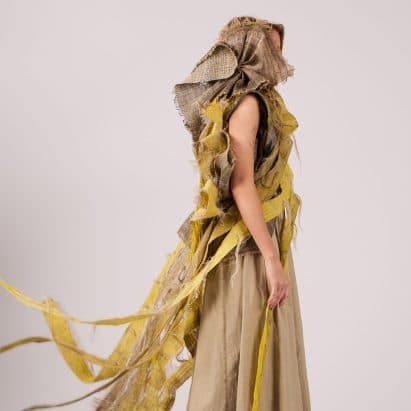
The standout fashion collection in question is built around the concept of "living fibre" — a design philosophy that treats foraged, natural, and biologically active materials not merely as resources to be harvested and processed, but as living collaborators in the design process itself. The collection takes its raw ingredients from the landscape: gathered plant matter, naturally occurring fibres, and organic compounds that retain a degree of biological character even after being woven into garments.
The resulting pieces are striking in their texture, depth, and quiet complexity. Woven clothing constructed from these foraged materials carries an organic irregularity that synthetic textiles simply cannot replicate. Each piece tells the story of the landscape it was drawn from — a philosophy that stands in sharp contrast to the homogenised, industrialised production chains that dominate fast fashion. The collection raises important questions about provenance, material intelligence, and the relationship between the wearer and the natural world.
Challenging the Boundaries of Sustainable Fashion
Sustainable fashion is no longer a niche conversation — it sits at the heart of the industry's future. But for all the talk of organic cotton and recycled polyester, truly radical approaches to fashion's material problem remain rare. The living fibre collection at New Designers 2026 represents a more ambitious position: rather than simply substituting one conventional material for a greener equivalent, it proposes a wholesale rethinking of what textile production can mean.
By foraging rather than farming or manufacturing, the designer sidesteps many of the most resource-intensive stages of conventional textile production. The process is labour-intensive and inherently local, scaling naturally with the rhythms and availability of a specific ecosystem rather than the demands of global supply chains. This is slow fashion taken to its logical and most beautiful extreme.
Other Highlights From New Designers 2026
While the living fibre collection has generated significant buzz, it is far from the only work worth noting at this year's show. New Designers 2026 as a whole reflects a cohort intensely focused on material research, circular systems, and the social dimensions of design. Several other projects have drawn attention from visitors and press throughout the event's run.
Product and Industrial Design
The product design section features numerous projects exploring repair culture and design for longevity — a thematic thread running throughout the show. Several graduates have created tools, furniture, and objects explicitly designed to be disassembled, repaired, and upgraded, rather than discarded. The craftsmanship on display is confident, with a strong emphasis on tactile material quality over surface-level aesthetics.
Interior and Spatial Design
In the spatial design categories, biophilic principles continue to dominate. Graduates have proposed living walls, mycelium-based building components, and modular spatial systems that respond dynamically to occupancy and environmental conditions. These projects speak to a generation trained to think about buildings not as static objects but as adaptive, metabolic environments.
Graphics, Branding, and Communication
The communication design works on show are notably less screen-centric than in previous years, with a renewed interest in print, tactile publication design, and wayfinding systems that exist beautifully in physical space. Several projects tackle information design around ecological data, translating complex climate and biodiversity statistics into visually accessible and emotionally resonant formats.
Why the Living Fibre Collection Resonates Beyond Fashion
What makes the foraged living fibre collection so compelling as a piece of design — not just as a fashion statement — is the clarity of its conceptual argument. It does not simply look different; it thinks differently. It positions the designer as a listener to natural systems rather than a controller of them, and it asks the wearer to consider their clothing as something with a genuine origin story, rooted in a specific place and time.
In an era when the fashion industry accounts for a significant percentage of global carbon emissions and water usage, proposals like this feel genuinely urgent. They may not offer an immediately scalable solution — foraging cannot clothe billions of people — but they offer something arguably more valuable at this stage: a proof of concept, a demonstration that radically different relationships between fashion and nature are not only imaginable but achievable.
New Designers 2026 and the Future of Graduate Design
New Designers 2026 affirms that graduate design in the UK remains a vital and generative space. The cohort emerging this year has been shaped by a world in accelerating flux, and their responses to that world are thoughtful, technically accomplished, and often genuinely inspiring. The foraged living fibre fashion collection is the kind of project that will be discussed and referenced for years to come — a reminder that the most interesting ideas in design rarely come from the centre of established industry, but from its young, questioning edges.
Whether you are a design industry professional, a fashion sustainability advocate, or simply someone curious about where material culture is heading, New Designers 2026 is well worth your attention. The future, it turns out, might be woven from the forest floor.