
Gaudí's Crypt at Colònia Güell: A Century Ahead of Its Time
When Antoni Gaudí began designing the Crypt at Colònia Güell in 1908, the architectural world had no language to describe what he was doing. There were no computers, no algorithmic design tools, and no formal theory of parametric architecture. Yet the small, haunting structure he built on the outskirts of Barcelona contained within its tilted columns and branching vaults a design logic so mathematically sophisticated that it would not be properly named or replicated until well into the twenty-first century. Today, as the building marks its centenary, architects and historians are revisiting this masterpiece not merely as a curiosity of Catalan Modernisme, but as the genuine origin point of what we now call parametricism.
What Is Parametricism and Why Does It Matter?
Parametricism is a contemporary architectural style and methodology in which the form of a building is generated and refined through the manipulation of parameters — numerical variables that govern shape, structure, material behaviour, and spatial relationships. Rather than drawing a fixed design, a parametric architect defines a set of rules and relationships, then adjusts the underlying variables to explore thousands of possible outcomes. The style is most closely associated with the work of Zaha Hadid Architects and the theoretical writings of Patrik Schumacher, who coined the term in 2008. Its hallmarks are fluid curves, organic continuity between surfaces, and an almost biological sense of growth and adaptation.
What makes Gaudí's Crypt so startling is that he achieved an equivalent result a full century earlier, using nothing more than hanging chains, weighted models, and an extraordinary intuitive grasp of structural mechanics. The connection between his analogue methods and today's digital parametric tools is not merely metaphorical — it is direct, documented, and deeply significant for anyone who wants to understand where modern architecture truly comes from.
The Hanging Chain Model: Gaudí's Analogue Algorithm
To design the Crypt, Gaudí constructed an inverted scale model using chains, strings, and small weighted bags. By hanging the chains freely, he allowed gravity to determine their natural catenary curves. When the model was photographed and the image flipped upside down, the hanging curves became perfect arches — structurally pure forms in which every element works in pure compression, with no bending stress whatsoever. This was not an artistic choice but a rigorous structural calculation performed by the physical world itself.
In contemporary terms, what Gaudí built was an analogue parametric solver. The weights attached to the chains were his parameters. Changing a weight altered the curve of a chain, which in turn affected the surrounding geometry. Every element of the model was interdependent, just as elements in a digital parametric model respond dynamically to adjustments in the underlying script. Gaudí could iterate rapidly, testing structural logic through physical simulation in a way that is conceptually identical to how Grasshopper or Rhino plugins work today.
Structural Honesty and the Organic Column
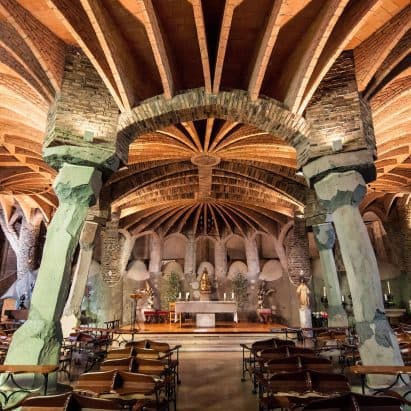
One of the most immediately striking features of the Crypt is its columns. They do not stand vertical in the conventional sense. They lean, branch, and tilt at angles that initially seem precarious but are in fact structurally optimal. Gaudí used basalt, brick, and rubble in combination, selecting materials based on the compressive loads each column needed to bear. Heavily loaded columns are made of harder stone; lighter ones of brick. The visual result is a forest-like interior, rich with geological texture, where structure and ornament are indistinguishable.
This approach — letting structural forces dictate form rather than imposing a predetermined aesthetic — is precisely the ambition of contemporary parametric and computational design. Architects like Toyo Ito, Cecil Balmond, and the late Zaha Hadid have all cited the imperative to allow performance data to shape buildings. Gaudí arrived at this philosophy through observation of nature, study of Gothic cathedrals, and a deeply held belief that architecture should follow the same laws that govern trees, bones, and shells.
The Crypt's Legacy in the Digital Age
The influence of Gaudí's structural experiments on digital architecture has been acknowledged widely, though it is perhaps still underappreciated in mainstream architectural discourse. When researchers at institutions such as ETH Zurich began developing computational form-finding methods in the late twentieth century, they repeatedly pointed to Gaudí's chain models as the conceptual forerunner of their work. Block Research Group's Thrust Network Analysis, a method for designing compression-only shell structures, is in many ways a digital formalisation of what Gaudí did by hand.
Beyond the technical dimension, the Crypt also anticipates parametricism's aesthetic sensibility. Its porous, cave-like quality, its refusal to separate interior from exterior, and its insistence on material variation across a single continuous surface are all qualities that parametric architects prize today. Walking through the Crypt feels less like entering a building and more like entering a formation — something grown rather than constructed.
Why the Centenary Matters for Contemporary Architecture
Marking a centenary is never simply an exercise in historical nostalgia. In the case of Gaudí's Crypt, the anniversary arrives at a moment when architecture is grappling seriously with how digital tools, artificial intelligence, and computational optimisation should relate to human creativity and structural necessity. Gaudí's example is a powerful reminder that these questions are not new. The desire to allow form to emerge from structural logic, to encode natural forces into design process, and to make buildings that feel alive and inevitable rather than arbitrary — all of this existed before the computer and will endure long after any particular software platform becomes obsolete.
The Crypt at Colònia Güell is a UNESCO World Heritage Site and one of the most visited architectural pilgrimages in Catalonia. Yet its deeper significance — as the founding experiment of a design philosophy that now shapes some of the world's most ambitious buildings — deserves far greater recognition. As parametricism continues to evolve and as computational tools grow ever more powerful, architects would do well to return to this small, leaning, brilliant building and remember that its designer solved the same problems they are solving today, with nothing but gravity and chains.
Key Takeaways
- Gaudí's Crypt at Colònia Güell (begun 1908) used hanging chain models to generate structurally optimal, parametric-style forms more than a century before digital tools existed.
- The concept of allowing physical or computational forces to determine architectural form — central to modern parametricism — is directly prefigured by Gaudí's analogue methodology.
- Contemporary researchers in computational structural design, including teams at ETH Zurich, explicitly trace their methods back to Gaudí's form-finding experiments.
- The Crypt's aesthetic — fluid, organic, materially varied, and structurally honest — anticipates the visual language of parametric architecture as practised by Zaha Hadid Architects and others.
- The building's centenary is an opportunity for the architecture profession to revisit its own history and recognise how deeply modern computational design is rooted in pre-digital innovation.