
Beyond the Mosaics: Gaudí's Forgotten Gothic Side
When most people picture the work of Antoni Gaudí, their minds immediately conjure the kaleidoscopic tile work of Park Güell, the soaring organic spires of the Sagrada Família, and the undulating ceramic facade of Casa Batlló. These are the images that have turned Barcelona into one of the world's most-visited cities and cemented Gaudí's reputation as the supreme master of Catalan Modernisme. Yet there is another Gaudí — one who worked in stone, towers, and battlements, producing buildings that look more like medieval castles than psychedelic fever dreams. These lesser-known, neo-gothic works represent a critical chapter in the architect's development, and they deserve far more attention than they typically receive.
As the world marks the centenary of Gaudí's death, it is the perfect moment to shine a light on the buildings that are so often overlooked in favour of his more flamboyant later output. His gothic-influenced designs are not mere juvenilia or stylistic detours — they are sophisticated, deeply considered works of architecture that reveal how thoroughly Gaudí understood and then transcended the historical styles he absorbed.
Gaudí and the Gothic Revival
Gaudí studied architecture in Barcelona during the 1870s, a period when the Gothic Revival was sweeping across Europe. Architects from Augustus Pugin in England to Eugène Viollet-le-Duc in France were championing medieval Gothic as the true expression of Christian civilisation and structural logic. For a young Catalan architect steeped in regional pride, the Gothic held additional significance: the great Gothic cathedrals of Catalonia, from Barcelona's own cathedral to the magnificent church of Santa Maria del Mar, were symbols of a golden age of Catalan power and culture.
Gaudí absorbed these influences deeply but was never content simply to copy what had come before. From early in his career, he was probing the structural logic of Gothic architecture — its pointed arches, flying buttresses, and ribbed vaults — looking for ways to solve the problems he believed Gothic builders had only partially addressed. His neo-gothic buildings represent the phase of that investigation before he arrived at his famous parabolic arches and branching columns, which he argued made the buttress entirely unnecessary.
Casa Botines, León
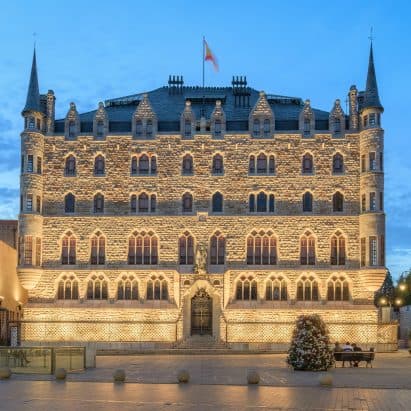
Perhaps the most striking of Gaudí's gothic buildings is Casa Botines, completed in 1892 in the city of León in northwestern Spain. Commissioned by two textile merchants as a combined residential and commercial building, the structure rises with four cylindrical corner towers topped by conical slate roofs, creating a silhouette that is unmistakably castle-like against the Castilian skyline. The facade is built from rough-hewn granite blocks, and the pointed window surrounds and iron details reinforce the medieval character of the whole composition.
What makes Casa Botines particularly fascinating is how it sits alongside León's genuinely medieval architecture — the city's famous Gothic cathedral is just a short walk away — without feeling like an embarrassing imitation. Gaudí's building holds its own with a confident, slightly theatrical presence that announces its nineteenth-century origins while paying genuine homage to the spirit of the Middle Ages. Today the building houses a museum dedicated to Gaudí's work and the history of the structure, making it one of the more accessible of his lesser-visited masterpieces.
Palau Episcopal, Astorga
Just over fifty kilometres from León lies the city of Astorga, home to another of Gaudí's gothic departures: the Palau Episcopal, or Bishop's Palace. Begun in 1889 and not completed until 1913 — after Gaudí had already moved on from the project following the death of the bishop who commissioned it — the building is a tour de force of neo-gothic theatricality. Its towers, turrets, and pointed arches in pale granite give it the appearance of a fairy-tale fortress, perched dramatically beside Astorga's own Roman-era cathedral.
The interior spaces are equally impressive, with vaulted ceilings and ironwork details that demonstrate Gaudí's extraordinary attention to craft. The palace today functions as a museum dedicated to the Way of Saint James, as Astorga is a significant stop on the Camino de Santiago pilgrimage route. Visitors walking the Camino who take the time to step inside the palace are often stunned to discover a Gaudí building so far removed in style and geography from what they expected.
El Capricho, Comillas
An even earlier gothic-inflected work is El Capricho, a summer villa Gaudí designed in 1883 in the coastal town of Comillas in Cantabria. While the building is perhaps better known for its sunflower-tile decoration — a hint of the polychromatic Gaudí to come — its tower, its arched loggia, and its general massing have a distinctly medieval quality that places it firmly in conversation with his gothic output. El Capricho is notable as one of the very few Gaudí buildings outside of Catalonia that welcomes tourists, and its relatively compact scale makes it an intimate and rewarding visit.
Why These Buildings Matter
Understanding Gaudí's gothic buildings is not simply a matter of completing an architectural checklist. These works matter because they reveal the intellectual seriousness beneath what can sometimes appear to be a purely intuitive or even eccentric creative process. Gaudí was a tireless student of structure and history, and his engagement with Gothic architecture was a genuine intellectual project, not a stylistic affectation.
- His gothic works demonstrate how deeply he understood the principles of medieval construction before he began to reimagine them entirely.
- They show that his mature style — the parabolic arches, the hyperboloid surfaces, the branching stone columns — grew logically out of a sustained critique of Gothic structural solutions.
- They offer a more complete portrait of one of architecture's most singular minds, one that goes beyond the postcard images most people associate with his name.
- And they provide compelling reasons to explore regions of Spain — León, Astorga, Cantabria — that far too few international visitors ever reach.
Discovering a Different Gaudí
The centenary of Gaudí's death in 2026 has brought renewed scholarly and popular attention to his life and work, with exhibitions, publications, and events taking place across Spain and beyond. It is an ideal moment to push past the familiar images and engage with the full breadth of what he created. His gothic buildings are waiting — in a quiet square in León, on a hillside in Astorga, along the Cantabrian coast — for the travellers curious enough to seek them out.
These are buildings that require no prior knowledge of architectural history to appreciate. Stand in front of Casa Botines on a late afternoon in León, when the granite takes on a warm amber glow, and the towers cast long shadows across the pavement, and you will understand immediately that you are in the presence of something exceptional. This is Gaudí before the mosaics, before the melting facades, before the global fame — and he is extraordinary.