
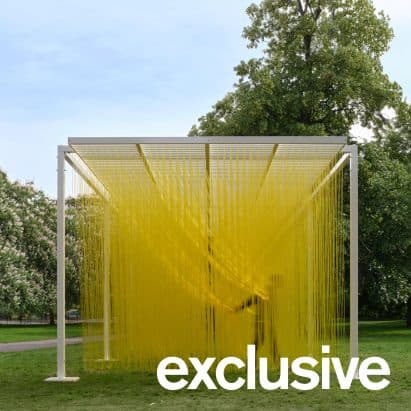
Jesús Rafael Soto's Pénétrable BBL Jaune Arrives in London
One of the most celebrated works in the history of kinetic and participatory art has found a striking new home in the heart of London. Jesús Rafael Soto's Pénétrable BBL Jaune — a luminous, immersive installation composed of thousands of suspended yellow plastic tubes — has been installed at the Serpentine Galleries, inviting visitors to walk directly into the artwork and experience it from within. The installation marks a landmark moment for art lovers in the UK and continues the Serpentine's tradition of presenting boundary-pushing works that challenge the line between sculpture, architecture, and lived experience.
Who Was Jesús Rafael Soto?
Jesús Rafael Soto (1923–2005) was a Venezuelan artist widely regarded as one of the founders of the kinetic and Op Art movements. Born in Ciudad Bolívar, Venezuela, Soto studied at the Escuela de Artes Plásticas y Artes Aplicadas in Caracas before relocating to Paris in 1950, where he became part of a vibrant international community of avant-garde artists. Alongside figures such as Carlos Cruz-Diez and Victor Vasarely, Soto helped pioneer a new visual language that emphasized movement, optical illusion, and the active participation of the viewer.
Throughout his prolific career, Soto moved steadily away from flat, static canvases toward three-dimensional, environment-scale works. His Pénétrable series, which he began developing in the 1960s, represented the culmination of his thinking: sculptures that did not merely ask to be looked at, but demanded to be entered, traversed, and felt. These hanging curtain-like structures transformed the viewer from a passive observer into an active participant — a radical idea that remains powerfully relevant in contemporary art today.
What Is a Pénétrable?
The term Pénétrable — French for "penetrable" — describes Soto's signature large-scale installations that visitors are invited to walk through. Typically consisting of hundreds or thousands of thin rods or tubes suspended from an overhead grid, the Pénétrables create an immersive curtain of material that responds to air currents, the movement of visitors, and shifting light. The resulting effect is one of near-dissolution: as you move through the work, the rigid structure seems to dematerialize around you, blurring the boundaries between your body and the surrounding space.
Pénétrable BBL Jaune is one of the most iconic examples of this series. The "BBL" designation refers to the plastic tubing material used, while "Jaune" is simply the French word for yellow. The choice of a single, vivid colour is deliberate: the saturated yellow creates an overwhelming sensory environment that floods the visitor's field of vision, generating an almost meditative or transcendent quality. It is simultaneously playful and profound — a work that appeals equally to children discovering it for the first time and to art historians who understand its deep conceptual roots.
The Installation at the Serpentine Galleries
The Serpentine Galleries in Kensington Gardens have long been one of London's most progressive venues for contemporary and modern art, and the presentation of Pénétrable BBL Jaune continues that legacy with considerable ambition. The work's vivid yellow canopy creates a dramatic visual presence both inside and outside the space, drawing passersby from across the park and announcing itself as something unmissably alive.
Installed in proximity to the Serpentine Pavilion — the gallery's annual commission of a temporary structure by a world-renowned architect — Soto's piece enters into an exciting dialogue with architecture itself. Where the pavilion tradition emphasises structural ingenuity and spatial innovation, the Pénétrable operates according to entirely different logic: it is architecture that yields, that gives way, that allows the human body to pass through it without resistance. Together, the two commissions make a compelling case for the idea that space itself can be a medium for artistic and emotional experience.
The Significance of Kinetic Art Today
Kinetic art emerged in the mid-twentieth century as a direct response to the dominance of static, object-based art. Artists such as Soto, Alexander Calder, Jean Tinguely, and Naum Gabo were fascinated by the possibilities of movement — whether mechanical, optical, or induced by environmental forces — as a fundamental artistic element. Their work asked audiences to rethink what a sculpture could be and, crucially, what role the viewer played in completing the artwork.
Decades later, kinetic art feels more relevant than ever. In an era when digital and interactive experiences have become the norm, Soto's Pénétrables offer something that no screen can replicate: full-body, analogue immersion in a physical space. The gentle swaying of the yellow tubes, the whisper of plastic against skin, the optical shimmer of colour and light — these are profoundly human experiences, and they speak to a growing cultural hunger for art that engages the senses rather than merely the eyes.
Why This Exhibition Matters for London's Art Scene
London's art scene has never lacked ambition, but major retrospective attention to Latin American modernism has historically been less consistent than coverage of European and North American movements. The prominent installation of Soto's work at the Serpentine represents an important corrective, shining a spotlight on a body of work that has influenced generations of artists worldwide yet often receives less mainstream recognition than it deserves.
- It introduces new audiences to the depth and innovation of mid-century Latin American art.
- It reinforces the Serpentine's commitment to presenting art that transcends conventional gallery formats.
- It provides a rare opportunity to experience a monumental Pénétrable in person in the UK.
- It sparks wider conversations about participatory art, sensory experience, and the evolving relationship between art and its audience.
Visiting Pénétrable BBL Jaune in London
If you are planning a visit to Kensington Gardens this summer, the installation of Pénétrable BBL Jaune at the Serpentine is an unmissable experience. Unlike many museum-based works that must be admired from a respectful distance, this is a piece that actively invites physical engagement. Visitors are encouraged to step inside, to let the tubes brush against them, to stand still and let the work move around them. There is no single correct way to experience it — every body moving through the space creates a unique choreography.
For families with children, it offers a rare instance of a major artwork that is both intellectually serious and entirely accessible to young visitors. For architecture and design enthusiasts, the structural elegance of Soto's hanging system rewards close inspection. And for anyone who has ever felt that contemporary art can be cold or exclusionary, Pénétrable BBL Jaune is a warm, generous, and brilliantly coloured reminder that art at its best reaches out and draws you in.
A Legacy That Continues to Resonate
Jesús Rafael Soto passed away in 2005, but his work has lost none of its vitality or relevance. His Pénétrables can be found in major museum collections around the world, from the Museum of Modern Art in New York to the Tate Modern in London and the Museo de Arte Moderno Jesús Soto in his native Ciudad Bolívar. Each installation is a testament to his belief that art should not be a passive object but a living environment — one that changes with every visitor who enters it.
The arrival of Pénétrable BBL Jaune at the Serpentine is a vivid reminder that the most forward-thinking art of the twentieth century still has urgent things to say to us today. Step inside the yellow light, let the tubes part around you, and discover for yourself what kinetic art can feel like when it is working at its absolute best.