
JR Transforms Paris's Pont Neuf With a Monumental Inflatable Cave
Paris has long served as a canvas for some of the world's most ambitious public art. From Christo and Jeanne-Claude's wrapped Pont Neuf in 1985 to the annual installations along the Champs-Élysées, the French capital has an unparalleled tradition of embracing art at an architectural scale. Now, the anonymous French-American street artist and photographer known simply as JR has added a remarkable new chapter to that legacy with La Caverne du Pont Neuf — a massive inflatable structure that quite literally wraps and reimagines one of the city's most storied bridges, and whose recently revealed interior images have captured the imagination of art lovers and architecture enthusiasts worldwide.
What Is La Caverne du Pont Neuf?
La Caverne du Pont Neuf — which translates roughly as "The Cave of the New Bridge" — is a large-scale inflatable installation conceived by JR and positioned at the Pont Neuf, the oldest standing bridge across the Seine in Paris. The work forms part of JR's ongoing exploration of public space, identity, and the relationship between architecture and human presence. Known globally for his large-format black-and-white photographic paste-ups on buildings, bridges, and landscapes, JR has consistently pushed the boundaries of what street art can be, and this latest project is no exception.
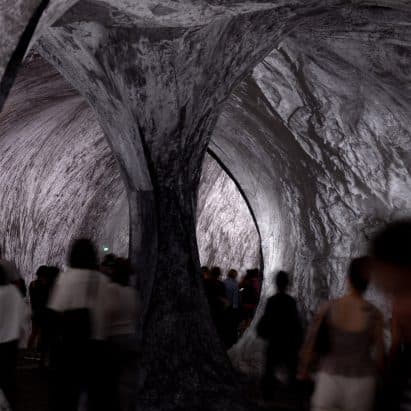
Unlike a traditional gallery exhibition, La Caverne du Pont Neuf invites the public directly into the artwork itself. The inflatable structure creates a fully immersive environment, enveloping visitors within its billowing, cave-like form. Newly released images of the interior have drawn particular attention, revealing a dramatic tunnelled passage that feels simultaneously ancient and otherworldly — evoking limestone grottos while remaining unmistakably contemporary in its execution.
A Tunnelled Interior Unlike Anything Else in Paris
The interior photographs tell a story that the exterior alone cannot. Once inside La Caverne du Pont Neuf, visitors find themselves moving through a corridor of soft, undulating walls that curve overhead to form a continuous organic tunnel. The pale, almost luminous surfaces of the inflated structure catch and diffuse light in ways that shift depending on the time of day and the number of people present, creating an atmosphere that is meditative and somewhat dreamlike.
JR has incorporated his signature photographic imagery into the experience. Vast black-and-white portraits — his visual trademark — are printed directly onto the inflatable surfaces, so that faces emerge from the walls and ceiling of the tunnel, watching visitors as they pass through. This creates a powerful effect: the sensation of being both inside a geological formation and inside a living gallery of human expression. The scale of the faces, monumental and intimate at once, reinforces JR's long-held belief that photography can humanize the spaces we move through every day.
JR's Vision: Art That Belongs to Everyone
JR has always been explicit about his democratic approach to art. By working in public spaces rather than traditional museums, he ensures his work is accessible to anyone who happens to walk past — no ticket required, no institutional gatekeeping. La Caverne du Pont Neuf extends this philosophy into three dimensions. The Pont Neuf itself is one of the most visited spots in all of Paris, a crossing that connects the Île de la Cité to both banks of the Seine and draws tourists and locals in equal measure. Placing his installation here means that the audience is not curated; it is simply the city itself.
In previous projects — including his Inside Out initiative, which has spread to over 140 countries, and his breathtaking installation at the Louvre pyramid — JR has demonstrated a talent for making art feel urgent and personal even at enormous scale. La Caverne du Pont Neuf continues that tradition, but the inflatable medium introduces something new: a sense of impermanence and fragility that contrasts sharply with the solid stone arches of the bridge it inhabits.
The Technical Achievement Behind the Installation
Creating an inflatable structure of this scale in a UNESCO World Heritage setting is no small feat. The engineering demands alone are considerable — the structure must be stable enough to admit visitors safely while remaining responsive to the weather conditions common along the Seine, including wind and rain. The inflatable material must also be capable of bearing JR's high-resolution photographic prints without distortion, ensuring that the visual impact of the portraits is maintained across every curved surface.
The collaboration between JR's studio and the technical teams responsible for the installation reflects a broader trend in contemporary public art toward projects that require expertise drawn from architecture, industrial design, and structural engineering as much as from fine art. The result is something that feels neither purely architectural nor purely artistic, but occupies a compelling space between the two.
Why La Caverne du Pont Neuf Matters
At a moment when public space is increasingly contested — between commerce and culture, between digital experience and physical presence — La Caverne du Pont Neuf offers something rare: a reason to slow down, step inside, and look up. JR's installation does not demand that visitors understand contemporary art theory or carry any prior knowledge of his work. It simply asks them to walk through a cave made of light and photographs and emerge on the other side having felt something.
- The installation transforms one of Paris's oldest bridges into a site of contemporary artistic dialogue.
- Its tunnelled interior uses inflatable architecture and large-format photography to create full sensory immersion.
- The project is freely accessible to the public, in keeping with JR's democratic approach to art-making.
- Interior images have revealed a dramatic, cave-like corridor lined with JR's signature monumental portraits.
- The work stands as a significant moment in the intersection of public art, inflatable architecture, and urban heritage.
For visitors to Paris in 2026, La Caverne du Pont Neuf is already shaping up to be one of the unmissable cultural experiences of the year. Whether you approach it as an art installation, an architectural curiosity, or simply a beautiful and unexpected interruption to your walk along the Seine, JR's inflatable cave beneath the Pont Neuf makes a powerful case for the continued relevance of public art at a human scale — and at a monumental one.