
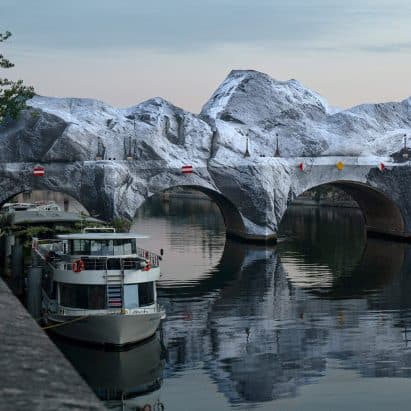
JR's La Caverne du Pont Neuf: A Bold Artistic Vision Meets Parisian Weather
French street artist JR, one of the most celebrated and provocative public artists working today, has seen his ambitious new installation in Paris hit an unexpected setback. La Caverne du Pont Neuf — a monumental inflatable structure anchored beneath the city's iconic Pont Neuf bridge — has had its opening delayed following wind damage that compromised the installation before it could welcome visitors. The news has drawn considerable attention from the art world, architecture enthusiasts, and Parisians alike, all of whom had been eagerly anticipating the unveiling of what promised to be one of the most visually striking public artworks the French capital has seen in years.
What Is La Caverne du Pont Neuf?
La Caverne du Pont Neuf, which translates roughly to "The Cave of the Pont Neuf," is an immersive inflatable architectural installation designed and conceived by JR. The structure is intended to occupy the space beneath the Pont Neuf — Paris's oldest standing bridge and one of its most beloved landmarks — transforming the arches and underbelly of the bridge into a cavernous, experiential space that visitors can enter and explore.
The installation is characteristically bold in scale and ambition, reflecting JR's longstanding practice of using urban architecture and public space as both canvas and stage. Known globally for his large-scale black-and-white photographic paste-ups on building facades, bridges, and walls across dozens of countries, JR has consistently pushed the boundaries of what public art can look and feel like. La Caverne du Pont Neuf represents a significant evolution in that practice — moving from flat imagery applied to surfaces toward a fully three-dimensional, inhabitable structure.
The inflatable design draws on the aesthetic language of cave-like forms, creating a sense of entering an ancient, subterranean world while remaining firmly in the heart of one of Europe's most modern and densely visited cities. The contrast between the organic, billowing shapes of the inflatable and the rigid stone architecture of the Pont Neuf was intended to be a central part of the artistic experience.
The Wind Damage: What Happened?
Prior to its scheduled public opening, the installation suffered damage caused by strong winds along the Seine. Inflatable structures, by their very nature, are particularly vulnerable to adverse weather conditions. Despite being engineered to withstand the demands of an outdoor urban environment, the unpredictable force of the wind proved to be more than the structure could handle at that stage of its installation. The damage required the team behind the project to postpone the opening in order to carry out the necessary repairs and ensure that the structure was safe and fully intact before welcoming the public.
The delay is a reminder of the very real technical and logistical challenges involved in mounting large-scale temporary art installations in exposed, open-air public settings. While the setback is undoubtedly frustrating for the artist, the production team, and the many people who had planned to visit, the decision to delay rather than rush an opening with a compromised structure reflects a responsible approach to both visitor safety and the integrity of the artwork itself.
JR and the Tradition of Transforming Paris's Public Spaces
JR has a long and storied history with Paris and with the Pont Neuf in particular. The bridge has been a site of significant artistic interventions over the decades, perhaps most famously Christo and Jeanne-Claude's wrapping of the entire structure in fabric in 1985 — a project that took ten years of planning and became one of the defining public art moments of the twentieth century. JR's La Caverne du Pont Neuf places itself consciously within that lineage of artists who have dared to reimagine iconic Parisian infrastructure as a site of artistic possibility.
Beyond the Pont Neuf, JR has transformed spaces across Paris with his signature style, including projects on the Louvre Pyramid, the Palais Royal, and numerous walls and buildings across the city's arrondissements. His work consistently engages with questions of identity, history, community, and the relationship between individuals and the urban environments they inhabit. La Caverne du Pont Neuf continues those thematic preoccupations while adding a new spatial dimension to his practice.
Inflatable Architecture as a Growing Artistic and Design Trend
The use of inflatable structures in art and architecture has grown substantially as a creative medium in recent years. Designers and artists around the world have embraced the unique formal qualities of inflatables — their softness, their scale, their ability to create immersive interior environments, and their inherently temporary and transportable nature. From large-scale public art installations to experimental architectural pavilions, inflatable structures have carved out a distinctive niche in contemporary design culture.
- Inflatable installations offer unmatched visual impact at a scale that would be prohibitively expensive or complex using traditional construction methods.
- Their temporary nature means they can occupy historic or sensitive sites without permanent alteration, making them ideal for projects in protected urban environments like central Paris.
- They create genuinely immersive spatial experiences that engage visitors bodily, not just visually, blurring the line between art installation and architecture.
- The material lightness and packability of inflatable structures also gives them an inherently sustainable edge over permanent construction, though energy use for inflation must be factored into any environmental assessment.
JR's La Caverne du Pont Neuf fits squarely within this tradition while bringing the artist's distinctive visual and conceptual sensibility to the medium in a way that feels wholly his own.
What to Expect When the Installation Opens
Once repairs are completed and the installation is deemed safe for public access, visitors to La Caverne du Pont Neuf can expect a fully immersive experience beneath one of Paris's most historic bridges. The interior of the inflatable cave is expected to feature JR's characteristic photographic imagery, transforming the walls of the structure into a gallery of faces, figures, and landscapes rendered at monumental scale. The combination of the organic, enclosed space with the artist's powerful documentary imagery promises an experience that is both intimate and overwhelming — a signature quality of JR's best work.
The location itself adds an extraordinary layer of meaning. The Seine, flowing just meters away, has witnessed centuries of Parisian history. To stand beneath the Pont Neuf inside a structure that feels simultaneously ancient and entirely contemporary is an experience that few cities other than Paris could offer, and few artists other than JR could engineer.
Looking Ahead
The wind damage delay is a temporary obstacle to what promises to be one of the most significant public art events in Paris this year. The team behind La Caverne du Pont Neuf has confirmed that the work is progressing on repairs and that a new opening date will be announced. For art lovers, architecture enthusiasts, and anyone with an interest in the ongoing reinvention of Paris's public spaces, this is an installation well worth the wait. JR has never been an artist who does things by halves, and La Caverne du Pont Neuf — wind damage and all — looks set to be no exception.