
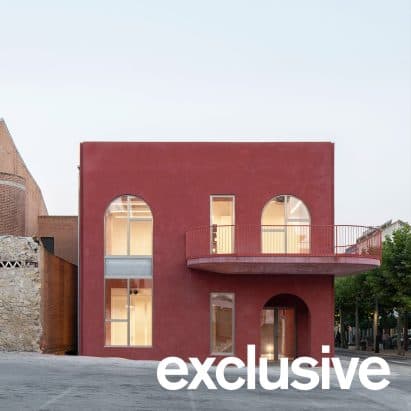
MACH Designs a Bold Red Town Hall in Calasparra, Spain
Spanish architecture studio MACH has completed a striking new town hall for the municipality of Calasparra, a small city nestled in the Murcia region of southeastern Spain. Defined by its commanding red facade and grounded civic character, the building was designed with a clear and intentional purpose: to project a "warm and welcoming presence" that reflects both the identity of its community and the sunbaked landscape that surrounds it. In an era when public architecture often defaults to cold minimalism or anonymous glass facades, the Calasparra Town Hall stands as a confident, humane, and deeply contextual statement about what civic buildings can and should be.
A Local Studio With a Community-Centered Vision
MACH is a local architecture practice with deep roots in the Murcia region, and that proximity to the project's context is evident in every design decision made for the Calasparra Town Hall. Rather than importing a generic international aesthetic, the studio drew on the architectural memory of the region — its terracotta tones, its shaded plazas, and the thick-walled traditions of Mediterranean civic construction — to create a building that feels genuinely of its place.
This approach speaks to a broader shift in contemporary architecture, where locally informed design is increasingly valued over globalized uniformity. For smaller municipalities like Calasparra, a well-considered town hall is more than an administrative center; it is a symbol of collective identity, a landmark that residents encounter throughout their lives. MACH clearly understood this responsibility, and the resulting building wears it confidently.
The Significance of the Red Facade
The most immediately striking feature of the Calasparra Town Hall is undoubtedly its red exterior. Far from an arbitrary stylistic choice, the bold color connects the building to its regional landscape and the warm, earthy tones of the surrounding architecture and terrain. The Murcia region is characterized by its arid, sun-drenched environment, and the red hue chosen by MACH mirrors the ochres and terracottas found in the local soil, the historic masonry, and the region's agricultural heritage.
Color in architecture carries enormous communicative weight. A red civic building does not fade into the background — it asserts itself as a place of importance, a destination, a center of public life. Yet the warmth of the tone prevents it from feeling aggressive or imposing. Instead, the redness invites; it signals that this is a place built for people, not merely an institutional facility to be endured. This balance between civic authority and human approachability is one of the project's most notable achievements.
Designing for Warmth and Accessibility in Public Architecture
The concept of a "warm and welcoming presence" guided not just the color palette but the spatial logic of the entire building. Civic architecture has a long and troubled history of inadvertently alienating the very citizens it is meant to serve — oversized lobbies, bureaucratic corridors, and intimidating facades have historically reinforced the distance between institutions and people. MACH's design for Calasparra deliberately pushes in the opposite direction.
The building's massing and entry sequence are designed to feel accessible at the human scale. Public spaces are organized to encourage circulation and encounter, reflecting an understanding that a town hall should function not just as an administrative hub but as a genuine gathering place for community life. Natural light, proportioned openings, and considered transitions between interior and exterior all contribute to an environment where residents feel that the building is working with them rather than against them.
Contextual Architecture in the Murcia Region
Calasparra is perhaps best known beyond Spain for its prestigious designation as a producer of Protected Designation of Origin (PDO) rice, one of only two municipalities in Spain to hold this distinction. It is a town with genuine agricultural and cultural heritage, and that heritage demanded an architectural response that was respectful rather than disruptive.
MACH's solution draws on the Mediterranean civic typology — the kind of public building that defines a town's central square and anchors community life across generations. The studio paid careful attention to the way the building relates to its immediate urban surroundings, ensuring that the new town hall contributes positively to the existing fabric of Calasparra rather than overwhelming it. The red exterior reads as bold on first encounter but settles naturally into the warm palette of the surrounding streetscape upon reflection.
Contemporary Civic Architecture and the Challenge of Public Trust
The Calasparra Town Hall arrives at a moment when public institutions across the world are grappling with questions of trust, legitimacy, and connection to the communities they serve. Architecture alone cannot solve these problems, but it can make a meaningful contribution. Buildings that are designed with genuine care for their users, that are legible and inviting rather than opaque and forbidding, and that speak the architectural language of their place rather than an imported idiom, go a long way toward signaling that a local government takes its responsibilities seriously.
MACH's approach exemplifies this kind of thoughtful civic design. By choosing warmth over austerity, locality over universality, and human scale over institutional grandeur, the studio has produced a town hall that has every chance of becoming genuinely beloved by the people of Calasparra — the ultimate measure of success for any civic building.
Key Design Principles Behind the Calasparra Town Hall
- Contextual color strategy: The red facade connects the building to the earthy tones of the Murcia landscape, grounding it visually in its regional environment while ensuring it reads as a civic landmark.
- Human-scale massing: The building's proportions and spatial organization are calibrated to feel accessible and welcoming rather than monumental or intimidating.
- Mediterranean civic typology: MACH drew on regional architectural traditions — shaded openings, thick walls, and carefully considered public spaces — to produce a building that is culturally resonant.
- Community-centered functionality: Beyond its administrative purpose, the town hall is designed to function as a genuine public gathering space, encouraging civic participation and encounter.
- Landscape integration: The choice of materials, tones, and forms reflects the broader visual character of Calasparra and the Murcia region, ensuring the building contributes to rather than disrupts its surroundings.
A New Benchmark for Civic Architecture in Spain
The completed Calasparra Town Hall demonstrates that civic architecture in Spain continues to evolve with intelligence and ambition. MACH's project is a timely reminder that the buildings we build for public life matter profoundly — that they shape how communities understand themselves and how residents relate to the institutions that govern them.
By designing a town hall that is red, warm, contextual, and deeply considered, MACH has delivered far more than a functional administrative building. They have given Calasparra a new civic landmark — one that should stand as a reference point for public architecture in the region for decades to come. In a discipline that too often prioritizes spectacle over sincerity, this quiet confidence is something worth celebrating.