
A Startling New Study Says New Orleans May Not Be Livable by 2100
Moving is one of life's most universally stressful experiences. Now imagine relocating not just a household, but an entire city of nearly 400,000 people. That is the unsettling question raised by a landmark study published in Nature Sustainability, one of the world's most respected peer-reviewed scientific journals. According to its findings, New Orleans—one of America's most culturally iconic cities—faces a profound and potentially irreversible climate threat that could render it uninhabitable within the lifetime of children alive today.
The study, conducted by an interdisciplinary team of researchers from Tulane University, Yale University, Florida State University, and Coastal Carolina University, paints a grim picture of what coastal Louisiana will look like as global temperatures continue to climb. Based on historical geological evidence, the researchers project that New Orleans will lose approximately 75% of its remaining wetlands by 2070. By the end of the century, the city could effectively become an isolated island, surrounded on all sides by the Gulf of Mexico.
What the Science Actually Says
To understand the future, the scientists looked deep into the past. By studying an ancient shoreline, the research team discovered that roughly 125,000 years ago—during a period when global temperatures were only 0.5 to 1.5 degrees Celsius warmer than pre-industrial levels—the waters of the Gulf of Mexico extended to a point approximately 30 miles north of where modern-day New Orleans now stands.
That historical data point is especially alarming because the global climate today is already approaching that same threshold. The Earth has warmed by nearly 1.5 degrees Celsius above pre-industrial levels, meaning the conditions that once pushed Gulf waters deep into Louisiana's interior are effectively being recreated in real time. The wetlands that currently act as natural buffers between New Orleans and the open Gulf are disappearing at a rate that makes their near-total elimination within decades not just possible, but likely.
Why Wetlands Matter So Much
Wetlands are not simply swampy, unused land. They are a critical ecological and protective infrastructure system. For New Orleans, coastal wetlands serve several vital functions:
- They absorb storm surge energy during hurricanes, significantly reducing the destructive power of floodwaters before they reach populated areas.
- They act as natural carbon sinks, storing carbon dioxide that would otherwise accelerate climate change.
- They support rich biodiversity, including fisheries that underpin Louisiana's multibillion-dollar seafood industry.
- They provide a physical land buffer that slows the encroachment of saltwater into freshwater systems and developed areas.
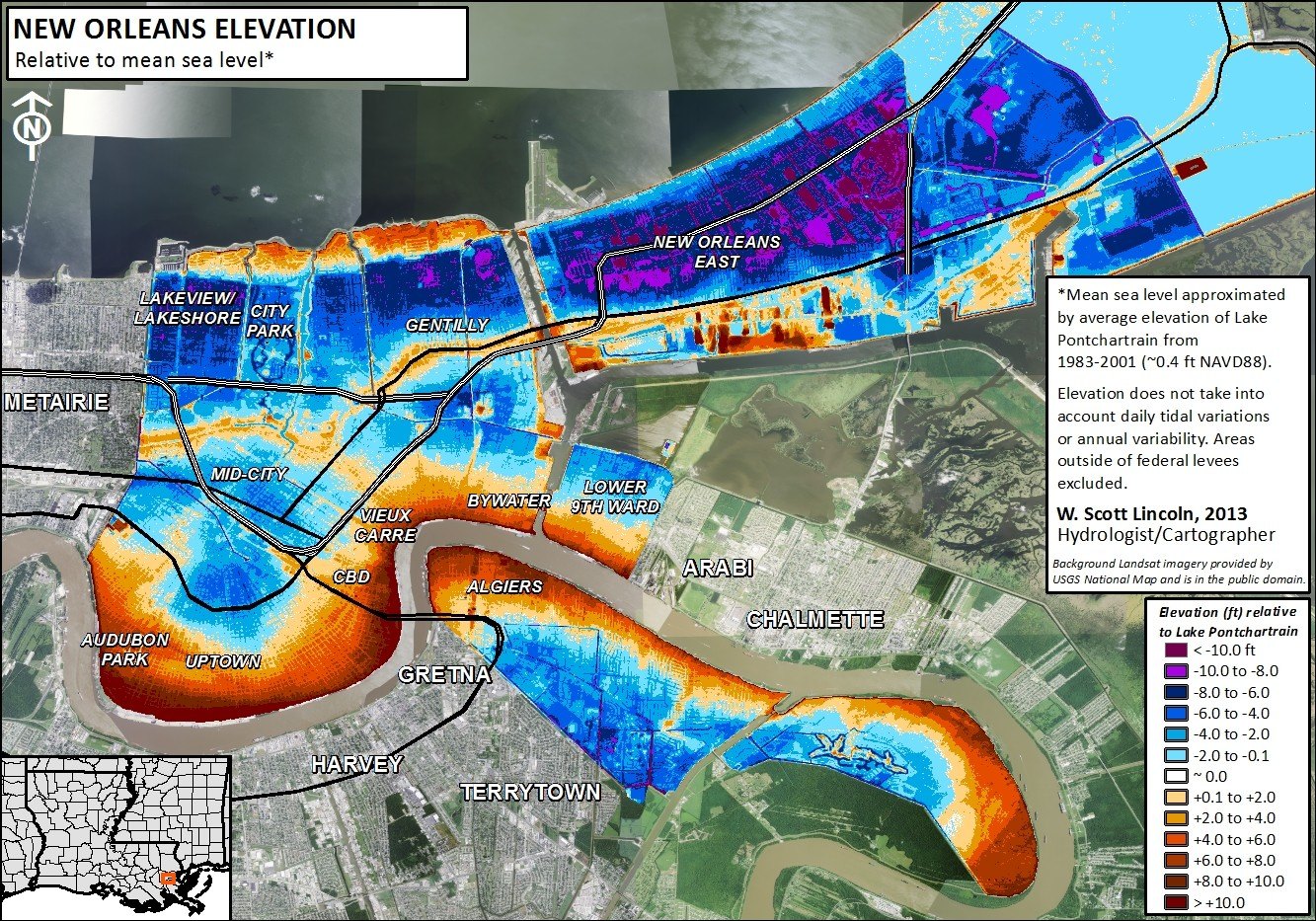
When these wetlands disappear—whether through sea level rise, land subsidence, or erosion—the city loses its natural armor. New Orleans already sits below sea level in many neighborhoods. Without its surrounding wetland buffer, the city becomes extraordinarily vulnerable to even moderate weather events, let alone the Category 4 and Category 5 hurricanes that increasingly batter the Gulf Coast.
New Orleans Is Already Sinking
The threat to New Orleans is not purely a future problem. The city is actively sinking through a process called subsidence, driven by the compaction of the soft soils on which it was built, the extraction of groundwater, and the deprivation of sediment that would naturally replenish the delta. Combined with rising sea levels, this dual dynamic means that the relative sea level experienced by New Orleans residents is rising faster than the global average.
Residents in low-lying neighborhoods already deal with regular "nuisance flooding" during heavy rainstorms. Infrastructure including roads, water mains, and drainage systems is under constant strain. Insurance premiums for homeowners in flood-prone zones have surged dramatically, pricing many long-term residents out of their own communities. In practical terms, the slow-motion crisis described by climate scientists is already unfolding on the ground.
So How Do You Actually Move a City?
The concept of managed retreat—the deliberate, planned relocation of communities away from high-risk climate zones—is no longer a fringe idea in urban planning and climate policy circles. But moving a city the scale and cultural complexity of New Orleans presents challenges that dwarf anything previously attempted in the United States.
The Logistical Challenges Are Immense
New Orleans is home to roughly 383,000 people, with a metropolitan area population exceeding 1.2 million. Relocating even a significant portion of that population would require massive investment in housing, transportation, schools, hospitals, and employment infrastructure in receiving communities. There is currently no federal framework in the United States designed to coordinate or finance urban relocation at this scale.
Beyond logistics, there are profound questions of equity. Historically, the communities most vulnerable to flooding in New Orleans—those in the lowest-lying, least-protected neighborhoods—are disproportionately lower-income and communities of color. Any relocation plan that fails to center these residents risks repeating or worsening existing patterns of displacement and disenfranchisement. The experience of Hurricane Katrina in 2005, which scattered hundreds of thousands of New Orleans residents across the country with uneven and often inadequate government support, offers a cautionary tale about what unplanned climate displacement looks like.
The Cultural Dimension Cannot Be Ignored
New Orleans is not just a city in the geographic sense. It is a living cultural institution, home to jazz, Creole cuisine, Mardi Gras, and a unique blend of French, Spanish, African, and Caribbean heritage found nowhere else on Earth. Many residents feel a profound and unbreakable connection to the city—its streets, its traditions, its music, its food. For many communities, particularly those with deep ancestral roots in Louisiana, the idea of relocation is not simply inconvenient. It is a form of cultural erasure.
What Could Be Done Instead?
Not all experts agree that full relocation is inevitable or even necessary. Some argue that aggressive investment in coastal restoration, levee reinforcement, and green infrastructure could extend the city's viability significantly. Louisiana's Coastal Master Plan, a long-term state initiative, has already allocated billions of dollars toward sediment diversion projects designed to rebuild land in the delta. Some researchers believe that if these interventions are implemented at scale and with speed, they could meaningfully slow the loss of wetlands and buy critical time.
Others advocate for a hybrid approach: protecting the city's historic core and highest-elevation neighborhoods while encouraging voluntary relocation from the most vulnerable low-lying areas, supported by buyout programs and resettlement assistance. This model would preserve the cultural heart of New Orleans while reducing the number of people exposed to the most extreme flood risk.
The Broader Warning for Coastal America
New Orleans is not alone. From Miami to Houston to Norfolk, Virginia, dozens of American cities face escalating climate risks driven by rising seas and intensifying storms. The questions raised by the New Orleans study—about who bears responsibility for protecting vulnerable communities, how relocation can be made equitable, and what it means to lose a place entirely—are questions that American society will need to answer at a national scale in the decades ahead.
The Nature Sustainability study is not a death sentence for New Orleans. But it is a serious, evidence-based warning that the window for action is narrowing. Whether that action takes the form of adaptation, relocation, or some combination of both, one thing is clear: the time to plan is now, while choices still exist—not after the Gulf has already made them for us.