
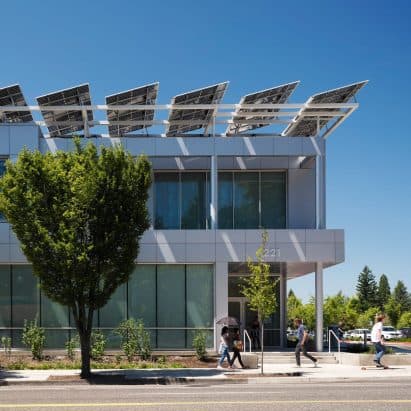
How a Vacant Portland Supermarket Became a Thriving Library Operations Hub
In a city long recognized for its progressive urban planning and commitment to sustainability, Portland, Oregon has added another landmark project to its architectural legacy. Architecture firm Hennebery Eddy has completed the transformation of a former vacant supermarket into the Multnomah County Library Operations Center, a facility that reimagines how public institutions can breathe new life into underused commercial spaces. The project stands as a compelling example of adaptive reuse architecture — a growing design philosophy that prioritizes renovation and repurposing over demolition and new construction.
What Is the Multnomah County Library Operations Center?
The Multnomah County Library Operations Center serves as the operational backbone of one of the most celebrated public library systems in the United States. Rather than functioning as a traditional reading room open to the public, this facility is the behind-the-scenes nerve center that keeps the entire library network running. It houses book processing, cataloging, administrative offices, staff support spaces, and the logistical infrastructure required to manage millions of materials circulating across the county's many branch locations.
Before the conversion, the building sat vacant — a common fate for large-format retail spaces in American cities as shopping habits have shifted and supermarket chains have consolidated or closed locations. Instead of allowing the structure to continue deteriorating or demolishing it entirely, Multnomah County and Hennebery Eddy saw an opportunity to give the building a meaningful second life while keeping costs lower than ground-up construction would allow.
The Vision Behind the Adaptive Reuse Project
Adaptive reuse has gained significant momentum in architectural and urban planning circles over the past decade, and for good reason. Converting an existing building rather than constructing a new one typically reduces carbon emissions associated with manufacturing and transporting new materials. It also preserves embodied energy — the energy already invested in the original structure — and helps stabilize neighborhoods by eliminating the blight that vacant large-footprint buildings can create.
Hennebery Eddy, a Portland-based firm known for its thoughtful approach to civic and institutional architecture, embraced the challenge of working within the constraints of a former grocery store layout. Large-format retail buildings present a unique set of design challenges: they typically feature vast, column-free floor plates, low ceiling heights relative to their footprint, limited natural light penetration toward the center of the building, and loading dock infrastructure designed for high-volume commercial deliveries rather than office or civic use.
Rather than fighting against these characteristics, the design team used them to their advantage. The expansive, open floor plan proved ideal for the library's sorting, processing, and cataloging operations, which require large, flexible working areas unobstructed by structural columns. The existing loading docks were repurposed and integrated into the facility's book delivery and distribution workflow, minimizing the need for significant structural modification in those zones.
Design Highlights and Interior Transformation
One of the most significant challenges Hennebery Eddy faced was transforming a space originally designed for commercial retail into one that supports the wellbeing and productivity of library staff who spend full working days inside the building. To address this, the architects introduced a series of thoughtful interior interventions:
- Strategic placement of skylights and clerestory windows to draw natural daylight deep into the building's core, dramatically improving the quality of the working environment while reducing artificial lighting loads.
- Creation of distinct functional zones within the open floor plan, allowing operational areas such as book processing and cataloging to coexist alongside administrative offices, meeting rooms, and staff lounge spaces without interference.
- Use of warm, tactile materials to humanize what might otherwise feel like a purely utilitarian industrial space, reinforcing the library's identity as a civic institution that values both efficiency and community.
- Integration of sustainable building systems designed to reduce long-term operational energy consumption, consistent with Multnomah County's broader environmental commitments.
The exterior of the building was also updated to better reflect its new civic identity, moving away from the anonymous commercial aesthetic typical of supermarket architecture toward a more welcoming and purposeful institutional presence within its neighborhood context.
Why This Project Matters for Urban Architecture
The Multnomah County Library Operations Center is more than an interesting renovation story — it represents a wider shift in how cities and public institutions are approaching infrastructure investment. As American retail real estate continues to face headwinds from e-commerce growth and changing consumer behavior, vacant big-box stores and supermarkets are increasingly being eyed by municipalities, nonprofit organizations, and developers as candidates for creative reuse.
Libraries, in particular, have emerged as strong candidates for occupying these spaces. Their need for large, flexible floor plates aligns naturally with what former retail buildings offer, and their role as civic anchors can help stabilize and revitalize neighborhoods that have been left with a commercial void.
Hennebery Eddy's work on this project demonstrates that with thoughtful design, sensitive attention to the needs of building occupants, and a commitment to sustainability, spaces that were once written off can become vibrant, functional community assets.
Hennebery Eddy Architects and Their Approach to Civic Design
Founded in Portland, Hennebery Eddy has built a strong reputation for institutional, civic, and educational architecture across the Pacific Northwest. The firm consistently engages with questions of sustainability, community identity, and the long-term stewardship of built environments. The Multnomah County Library Operations Center adds to a portfolio of projects that demonstrate their ability to solve complex programmatic and technical challenges while delivering spaces that genuinely serve the people who use them.
Their approach to the supermarket conversion reflects a broader ethos: that good architecture is not simply about creating visually striking new buildings, but about making intelligent, responsible decisions about the buildings we already have.
A Model for the Future of Public Infrastructure
As cities across North America grapple with the twin challenges of aging infrastructure and surplus commercial real estate, the Multnomah County Library Operations Center offers a replicable model worth studying. It proves that public institutions can meet their operational needs in a fiscally responsible, environmentally conscientious way — without sacrificing quality, functionality, or the dignity of the people who work within those walls. Portland's latest architectural transformation is a quiet but powerful reminder that the future of our cities may well be built not from the ground up, but from what is already standing.