
Where Architecture Meets the Dining Table: Paris School of Architecture's Bold Student Vision
Few design arenas carry as much cultural weight as the dining table. It is the site of daily ritual, communal gathering, and centuries of social meaning. Now, a new generation of architectural thinkers is asking a provocative question: what happens when the table is treated not as a piece of furniture, but as a conceptual object — a space for interrogating how we live, eat, and connect? The answer, it turns out, is extraordinary. Students from the Paris School of Architecture have produced a remarkable series of speculative table design projects that are turning heads in the global design community and offering a thrilling glimpse into the future of the domestic interior.
What Is Speculative Design — and Why Does It Matter?
Before diving into the work itself, it helps to understand the discipline that underpins it. Speculative design is a practice that uses design objects and scenarios not to solve immediate commercial problems, but to provoke thought, challenge assumptions, and open up conversations about possible futures. Rather than asking "how do we make a better table?", speculative designers ask "what does a table tell us about who we are — and what might it say about who we could become?"
This approach has deep roots in European design education, and Paris, with its rich heritage in both fine arts and applied design, is a particularly fertile ground for it. The Paris School of Architecture has long encouraged students to approach spatial and material problems with philosophical ambition, and the results of that pedagogy are now very much on display.
Arts de la Table: The Student Project That's Generating Buzz
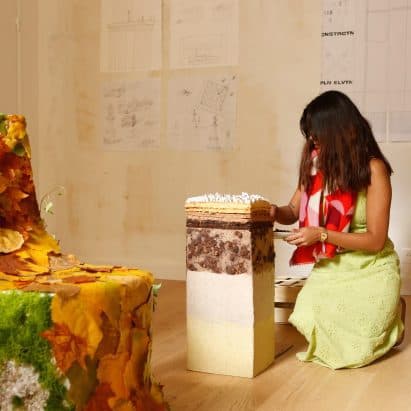
The standout conceptual project making waves is the Arts de la Table series, produced by students in the Integrated Research Project program. The work takes its name from the classical French tradition of table arts — the elaborate, almost theatrical practice of setting, decorating, and arranging a dining table as a form of cultural expression. The students have taken this tradition and subjected it to a rigorous, often irreverent, architectural lens.
Rather than producing conventional furniture designs, these student projects treat the table as a site of inquiry. Some pieces challenge the geometry of the traditional dining surface, introducing irregular planes and asymmetrical arrangements that disrupt the expected hierarchy of host and guest. Others use material experimentation — combining ceramic, cast concrete, hand-blown glass, and biologically derived composites — to ask questions about sustainability, permanence, and fragility in domestic life.
What unites the work is a shared conviction that the table is never neutral. It encodes power, culture, memory, and desire. The Paris School of Architecture students are making those encodings visible and, in doing so, inviting the viewer to see the most familiar of domestic objects with entirely fresh eyes.
Key Themes Running Through the Conceptual Projects
- Ritual and Performance: Several student projects treat the act of dining as a kind of choreography. Table surfaces are designed to guide movement, dictate proximity, or create zones of intimacy and distance within a single shared space. These designs acknowledge that every meal is, on some level, a performance.
- Material Honesty: Across the work, there is a clear rejection of surface treatment that disguises or decorates. Students favor materials that speak plainly about their origins — raw, cast, pressed, or grown. This is a design language that insists on transparency about how things are made and where they come from.
- Ecological Urgency: In keeping with the broader concerns of contemporary architectural education, many of the projects engage with questions of environmental impact. Students are experimenting with mycelium-based composites, recycled urban aggregates, and even food waste derivatives as potential table materials, weaving ecological responsibility directly into the formal vocabulary of the object.
- Scale and Proportion: As architecture students, these young designers bring a heightened sensitivity to scale. Several projects play with the idea that the table is itself a kind of landscape — a topography across which people move objects, build temporary structures of bottles and dishes, and negotiate territory. This architectural thinking at the micro-scale produces objects that feel genuinely novel.
Why Architecture Schools Are the Right Place for This Kind of Design
It might seem unusual that a school focused on buildings and urban space would be producing cutting-edge furniture design. But in practice, the crossover makes perfect sense. Architecture training gives students a sophisticated toolkit for thinking about space, proportion, material, and social use — all of which are directly relevant to the design of domestic objects. When that toolkit is applied to something as deceptively simple as a dining table, the results can be genuinely revelatory.
The Paris School of Architecture's Integrated Research Project structure is particularly well suited to this kind of work because it allows students to pursue extended investigations across multiple media and disciplines. Rather than producing a single resolved object, students are encouraged to develop a body of thinking that unfolds across drawings, models, prototypes, and critical writing. This produces a richness and complexity that is rare in commercial design environments.
Speculative Furniture Design as a Global Conversation
The work coming out of Paris does not exist in isolation. It is part of a broader international conversation about the role of speculative and critical design in shaping culture. Schools in London, Rotterdam, Tokyo, and São Paulo are all engaged in related explorations, and platforms like Dezeen School Shows are playing a vital role in making this work visible to a global audience.
What distinguishes the Paris School of Architecture's contribution is its particular blend of intellectual rigor and sensory pleasure. These are objects that think hard, but they are also objects that seduce. There is an unmistakably French quality to the work — a belief that intellectual seriousness and aesthetic elegance are not in conflict, but are in fact natural partners.
The Future of the Table — and the Designers Who Will Shape It
As design education continues to expand its ambitions, projects like Arts de la Table serve as important markers of where the field is heading. The dining table, for all its apparent simplicity, turns out to be one of the richest sites for design investigation available to us. It sits at the intersection of body and space, private and public, tradition and innovation.
The students of the Paris School of Architecture are proving that speculative table design is far more than an academic exercise. It is a discipline with real cultural stakes, one that has the power to change how we see the most intimate spaces of our daily lives. As these young designers move into professional practice, the ideas they are developing now will ripple outward — into homes, restaurants, galleries, and public spaces — reshaping the way we gather, eat, and belong to one another.
For anyone interested in the cutting edge of conceptual furniture design and architectural thinking, the work emerging from Paris right now is essential viewing.