
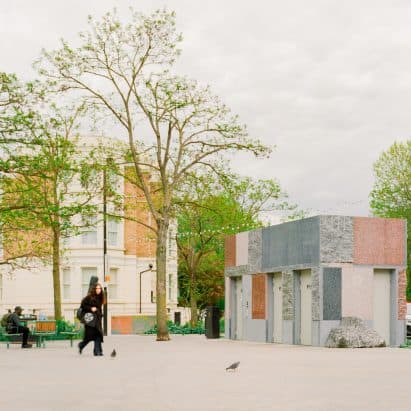
Studio Weave's Maida Hill Toilet Block: Redefining Public Architecture in London
When most people think about public toilet blocks, words like "landmark," "democratic," or "artful" rarely come to mind. Yet London-based architecture practice Studio Weave has managed to do exactly that — turning one of the city's most overlooked typologies into a thoughtful, stone-clad structure that is sparking genuine conversation about what public infrastructure can and should be. Located in Maida Hill, west London, the project has already drawn comparisons to art, with one online commenter asking simply: "Canvas for a Banksy?" That single question captures the building's peculiar power: it is functional, beautiful, and somehow completely unexpected.
The Philosophy Behind the Design: Architecture as Democracy
Studio Weave's stated ambition for the Maida Hill toilet block was to "express democracy" through design. This is not an empty slogan. The practice has long been associated with community-focused, context-sensitive architecture that resists the tendency to treat public buildings — especially utilitarian ones — as afterthoughts. By investing real material richness and design care into a structure that exists purely for public use, Studio Weave is making an argument: that every person who uses this building, regardless of their background or economic status, deserves to encounter quality craftsmanship and considered space.
This approach sits within a broader movement in contemporary urban design that pushes back against the austerity aesthetic that has dominated public infrastructure for decades. The argument is straightforward — when public buildings are poorly designed, they communicate to communities that their daily experience does not warrant investment. When they are designed well, they do the opposite. The Maida Hill project is a tangible, built expression of that belief.
Materials and Construction: Reclaimed Stone as Urban Memory
One of the most striking decisions in the project is the use of reclaimed stone. In an era when sustainability is frequently invoked but rarely fully embedded into the materiality of a building, Studio Weave has made reclaimed stone a central design element rather than a footnote. The choice carries both ecological and cultural weight.
Reclaimed materials carry histories. Each stone block or slab has existed somewhere else before — perhaps in a Victorian warehouse, a demolished civic building, or an old street pavement. By reusing these materials, the toilet block becomes, in a quiet way, an archive of London's built past. It is layered with time in a way that newly quarried stone simply cannot be. This gives the structure an unusual sense of depth and rootedness for what is, functionally, a very modest building.
From a sustainability perspective, the use of reclaimed stone significantly reduces the embodied carbon associated with the structure. New stone extraction is an energy-intensive process, and the construction industry accounts for a substantial share of global carbon emissions. Practices like Studio Weave that build circularity into their material choices at this small scale are, in aggregate, part of a much larger shift that the sector urgently needs to make.
Public Reaction: Between Admiration and Amusement
The online response to the Maida Hill toilet block has been characteristically mixed — part genuine admiration, part good-humored disbelief. The "canvas for a Banksy?" comment that has circulated widely is a perfect encapsulation of the building's strange position in the cultural landscape. It is clearly too beautiful, too considered, to be treated purely as infrastructure. And yet it is, unambiguously, a toilet block.
This tension is not a flaw — it is precisely the point. The building invites double-takes. It makes people stop and look, and in doing so, it prompts questions about why we accept such low standards for public space in the first place. Humor is often the entry point into those more serious conversations, and in that sense, the Banksy comment is doing real critical work, even if its author intended it lightly.
Other commenters have been more directly appreciative, noting the quality of the stonework and the thoughtfulness of the structure's relationship to its surroundings. For a discipline that often struggles to communicate its value to a general public, the level of lay engagement with this project is notable and encouraging.
Urban Design Implications: What the Maida Hill Project Teaches Us
The Maida Hill toilet block raises questions that extend well beyond its modest footprint. First, it challenges assumptions about where architectural ambition is permissible. There is an unspoken hierarchy in the profession that reserves serious design attention for museums, galleries, corporate headquarters, and expensive private homes. Studio Weave's project is a direct refusal of that hierarchy.
Second, it demonstrates what is possible when clients — in this case, a local authority or community body — are willing to support considered design even for small-scale, unglamorous programs. The building could not exist without a commissioning body that shared Studio Weave's belief that public facilities deserve real design investment. That relationship between architect and client is as important as any material or spatial decision.
Third, and perhaps most significantly, the project offers a model for thinking about urban micro-interventions. Cities are not only shaped by their major landmarks. They are built, neighborhood by neighborhood, from hundreds of small decisions about bus shelters, benches, lighting columns, and yes, toilet blocks. When those decisions are made carelessly, cities feel careless. When they are made with attention and skill, cities feel — quite literally — more civilized.
Studio Weave: A Practice Committed to the Public Realm
Studio Weave has consistently demonstrated a commitment to public and community-oriented work throughout its history. The practice has completed projects ranging from playground structures to pavilions and community buildings, always with a particular sensitivity to the social and material context of each site. The Maida Hill toilet block is, in many ways, a distillation of everything the practice does well: contextual sensitivity, material richness, democratic intent, and a refusal to treat any building as too small to deserve care.
In a city where public amenities have been progressively defunded and degraded over decades of austerity, projects like this one carry an almost polemical charge. They are proof of concept. They show what is possible. And they do so not through grand gestures or large budgets, but through careful, principled design applied to the most everyday of programs. Whether or not a Banksy ever appears on its walls, Studio Weave's Maida Hill toilet block has already made its mark on London's urban conversation.