
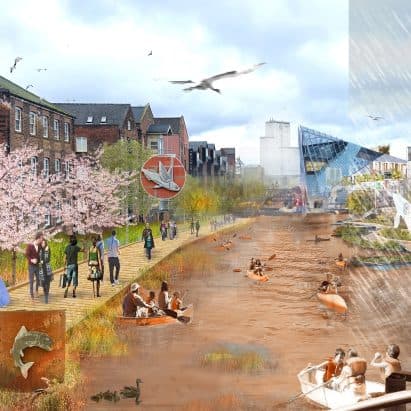
University of Sheffield Students Address Hull's Growing Flood Threat
As climate change continues to reshape the risks facing coastal and low-lying cities across the United Kingdom, the University of Sheffield's School of Architecture has turned its annual school show into a platform for meaningful, real-world problem-solving. Among the standout projects on display, a bold proposal targeting Hull's escalating sea level crisis has captured the attention of architects, urban planners, and climate researchers alike. The student-led initiative represents a new generation of designers who are not content with theoretical exercises — they want their work to matter.
Hull, formally known as Kingston upon Hull, has long been recognised as one of England's most flood-vulnerable cities. Situated at the confluence of the River Hull and the Humber Estuary, the city sits largely below sea level and faces compounding threats from tidal surges, groundwater flooding, and the accelerating effects of global climate change. The devastating floods of 2007, which left more than 8,500 homes and 1,300 businesses under water, remain a painful benchmark in the city's collective memory — and scientists warn that without significant intervention, events of that magnitude could become far more frequent.
What the Proposal Involves
The University of Sheffield project addressing Hull's sea level rise forms part of a wider school show that brings together architecture, landscape architecture, and urban design students at various stages of their studies. While individual proposals vary in scale and approach, the Hull-focused work demonstrates a sophisticated understanding of both the technical and human dimensions of flood resilience.
Rather than relying solely on traditional hard engineering solutions — such as higher flood walls or expanded pumping stations — the proposal explores an integrated design language that works with water rather than simply against it. This approach draws on principles from the Netherlands and Scandinavia, where cities have successfully reimagined waterfronts, streets, and public spaces as dynamic systems capable of absorbing, redirecting, and even celebrating water.
Key elements highlighted in student proposals include:
- The creation of green and blue infrastructure corridors that channel excess water away from residential zones while providing new public amenity spaces for communities.
- Elevated walkways and adaptable ground-floor building typologies that allow neighbourhoods to remain functional during moderate flood events.
- Tidal parks and constructed wetlands along the River Hull that serve as both ecological buffers and community green spaces.
- Phased retrofitting strategies for existing housing stock, particularly in areas identified as highest risk, using locally sourced materials and low-carbon construction methods.
- A redesigned relationship between Hull's historic city centre and its waterfront, restoring access and visibility to water while embedding flood-adaptive design into the urban fabric.
Why Hull Is a Critical Case Study for Climate-Adaptive Design
Hull's situation is not unique in the UK, but it is unusually acute. The city ranks among the most deprived local authority areas in England, meaning that the communities most exposed to flood risk are often those least equipped — financially and socially — to recover from it. This intersection of environmental vulnerability and socioeconomic disadvantage makes Hull a compelling and morally urgent subject for architecture students grappling with questions of climate justice.
The University of Sheffield has a strong tradition of socially engaged design education, and the school's emphasis on community consultation, co-design, and contextual research is visible in how students approach the Hull brief. Rather than parachuting in with ready-made solutions, student teams conduct site visits, engage with local residents and stakeholders, and interrogate the political and economic forces that have shaped Hull's built environment over decades.
This grounded methodology produces proposals that feel rooted in place — responsive to Hull's unique industrial heritage, its distinctive streetscapes of Victorian terraces, and the resilient culture of its communities — rather than generic templates imported from elsewhere.
The Broader Context: Architecture Schools and Climate Action
The University of Sheffield's school show is one of many annual graduate exhibitions across UK architecture schools, but it has developed a reputation for tackling urgent, real-world issues with rigour and ambition. Projects from Sheffield regularly address themes of housing inequality, post-industrial regeneration, biodiversity loss, and, increasingly, climate adaptation.
That a student proposal focused on Hull's sea level challenge has emerged as a headline project reflects a broader shift in architectural education. Climate change is no longer treated as a specialist elective or a peripheral concern — it is central to how the next generation of designers is being trained to think about cities, landscapes, and the built environment.
Institutions such as the Intergovernmental Panel on Climate Change (IPCC) have repeatedly emphasised that adaptation — designing cities and infrastructure to cope with inevitable climate impacts — must proceed in parallel with mitigation efforts. Architecture schools are increasingly heeding that call, and the work coming out of Sheffield is a compelling example of what design-led adaptation can look like at the urban scale.
Looking Ahead: From Student Proposal to Real-World Impact
Student proposals do not automatically translate into built projects, but they serve an important function in expanding the imagination of what is possible. Ideas that originate in architecture schools have a history of influencing practice, policy, and public debate — sometimes in ways that are difficult to trace but nonetheless real.
For Hull, a city that has already demonstrated extraordinary community resilience in the face of devastating floods, proposals like those emerging from the University of Sheffield offer something genuinely valuable: a vision of a future in which the city does not simply survive rising water, but adapts, evolves, and even thrives because of how it has chosen to respond to the challenge.
As sea levels continue to rise and the frequency of extreme weather events increases across the UK, cities like Hull will need every creative resource available to them. The work being done by architecture students at Sheffield suggests that, at least in the design disciplines, the will to meet that challenge is strong — and growing stronger with every new graduating cohort.