
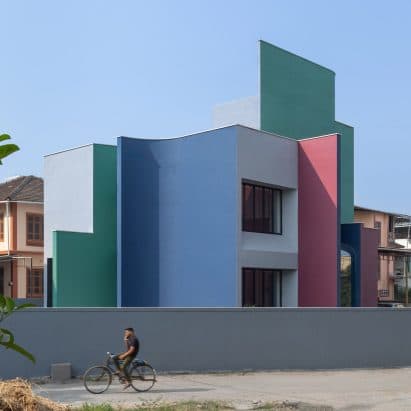
When Architecture Becomes Art: The Story of Villa Corsica in Mumbai
In a city as densely layered and visually chaotic as Mumbai, standing out requires more than a polished facade. It demands a point of view — a bold architectural philosophy that refuses to blend into the background. Villa Corsica, designed by Mumbai-based architect Neel Buddhadev, does exactly that. With sweeping curves, a daring palette of colours, and a spatial language borrowed from sculpture rather than conventional residential design, this private home has become one of the most talked-about architecture projects to emerge from India in recent years.
Described as a "sculptural installation," Villa Corsica is not simply a house that looks interesting from the outside. It is a fully immersive environment where every surface, angle, and material choice contributes to a unified artistic vision. For those who follow contemporary Indian architecture and interior design, this project signals a significant shift in how Indian homeowners and their architects are thinking about what a home can — and perhaps should — be.
The Design Philosophy Behind Villa Corsica
Neel Buddhadev's approach to Villa Corsica was rooted in a single governing idea: that the boundary between architecture and sculpture does not have to exist. In most residential projects, form follows function almost by default — rooms are rectangular, corridors are straight, and surfaces are flat because those choices are practical and cost-effective. Buddhadev deliberately challenged each of those assumptions at Villa Corsica.
The result is a home defined by organic, flowing curves that guide the eye and the body through space in ways that feel more cinematic than domestic. Walls do not simply divide rooms; they undulate, lean, and arc. Ceilings are not neutral overhead planes but active design elements that reinforce the mood of each space below them. Every transition from one room to the next has been treated as an opportunity to create a moment of architectural theatre.
This philosophy aligns with a broader global movement in contemporary architecture that draws heavily on the legacy of figures like Zaha Hadid, whose parametric curves redefined what was structurally and aesthetically possible in built form. Yet Villa Corsica is distinctly Indian in its sensibility — particularly in its fearless use of colour.
Colour as a Structural Element
If the curves give Villa Corsica its sculptural presence, the colours give it its soul. Buddhadev deployed a rich and carefully considered palette throughout the home, treating pigment not as decoration applied after the fact but as a structural element integral to the spatial experience. Deep terracottas sit alongside cool blues and warm ochres, creating a chromatic journey through the house that shifts in tone and intensity as natural light moves through the day.
This approach is particularly resonant in the Indian context, where colour has always carried cultural, spiritual, and emotional weight. From the festival hues of Holi to the saffrons and crimsons of temple architecture, India has never been a country that fears bold colour. Villa Corsica channels that chromatic confidence into a contemporary residential language, proving that vibrant colour and sophisticated design are not in tension with each other — they can be one and the same thing.
The interiors continue this dialogue between form and colour. Custom furniture pieces echo the curved vocabulary of the architecture, ensuring that the sculptural quality of the space is not disrupted by conventional rectilinear furnishings. Upholstery, textiles, and decorative objects have all been selected to reinforce the overall palette, creating rooms that feel cohesive and intentional at every scale.
Spatial Experience: Moving Through the Home
One of the defining qualities of Villa Corsica is the way it choreographs movement. Entering the home, visitors are immediately drawn into a spatial sequence that feels carefully staged — not in a theatrical or artificial sense, but in the way that great architecture always guides the body intuitively through space. There is a procession to the experience of moving through the house, with moments of compression and expansion, darkness and light, that keep the spatial narrative engaging from beginning to end.
- The ground-floor communal areas open generously, with curved walls creating fluid transitions between living, dining, and circulation zones.
- Upper levels introduce more intimate scales, where the curves become tighter and the colour palette shifts to create quieter, more contemplative atmospheres.
- Natural light is harnessed through carefully positioned openings that animate the curved surfaces at different times of day, ensuring the home feels alive and ever-changing.
- Material choices — including polished plasters, textured renders, and bespoke joinery — add tactile richness to the visual drama of the forms and colours.
Villa Corsica in the Context of Contemporary Indian Architecture
The emergence of projects like Villa Corsica reflects a broader evolution taking place in Indian residential architecture. For much of the late twentieth century, aspirational Indian homes looked outward to Western or global models for inspiration — modernist white boxes, neo-classical columns, or imported luxury finishes that signalled wealth and cosmopolitanism. Today, a new generation of Indian architects and their clients are asking a different question: what does a truly contemporary Indian home look and feel like on its own terms?
Villa Corsica offers one compelling answer. It is deeply rooted in a global architectural conversation — one that includes parametric design, bold materiality, and the blurring of art and architecture — while simultaneously embracing the chromatic richness and spatial generosity that have always been part of India's built heritage. It is neither nostalgic nor imitative. It is original.
Why Villa Corsica Matters for the Future of Residential Design
For architects, interior designers, and homeowners looking to push the boundaries of what a private residence can achieve, Villa Corsica by Neel Buddhadev is a landmark project. It demonstrates that sculptural ambition and everyday livability are not mutually exclusive goals. It proves that colour, used with conviction and skill, can elevate a space from the merely beautiful to the genuinely transformative. And it confirms that Mumbai — for all its challenges as a building environment — remains one of the most fertile grounds for architectural innovation in the world.
As more images of the project circulate through the architecture and design community, Villa Corsica is already inspiring conversations about the next chapter of Indian residential design. In a country where the appetite for bold, expressive living environments is growing rapidly alongside a new generation of talented designers willing to meet that appetite, projects like this one point toward an exceptionally exciting future.
Whether experienced in person or through the lens of architectural photography, Villa Corsica rewards close attention. It is a home that thinks of itself as a work of art — and in doing so, it has become exactly that.