
New York Ranks Dead Last for Homebuilding and Housing Affordability in 2026
If you've been struggling to find an affordable home in 2026, you're not alone—and depending on where you live, your state's own policies and construction pace may be working directly against you. The newly released 2026 Realtor.com® Housing Report Card paints a sobering picture of the national housing landscape, ranking all 50 states and the District of Columbia on homebuilding activity and housing affordability. The results are striking: coastal and Western states dominate the bottom of the list, with New York finishing dead last.
How the 2026 Housing Report Card Works
The Realtor.com® Housing Report Card scores every state on a 100-point scale across two primary categories: housing affordability and residential construction activity. The methodology considers factors such as median home prices relative to median incomes, permitting rates, housing supply growth, and overall builder activity. States that score well tend to have robust construction pipelines, lower regulatory burdens, and home prices that working families can reasonably afford. States that score poorly show the opposite—sluggish building, restrictive zoning, high costs, and a widening gap between what homes cost and what residents earn.
Grades are assigned on a traditional A-through-F scale, giving consumers and policymakers a quick, intuitive snapshot of where each state stands. The 2026 results reveal a widening divide between the Sun Belt and Midwest—where building booms are helping keep prices in check—and coastal markets where affordability continues to erode.
New York: The Worst State for Housing in 2026
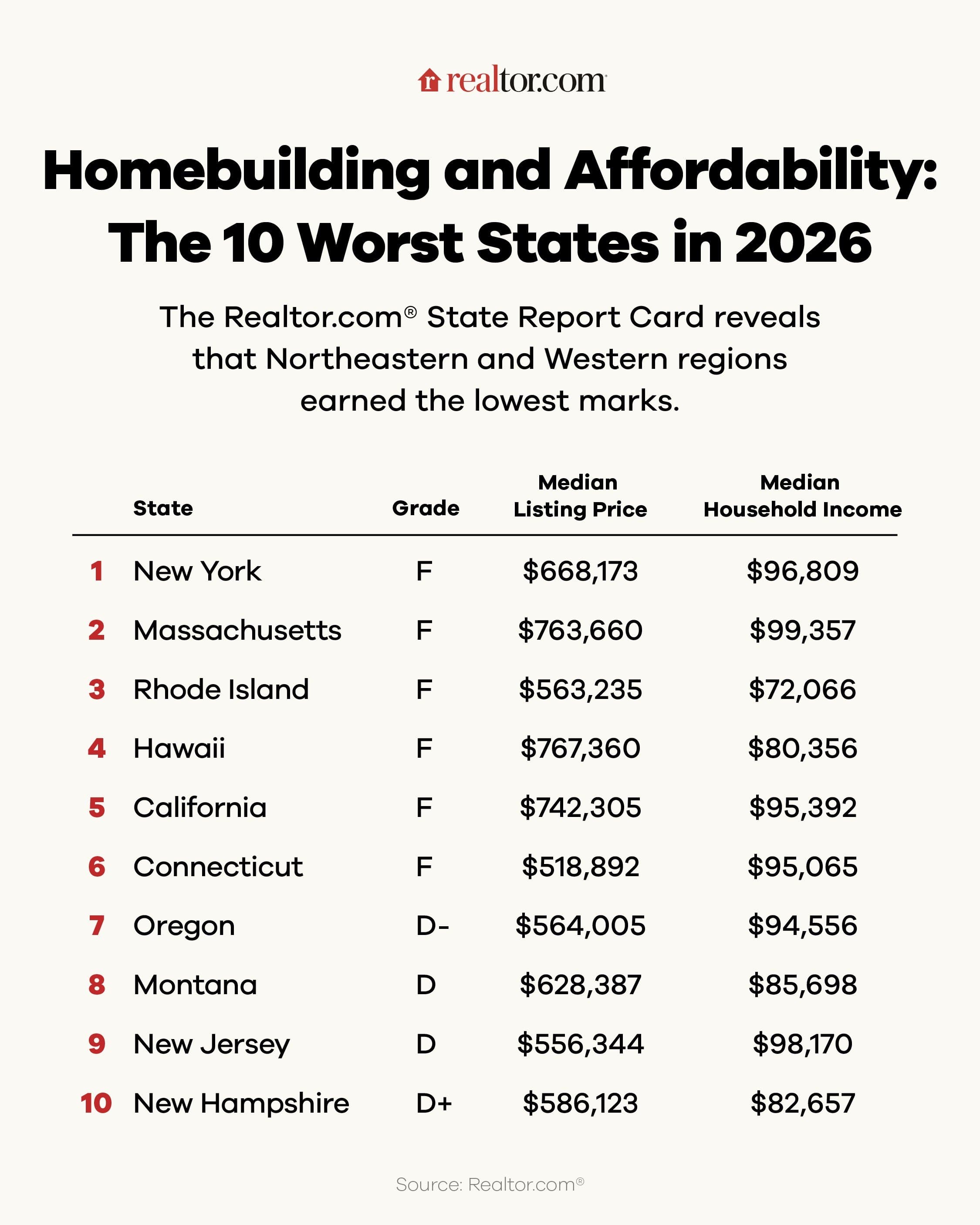
At the very bottom of the rankings sits New York, which earned a jaw-dropping score of just 8.5 out of 100—an F grade by any measure. The Empire State's dismal performance reflects years of chronic underbuilding, extraordinarily high construction costs, complex regulatory environments, and home prices that have far outpaced wage growth for the vast majority of residents.
New York City alone has long been one of the most expensive housing markets in the world, but the affordability crisis extends well beyond the five boroughs. Suburban Long Island, Westchester County, and even upstate cities like Albany and Buffalo have seen prices climb sharply in recent years as remote workers and city-dwellers seek lower-cost alternatives—only to find that few genuinely affordable options remain anywhere in the state.
The state's construction activity also remains stubbornly low relative to its population and demand. Restrictive zoning laws, lengthy permitting processes, and high labor and material costs make it extremely difficult and expensive to build new housing at scale. Without meaningful reform, experts warn that New York's housing crisis is likely to deepen in the years ahead.
The Other F-Grade States: A Coastal Pattern
New York is not alone in earning a failing grade. Five other coastal states also received F scores in the 2026 report card, reflecting similarly entrenched affordability and construction challenges:
- Massachusetts — Boston's red-hot real estate market and the state's limited buildable land continue to squeeze out middle- and lower-income buyers, despite some recent legislative efforts to ease zoning restrictions.
- Rhode Island — The nation's smallest state faces outsized housing pressure, with prices having surged during the pandemic era and construction struggling to keep pace with demand from Boston-area spillover.
- Hawaii — Geographic constraints and some of the highest construction costs in the country make Hawaii a perennial challenge for homebuilders and buyers alike. Land scarcity and import costs for materials compound the problem significantly.
- California — Despite years of headlines about its housing crisis and incremental policy reforms, California continues to dramatically underbuild relative to population needs, keeping prices among the highest in the continental United States.
- Connecticut — Once seen as a more affordable alternative to New York and Massachusetts, Connecticut's proximity to both metros has driven prices sharply higher, while its construction output has not kept pace.
D-Grade States: Not Failing, But Far From Passing
Just above the F-grade cluster sit four states that performed marginally better but still earned grades ranging from D- to D+. These states face many of the same structural challenges but showed slightly more construction activity or marginally better affordability metrics:
- Oregon — Portland's housing woes are well-documented, and statewide construction has struggled to offset years of underbuilding in the metro area.
- Montana — The pandemic-era influx of remote workers dramatically inflated home prices in cities like Bozeman and Missoula, putting homeownership out of reach for many long-time residents.
- New Jersey — High property taxes, dense development patterns, and strong demand from New York City commuters keep costs elevated and affordability elusive.
- New Hampshire — Once a refuge for Boston-area buyers seeking lower prices, New Hampshire has seen inventory tighten and prices climb considerably over the past several years.
Indiana Leads the Nation with an A Grade
On the opposite end of the spectrum, Indiana topped the 2026 Housing Report Card with an impressive score of 76.3 out of 100 and an A grade. The Hoosier State's combination of strong homebuilding activity, relatively low regulatory hurdles, and genuinely affordable home prices—particularly in Indianapolis and its surrounding suburbs—helped it stand apart from the rest of the nation. Indiana's performance is a reminder that policy choices and market conditions can work together to produce housing environments where middle-class families can actually afford to buy.
What These Rankings Mean for Homebuyers and Policymakers
The 2026 Realtor.com® Housing Report Card is more than a scorecard—it's a call to action. The states clustered at the bottom share common traits: restrictive land-use regulations, slow permitting, high construction costs, and a persistent political reluctance to embrace density or meaningful zoning reform. Until those structural issues are addressed, residents in New York and its fellow F-grade states will continue to face one of the most difficult housing markets in the developed world.
For homebuyers currently priced out of coastal markets, the data suggests that interior states—particularly in the Midwest and parts of the South—offer a dramatically different housing reality. Whether that means relocating or advocating loudly for reform at home, the 2026 report card makes one thing abundantly clear: where you live has never mattered more when it comes to your ability to afford a home.