
Living With Parents Is No Longer Just a Young Person's Last Resort
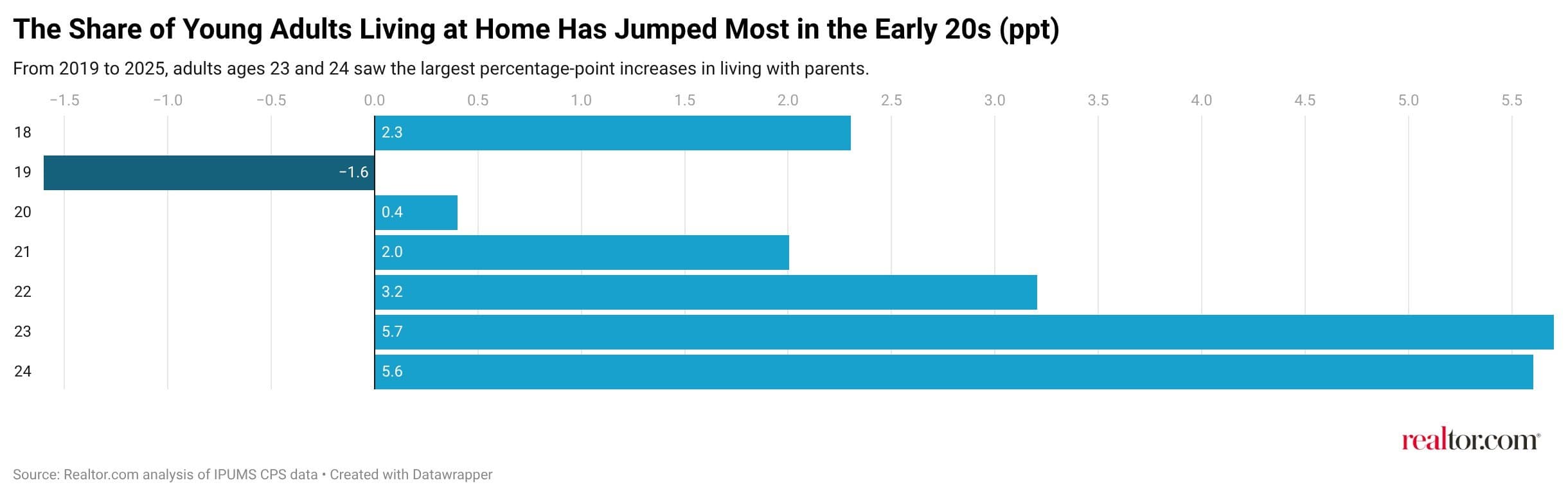
For decades, moving back in with mom and dad carried a certain stigma—a quiet admission that adulthood hadn't quite clicked into place. But in 2025, that narrative is rapidly unraveling. According to new research from Realtor.com, a record 25.2 million adults under the age of 35 are currently living with their parents. That's nearly one in three young adults, and the number now exceeds even the elevated counts recorded during the height of the COVID-19 pandemic.
What makes this finding especially striking isn't just the scale—it's who is doing the living at home. Contrary to popular assumptions, most of these young adults are not unemployed, idle, or struggling to find their footing in the job market. Millions of them are working professionals who simply cannot afford to leave.
The Employment Myth: A Paycheck Is No Longer Enough
One of the most persistent stereotypes about adults living with their parents is that they lack jobs, ambition, or the discipline to budget their way into independence. New data from Realtor.com dismantles that assumption with striking clarity.
"Roughly 70% of 25- to 34-year-olds living with parents are employed," says Hannah Jones, senior economist at Realtor.com and author of the report. "That share held steady even as the overall co-residence rate has climbed—meaning the growth is coming from working adults, not people waiting to find jobs."
Breaking the numbers down further, 71% of adults ages 25 to 29 who live at home are employed, and 68% of those ages 30 to 34 are as well. These are not young people on the margins of the economy. These are working adults earning paychecks—and still finding that a paycheck is not enough to cover the cost of going it alone.
That reality reframes one of the most important questions facing the housing market today: if having a stable job is no longer a reliable ticket to independent living, what is?
What's Really Keeping Young Adults at Home?
Jones points to a combination of forces that have collectively raised the bar for housing independence to a level many working young adults simply cannot clear on their own.
- Soaring housing costs: Home prices and rents have surged dramatically over the past several years, outpacing wage growth in most major metropolitan areas. In many cities, the monthly cost of renting a one-bedroom apartment now consumes the majority of a young adult's take-home pay.
- Student loan debt: Millions of millennials and Gen Z adults are carrying significant student loan balances that limit their ability to save for a down payment or absorb the monthly cost of rent on top of debt repayment obligations.
- Income stagnation relative to costs: While employment rates among at-home young adults remain high, income levels vary widely. Many are employed in fields or at salary levels that don't align with the cost of housing in the markets where they live or work.
- Geographic constraints: Job opportunities often cluster in high-cost urban centers, leaving young adults with a difficult choice: live affordably in a market with fewer opportunities, or stay employed in a market where affording rent means moving back home.
"Something about their income level, debt load, or the cost of housing in their market is keeping them home despite steady employment," Jones explains. The data does not tell a story of failure—it tells a story of a housing economy that has fundamentally shifted beneath an entire generation's feet.
The Changing Social Calculus Around Co-Residence
Beyond the financial mechanics, something cultural is shifting as well. Living with parents—once a quiet source of embarrassment for many young adults—is increasingly being reframed as a rational, even strategic financial decision. As the numbers grow, so does the social acceptability of the arrangement.
This normalization matters for several reasons. It means fewer young adults are rushing into housing decisions they can't actually afford just to avoid the stigma of living at home. It also means more families are structuring their living situations around mutual financial benefit, rather than social convention.
In many cultures around the world, multi-generational living has always been the norm. The United States is, in many ways, catching up to a model that prioritizes financial stability and family proximity over the idealized—but increasingly unaffordable—vision of solo independent living.
What This Means for the Housing Market
The implications of this trend extend well beyond individual households. For the broader housing market, 25.2 million young adults living with their parents represents a massive pool of latent demand—millions of would-be renters and buyers who are financially capable of forming new households but are being held back by cost barriers.
When and if those barriers lower—through wage growth, declining rents, expanded housing supply, or some combination of all three—that pent-up demand could reshape the housing market significantly. Builders, lenders, and policymakers who understand the scale of this delayed household formation will be better positioned for what comes next.
In the meantime, the record number of employed adults still living at home sends an unmistakable signal: the old markers of financial readiness and independence are no longer functioning as they once did. For millions of young Americans, adulthood has arrived. The affordable housing to go with it has not.
The Bottom Line
The record 25.2 million young adults living with their parents in 2025 are not a generation that failed to grow up. They are a generation that grew up into a housing market that has left them with few good options. With nearly 70% of older at-home young adults employed, the story is less about ambition and more about arithmetic—and until the math changes, so-called "boomerang living" is likely to remain exactly where it is: the new normal.