
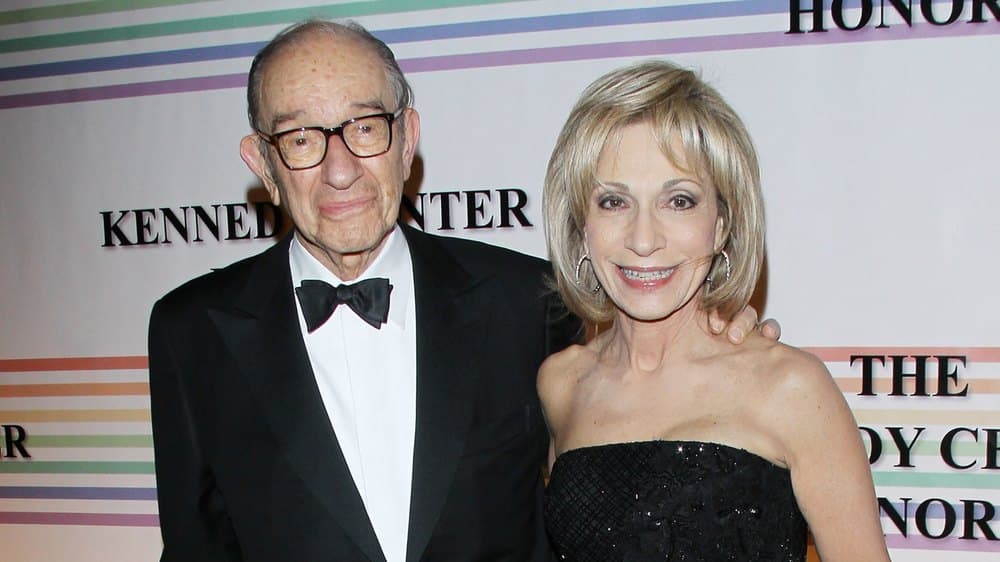
Alan Greenspan, Iconic Federal Reserve Chairman, Dies at 100
Alan Greenspan, one of the most influential economic figures in modern American history, has died at the age of 100. The longtime Federal Reserve chairman, who guided the United States economy through periods of remarkable prosperity and sowed the seeds of one of its most devastating downturns, passed away at his home in Washington, DC, from complications of Parkinson's disease. His death was confirmed in a statement by his wife of 29 years, NBC News correspondent Andrea Mitchell.
"Alan passed away at our home this morning at the age of 100 from complications of Parkinson's disease," Mitchell said in her statement. "He was a giant of a man who helped shape the U.S. economy for decades under presidents of both parties, but was always honest in acknowledging his mistakes."
That combination of towering influence and rare intellectual humility is perhaps the most fitting summary of a career that touched the lives of virtually every American household, shaping everything from mortgage rates to retirement savings and the broader arc of the U.S. housing market.
A Career Spanning Four Presidencies
Greenspan served as chairman of the Federal Reserve from 1987 to 2006, a tenure of nearly two decades that placed him at the center of American economic life under four presidents: Ronald Reagan, George H.W. Bush, Bill Clinton, and George W. Bush. Few individuals in the history of the United States have wielded as much sustained influence over economic policy without ever holding elected office.
During his time at the Fed, Greenspan became known for his advocacy of low interest rates and financial deregulation. These twin pillars of his philosophy helped fuel what many economists consider one of the greatest periods of economic expansion in American history. The 1990s in particular saw extraordinary GDP growth, low unemployment, surging stock markets, and rising homeownership rates — a prosperity boom that seemed to validate Greenspan's approach and earned him near-mythological status among policymakers and investors alike.
The Federal Reserve itself acknowledged his enormous impact in a statement following his death, saying that Greenspan "left a lasting mark on this institution, on the broader field of economics, and on the country."
The Shadow of the Subprime Mortgage Crisis
Yet Greenspan's legacy is inseparable from the subprime mortgage crisis of 2007 and the Great Recession that followed. Critics have long argued that the very policies that drove the boom — cheap money, loosened lending standards, and a hands-off regulatory posture toward financial innovation — also inflated the catastrophic housing bubble that eventually burst, sending shockwaves through the global economy.
The subprime mortgage market exploded in the years before the crisis, as lenders extended home loans to borrowers with weak credit histories, often under adjustable-rate terms that masked the true cost of borrowing. When interest rates began to rise and housing prices fell, millions of Americans found themselves holding mortgages worth more than their homes. Foreclosures skyrocketed, financial institutions collapsed, and the United States entered its worst economic downturn since the Great Depression.
Greenspan himself acknowledged in a landmark 2008 congressional testimony that his worldview had contained a fundamental flaw — that he had placed too much faith in the self-correcting nature of free markets and had not foreseen that financial institutions would fail to adequately manage the risks they were taking on. It was a moment of remarkable candor from a man who had long been treated as an infallible oracle.
What Greenspan's Policies Meant for the Housing Market
For everyday Americans, Greenspan's tenure at the Fed was felt most viscerally through the housing market. His preference for keeping interest rates low made mortgage borrowing cheap and accessible, helping drive homeownership to historic highs during the late 1990s and early 2000s. For a generation of buyers, the Greenspan era was synonymous with the dream of affordable homeownership becoming a reality.
But the same conditions that made homes accessible also made them dangerously overvalued. As credit flowed freely and lending standards eroded, home prices rose far beyond what incomes could justify. When the bubble finally burst, the damage was staggering:
- Millions of homeowners lost their properties to foreclosure between 2007 and 2010.
- Home values in many markets declined by 30% to 50% or more.
- The broader financial system, deeply exposed to mortgage-backed securities, teetered on the edge of collapse.
- The U.S. unemployment rate climbed to 10% by late 2009, erasing years of job gains.
The legacy of that crisis continues to shape housing policy, lending regulation, and public trust in financial institutions to this day.
A Complex Legacy in Economic History
Assessing Greenspan's overall legacy is a task economists and historians will continue to debate for generations. On one hand, his stewardship of the Fed during the 1990s expansion produced genuine, broadly shared prosperity. On the other, his reluctance to use the Fed's regulatory authority to rein in predatory lending and financial excess helped set the stage for an economic catastrophe.
What is beyond dispute is that Alan Greenspan was a towering figure whose decisions reverberated through every corner of the American economy. From the interest rate on a first-time homebuyer's mortgage to the retirement account of a working-class family, his fingerprints were everywhere.
Remembering Alan Greenspan
Beyond his role as a policymaker, Greenspan was remembered by those who knew him as a man of deep intellectual curiosity and genuine personal integrity. Andrea Mitchell's tribute highlighted not only his professional achievements but his willingness to confront his own errors — a quality that set him apart from many figures of comparable stature.
He leaves behind a complicated but undeniable legacy: a man who helped build one of the great economic booms of the twentieth century, grappled honestly with the consequences when it ended badly, and shaped the way Americans think about the relationship between monetary policy, housing, and financial stability. Alan Greenspan was 100 years old.