
Why Endless Corporate Spaces Terrify and Fascinate Us in Equal Measure
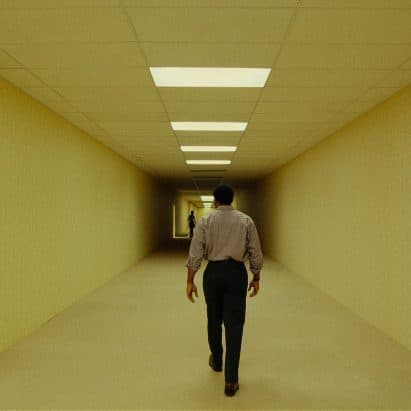
There is something deeply unsettling about a corridor that goes on too long. About fluorescent lighting that hums just slightly too loud. About carpet tiles in a pattern that seems almost deliberate, yet entirely without meaning. These are the raw materials of a particular modern dread — one that A24's surprise architectural horror hit Backrooms has tapped into with remarkable cultural precision, and one that the visionary architect Rem Koolhaas diagnosed decades before anyone thought to make a movie about it.
The film's success is not just a horror story. It is an architectural story. And to understand why it has resonated so profoundly with audiences, you have to understand something about the built environment we have collectively created and now collectively fear.
What Is the Backrooms? The Internet Legend That Became an A24 Film
For those unfamiliar with the origin, the Backrooms began as an internet creepypasta — a single, grainy photograph of an empty office interior, all yellow-tinged walls, stained carpet, and the uneasy suggestion of infinite continuation just beyond the frame. Posted anonymously around 2019, the image detonated across online communities because it triggered something visceral and near-universal: the feeling of having been somewhere just like that, somewhere mundane and yet deeply wrong.
A24's adaptation brings that liminal nightmare to the screen with full cinematic weight. The premise is deceptively simple — characters find themselves trapped in an endless labyrinth of office corridors, drop ceilings, and flickering strip lighting, with no apparent exit and no rational explanation. The horror is not in monsters, at least not primarily. The horror is in the architecture itself.
That distinction matters enormously. When a building becomes the antagonist, something philosophically interesting is happening. We are not afraid of a person or a creature. We are afraid of a system — of anonymous design, of spaces built for function stripped of humanity, of environments that have been optimized for productivity and stripped of everything that makes a place feel inhabited or alive.
Rem Koolhaas and the Theory of Junkspace
Here is where Rem Koolhaas enters the picture, and where architectural history intersects with internet horror in a way that feels almost too neat to be coincidental. In 2001, the Dutch architect and theorist published his landmark essay Junkspace, a dense, furious, and darkly funny meditation on the built environment of late capitalism. His target was the accumulated interior sprawl of shopping malls, airports, office parks, and corporate campuses — spaces he described as the byproduct of modernization rather than architecture proper.
Koolhaas wrote that junkspace is "the residue mankind leaves on the planet." He described spaces defined by their AC systems, by their dropped ceilings, by their carpet, by signage that pretends to guide you somewhere meaningful through corridors that are, in the end, interchangeable. He was writing about the architecture of the Backrooms more than two decades before the Backrooms existed as a cultural concept.
The parallels are striking enough to feel prophetic. Koolhaas identified the psychological condition these spaces create — a kind of ambient disorientation, a low-level alienation that you cannot quite name because nothing is visibly, dramatically wrong. Everything is merely slightly off. Slightly too generic. Slightly too much like everywhere else.
Why Liminal Spaces Have Become a Cultural Phenomenon
The broader liminal spaces aesthetic — which encompasses the Backrooms but extends to swimming pools at night, empty shopping malls, school hallways after hours, and parking garages at 3am — has become one of the defining visual languages of online culture in the 2020s. Understanding why requires thinking about what these spaces share beyond their surface appearance.
- They are designed for human occupation but photographed or depicted in the absence of humans, creating a profound sense of wrongness.
- They exist in the background of everyday life, noticed but rarely looked at directly, making them uncanny when foregrounded.
- They represent institutional or corporate power stripped of its human justification — the shell of productivity without the workers.
- They evoke memory without specificity, the way a generic corridor reminds you of a dozen different schools, hospitals, and offices at once.
This last quality is particularly important. Liminal spaces derive much of their power from the way mass-produced architecture has colonized collective memory. Because these spaces have been built to a template across decades and continents, they trigger recognition in almost everyone. That recognition, unmoored from any specific personal memory, is itself a form of horror.
Architecture as Antagonist: What Backrooms Tells Us About Design
The cultural success of the Backrooms film should prompt a serious conversation within architecture and design. If a dominant popular horror premise centers on the built environment itself as the source of dread, that is a meaningful signal about how the public experiences the spaces it inhabits daily.
Corporate and institutional architecture has, for decades, prioritized efficiency, standardization, and cost-per-square-foot over nearly every other value. The results are spaces that function, in the narrow sense, but that fail to feel meaningful, rooted, or human. The psychological cost of spending enormous portions of one's life in such environments is difficult to quantify but impossible to deny — and the viral resonance of the Backrooms suggests that this cost is being felt, even if it has found its outlet in horror fiction rather than architectural criticism.
Koolhaas was writing criticism. The Backrooms is entertainment. But they are describing the same phenomenon from different angles, and the fact that the entertainment version has reached millions of people who will never read an architectural theory essay suggests something important: the critique has escaped the academy and found its audience in a generation that grew up inside junkspace and learned to fear it instinctively.
The Dream Behind the Dread
There is another dimension worth exploring, one that Edwin Heathcote gestures toward in his original Dezeen essay: the fantasy of the secret door. The dream, familiar to many, of finding a hidden room in a home that turns out to be larger than it appeared. The Backrooms inverts this wish fulfillment darkly. Instead of discovering a welcome expansion, you discover an unwelcome infinity. Instead of a secret garden or a hidden library, you find another corridor. And then another.
That inversion speaks to anxieties about modern life that go beyond architecture specifically. The feeling of being trapped in systems too large to comprehend, of working within institutions that extend beyond any individual's ability to map or influence, of navigating a built world that was not designed with you in mind — these are broadly contemporary fears, and liminal horror has found a language for them that is immediate, visual, and viscerally effective.
Rem Koolhaas got there first, as the saying goes. But the Backrooms may have gotten further — into the cultural bloodstream, into the nightmares of a generation, into the conversation about what our buildings are actually doing to us. That conversation, uncomfortable as it is, is one the architecture world would do well to take seriously.