
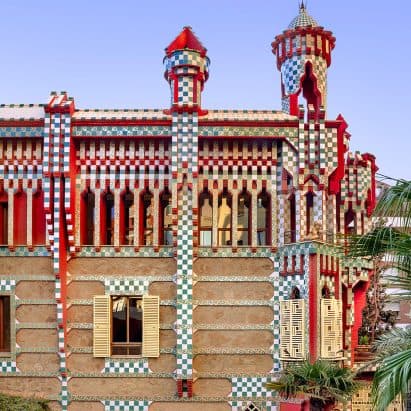
Casa Vicens: The House Where Gaudí's Genius Was Born
When we talk about Antoni Gaudí, minds immediately leap to the soaring spires of the Sagrada Família or the dreamlike curves of Casa Batlló. Yet long before those iconic landmarks defined the Barcelona skyline, a relatively modest summer house in the Gràcia neighbourhood announced the arrival of one of architecture's most radical and visionary minds. Casa Vicens, Gaudí's very first major commission, is increasingly celebrated not as a footnote in his career, but as the foundational document of his entire architectural philosophy — his so-called "manifesto home."
As the centenary of Gaudí's death approaches in 2026, renewed attention is falling on this extraordinary building, inviting both longtime admirers and first-time visitors to look more carefully at where it all began. Understanding Casa Vicens means understanding Gaudí himself.
The Origins of Casa Vicens
Casa Vicens was designed between 1883 and 1885 for Manuel Vicens Montaner, a tile and brick manufacturer, on what was then a semi-rural plot on the outskirts of Barcelona. Gaudí was just in his early thirties, freshly graduated from the Barcelona School of Architecture, and this was his opportunity to prove himself on a genuine residential commission.
The brief was relatively straightforward — a summer retreat for the Vicens family — but Gaudí's response was anything but conventional. Rather than following the historicist or neo-Gothic trends fashionable among his contemporaries, he produced something entirely new: a building that synthesised Moorish, Oriental, and vernacular Catalan influences into a visually explosive whole that defied easy categorisation. From the outset, Gaudí refused to work within inherited frameworks. Casa Vicens was his declaration of independence.
A Riot of Tile, Colour, and Ornament
The most immediately striking feature of Casa Vicens is its extraordinary surface treatment. The façades are covered in a dense, joyful patchwork of green and white ceramic tiles — ironically, not made by Vicens himself, but inspired by the marigold flowers Gaudí reportedly found growing on the site when he first visited it. The tile patterns draw heavily on Moorish geometric traditions, reflecting Gaudí's deep fascination with Islamic architecture, which he had studied intensively as a student.
Horizontal bands of checkered tile alternate with sections of exposed brick, creating a layered rhythm across the exterior that feels almost musical. The roofline is punctuated by elaborate ironwork grilles and railings — many featuring the distinctive palm-leaf motif that would recur throughout Gaudí's work — along with small turrets and decorative pinnacles that give the building an almost festive, fairy-tale quality.
Inside, the decorative vocabulary becomes even richer. Ceilings are adorned with painted birds and botanical motifs; Japanese fan designs appear on walls alongside intricate plasterwork. The effect is immersive rather than merely decorative, drawing nature indoors and blurring the boundary between building and garden.
Why Casa Vicens Is Called a Manifesto
The word "manifesto" implies a deliberate, programmatic statement of intent — and that is precisely what architectural historians and Gaudí scholars have come to see in Casa Vicens. Nearly every principle that would define his mature work is present here in embryonic form:
- Nature as the primary source of architectural form. The marigold-inspired tiles, the palm-leaf ironwork, the botanical ceiling paintings — all reflect Gaudí's conviction that architecture must learn its geometry and ornament from the natural world rather than from classical or Renaissance precedent.
- The integration of structure, surface, and decoration. At Casa Vicens, ornament is never applied as an afterthought. It grows from and reinforces the underlying structure, a principle Gaudí would pursue with increasing technical sophistication in later works.
- A synthetic, cross-cultural approach to historical precedent. Rather than reviving a single historical style, Gaudí freely borrowed from Moorish, Mudéjar, Japanese, and vernacular Catalan traditions, weaving them into something new and distinctly his own.
- Total design control. From the structural layout to the smallest decorative tile, Casa Vicens bears the mark of a single controlling imagination — a Gesamtkunstwerk, or total work of art, in the truest sense.
From Private Home to UNESCO World Heritage Site
For most of the twentieth century, Casa Vicens remained in private hands and was largely inaccessible to the public. The building was extended in the 1920s by architect Joan Baptista Serra de Martínez, who added a new section sympathetically designed to blend with Gaudí's original work, though purists have long debated where the authentic Gaudí ends and the extension begins.
In 2017, the house opened to the public as a museum for the first time, and the response was immediate and enthusiastic. Visitors who had spent years touring the Sagrada Família and Park Güell finally had the chance to stand inside the building where Gaudí's journey began. The same year, Casa Vicens was inscribed as a UNESCO World Heritage Site, joining six other Gaudí works already on the list and completing what UNESCO describes as a portfolio representing the peak of nineteenth and twentieth-century architecture.
Visiting Casa Vicens Today
The museum experience at Casa Vicens has been carefully designed to contextualise both the building itself and its place within Gaudí's broader career. Restored interiors reveal the original decorative schemes, while exhibition spaces explore the architectural influences Gaudí absorbed in the years leading up to the commission. Guided tours offer deeper insights into specific design decisions, and the restored garden — once a key part of the property's composition — provides a rare green retreat in this now densely urban neighbourhood.
With the centenary of Gaudí's death arriving in 2026, Casa Vicens is set to receive even greater attention as scholars, designers, and visitors reassess his legacy from the very beginning. If you want to understand where Gaudí's extraordinary vision came from, this is the place to start.
The Enduring Relevance of Gaudí's Debut
More than 140 years after its construction, Casa Vicens remains a startlingly contemporary building. Its insistence on drawing from nature, its rejection of stylistic orthodoxy, and its celebration of colour and surface as serious architectural tools all feel remarkably in tune with many of the preoccupations of twenty-first-century design. In an era when architects are once again looking to biomimicry, sustainable materials, and cultural hybridity for inspiration, Gaudí's first house speaks with unexpected urgency.
That a young architect, working in a peripheral city on a modest domestic commission, could produce something so fully formed, so confident, and so prophetic is remarkable enough. That this same building would go on to be recognised as the seed from which one of history's most inventive architectural careers grew makes Casa Vicens not just a manifesto, but a monument to the transformative power of a genuinely original mind.