
Chicago Fed Sounds the Alarm on Homeowners Insurance Affordability in the Midwest
Homeownership has long been considered the cornerstone of the American Dream, but for millions of families across the Midwest, that dream is becoming increasingly expensive — and not just because of rising home prices or mortgage rates. A new study from the Federal Reserve Bank of Chicago has highlighted a growing and underreported threat: the surging cost of homeowners insurance premiums, which are now rising faster than household incomes across multiple states and forcing many families into difficult financial trade-offs.
The Chicago Fed, which oversees the 7th Federal Reserve District encompassing all of Iowa and most of Michigan, Illinois, Indiana, and Wisconsin, released findings that paint a sobering picture of the insurance landscape for both current homeowners and prospective buyers. With more than 35 million people living across this region as of 2021, the implications of this affordability gap are far-reaching and demand serious attention from policymakers, lenders, and homeowners alike.
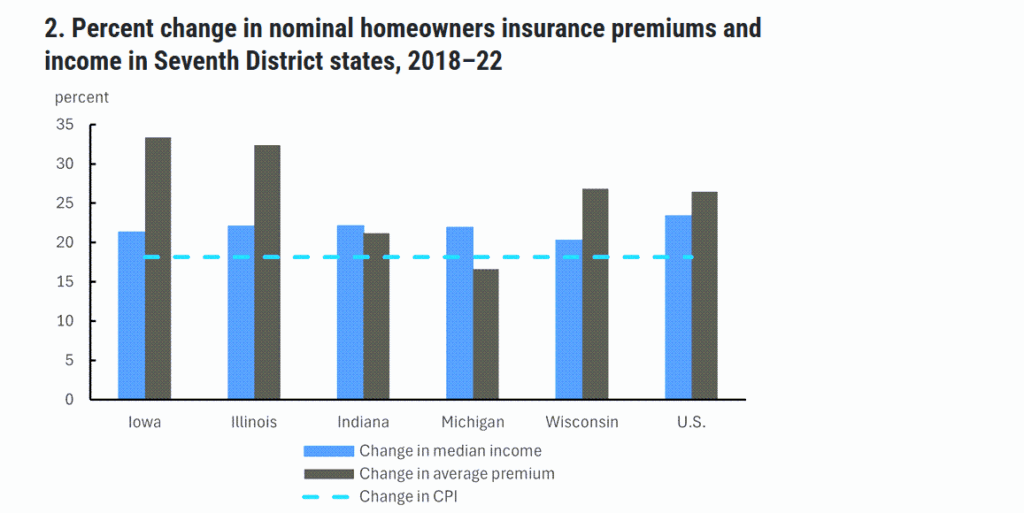
What the Data Shows: Premiums Outpacing Incomes
The numbers tell a stark story. Between 2018 and 2022, homeowners insurance premiums rose by an average of 25% nationwide — a figure that significantly outpaced wage growth over the same period. According to the Chicago Fed, households across the 7th District have borne the brunt of this trend, with insurance costs climbing at a pace that many family budgets simply cannot sustain.
Context makes this even more concerning. According to 2023 data from the U.S. Bureau of Economic Analysis, median income across the broader Midwest region stood at $76,800, noticeably behind the national median of $82,600. This income gap means that Midwest households already operate with less financial cushion than their counterparts in other parts of the country, making rapid insurance premium increases especially damaging.
Major metropolitan areas within the 7th District — including Chicago, Detroit, Milwaukee, Indianapolis, and Grand Rapids, Michigan — are home to large working- and middle-class populations who are particularly vulnerable to these rising costs. For these communities, homeowners insurance is not a luxury; it is a necessity tied directly to mortgage requirements and long-term financial security.
The Driving Forces Behind Rising Insurance Costs
Understanding why premiums have surged so dramatically requires looking at several converging factors that have reshaped the insurance market over the past decade.
- Higher rebuilding costs: Elevated labor and material expenses, accelerated in part by supply chain disruptions and inflationary pressures, have made it significantly more expensive for insurers to pay out claims related to property damage. When rebuilding a home costs more, insurers adjust their premiums accordingly.
- More frequent and intense storm damage: Climate-related weather events have become increasingly common and destructive across the Midwest and nationally. From powerful thunderstorms and tornadoes to flooding events, properties are facing a higher frequency of damage claims, driving up risk assessments and premium calculations.
- Rising reinsurance costs: Insurance companies themselves rely on reinsurance — essentially insurance for insurers — to manage their own risk exposure. As global reinsurance costs have climbed due to increasing catastrophic events worldwide, those costs are inevitably passed down to policyholders in the form of higher premiums.
Together, these forces have created a market environment where insurers face greater financial exposure than at any point in recent memory, and consumers are left absorbing the resulting price increases.
The "No-Win" Scenario for Long-Time Homeowners
Perhaps the most troubling aspect of the Chicago Fed's findings is the impossible situation many long-time homeowners now face. The report describes a stark set of choices for households that can no longer comfortably afford their insurance premiums: they can reduce their coverage by raising their deductible, which leaves them financially exposed in the event of a major loss, or — for those who own their homes outright without a mortgage — they may consider dropping coverage altogether, a gamble that could prove catastrophic.
"The rise in homeowners insurance costs may lead to no-win choices for long-time homeowners who can neither afford their premiums nor the cost of repair if they lower their premiums by increasing their deductible," the report stated directly.
This is especially relevant for elderly homeowners on fixed incomes and lower-income households, who have fewer options to absorb cost increases through budget adjustments or income growth. For these groups, the rising cost of insurance does not merely represent a financial inconvenience — it represents a genuine threat to housing stability.
What It Means for New Homebuyers and the Mortgage Industry
The insurance affordability crisis is not confined to existing homeowners. According to the Chicago Fed, the trend could effectively price prospective buyers out of certain housing markets entirely. When lenders calculate whether a borrower qualifies for a mortgage, total housing costs — including insurance — are factored into affordability ratios. As premiums rise, some buyers who might otherwise qualify for a loan find themselves pushed past the threshold.
This creates a ripple effect throughout the housing market. Sellers in high-insurance-cost areas may find their pool of qualified buyers shrinking. First-time homebuyers, already struggling with elevated home prices and interest rates, face yet another barrier to entry. The mortgage industry, meanwhile, must navigate an evolving landscape where insurance costs increasingly influence loan qualification and housing demand.
Looking Ahead: A Growing Policy Concern
The Federal Reserve Bank of Chicago's findings add an important dimension to the national conversation around housing affordability. While much attention has been focused on home prices and mortgage rates, the insurance cost crisis deserves equal scrutiny from lawmakers, housing advocates, and financial regulators. Without targeted interventions — whether through state-level insurance market reforms, investment in climate resilience, or expanded housing assistance programs — the affordability gap is likely to widen further.
For Midwest homeowners and aspiring buyers alike, the message from the Chicago Fed is clear: the cost of simply keeping a roof over your head is rising in ways that extend well beyond the mortgage payment, and the financial strain that results is both real and measurable. Staying informed, reviewing your coverage options regularly, and engaging with local housing resources are important first steps in navigating this challenging new reality.