
A Monthly Ritual on Its Way Out
For millions of Americans, the first of every month triggers the same ritual: dig out the checkbook, scrawl out a payment for a sum that feels larger every year, and hand it off to a landlord. It's a habit so deeply ingrained in renter culture that it has practically become a rite of adulthood. But that ritual is now officially in the minority — and its decline is accelerating faster than most people realize.
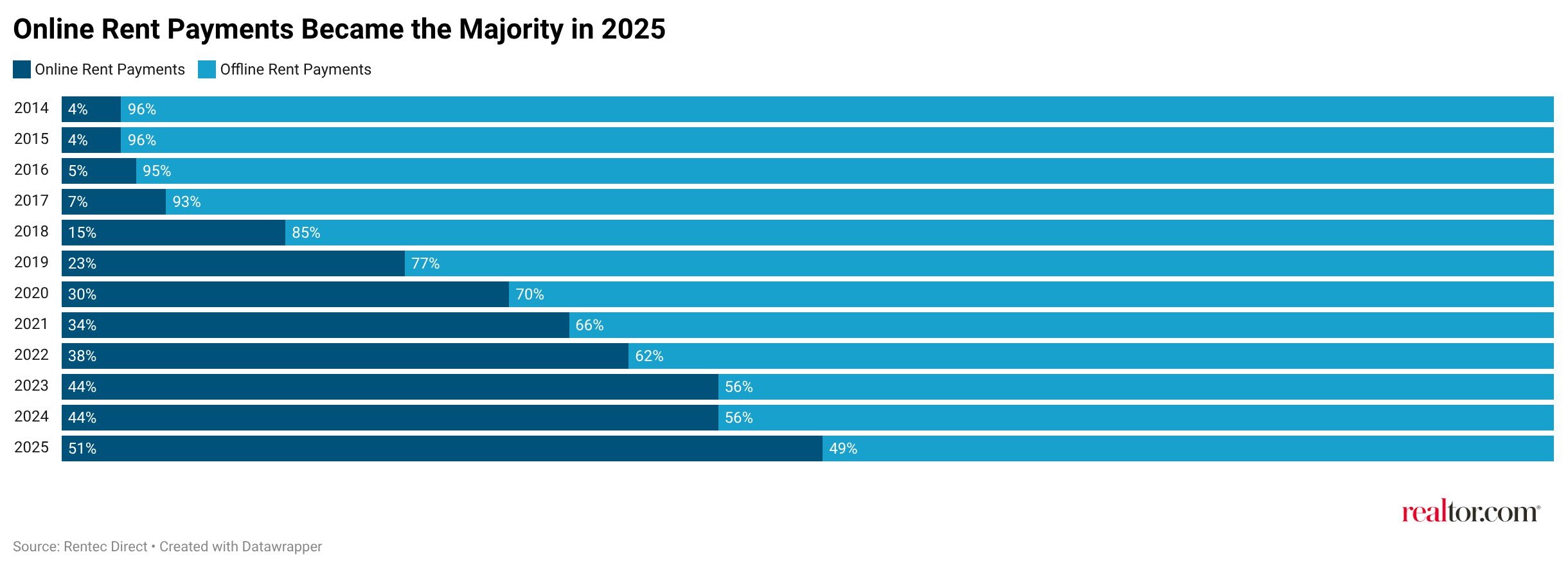
In 2025, online rent payments surpassed offline payments for the first time in recorded rental history. According to a comprehensive report by Rentec Direct, a leading property management software company, just 49% of renters in the United States still pay rent by check or cash. The other 51% have made the switch to digital. It's a quiet revolution, but its implications run deep — for renters, landlords, and the broader housing ecosystem.
The Numbers Behind the Shift
The Rentec Direct report is one of the most detailed analyses of rental payment behavior ever published. Drawing on a decade's worth of data from 1.2 million renters and more than $21 billion in processed payments, it tells a clear story: digital adoption in rent payment has been explosive. In 2014, online rent payments accounted for just 4% of all transactions captured in the dataset. By 2025, that figure had climbed to 51% — a more than twelvefold increase in just over a decade.
To put this in context, consumer payments overall began moving online much earlier. By 2015, around 10% of all consumer transactions were already taking place online or remotely, according to the Federal Reserve's Diary of Consumer Payment Choice. Rent, by contrast, was lagging far behind at just 4%. This gap raises an important question: why was rent so slow to go digital, and what finally pushed it over the tipping point?
Why Rent Took Longer to Go Digital
Unlike buying a product on Amazon or splitting a dinner bill via Venmo, paying rent involves a uniquely complex set of factors. First, the transaction amounts are large — often one of the biggest single payments a household makes each month — which historically made both renters and landlords cautious about digital platforms and the fees or security risks they might introduce.
Second, the landlord-tenant relationship is highly fragmented. Millions of rental units in the United States are owned by small, independent landlords who may lack the infrastructure, technical know-how, or motivation to set up online payment systems. Unlike large apartment complexes with dedicated property management software, a mom-and-pop landlord owning one or two rental properties often found it easier to simply collect a check at the door.
Third, trust and habit played enormous roles. Renters who had always paid by check saw little reason to change, and landlords who had always received checks saw the same. Inertia, in other words, was a powerful force keeping the analog system alive long after the tools to replace it were readily available.
What Finally Tipped the Scales
Several converging forces pushed online rent payments past the 50% threshold. The COVID-19 pandemic was arguably the most significant catalyst. When in-person interactions became logistically difficult or outright dangerous, the appeal of contactless payment options surged. Landlords who had never considered online payment platforms suddenly had strong incentive to adopt them, and renters who had previously handed over checks became far more comfortable with digital alternatives.
The rapid growth of property management software platforms also played a key role. Tools like Rentec Direct, AppFolio, Buildium, and others made it easier than ever for landlords of all sizes — not just large corporate operators — to offer online payment options to tenants. Many of these platforms now include automated reminders, recurring payment scheduling, and integrated financial tracking, making digital rent collection genuinely appealing for small landlords as well.
At the same time, the renter population itself has been changing. Younger renters who grew up managing their finances entirely through apps and digital platforms have little patience for checkbooks and money orders. As this demographic makes up an increasingly large share of the rental market, the cultural pressure to modernize payment systems has grown accordingly.
What This Means for Renters
The shift to online rent payments offers real benefits for tenants. Digital payments create automatic records of every transaction, which can be invaluable in disputes over late fees or lease violations. Autopay features eliminate the risk of forgetting to pay on time, protecting renters from late fees and negative marks on their credit reports. Some platforms even report on-time rent payments to credit bureaus, helping renters build credit history in a way that writing a check never could.
However, the transition is not without complications. Many online rent payment platforms charge processing fees — sometimes between 2% and 3% of the transaction — which can amount to a meaningful sum when applied to a $1,500 or $2,000 monthly rent payment. Some landlords absorb these fees; others pass them on to tenants. Renters should carefully read the terms of any payment platform before enrolling and ask their landlord who is responsible for covering transaction costs.
What This Means for Landlords
For property owners and managers, the benefits of digital rent collection are substantial. Online payments reduce the administrative burden of processing paper checks, eliminate trips to the bank, and provide cleaner financial records for tax and accounting purposes. Automated late fee enforcement and payment reminders also tend to improve on-time payment rates, reducing the stress of chasing down delinquent tenants.
Small landlords, in particular, stand to gain from adopting modern property management tools. While the upfront learning curve may seem daunting, most platforms are designed with non-technical users in mind and offer significant time savings once set up.
The Holdouts Are Not Going Away Quietly
Despite the milestone, nearly half of all renters are still paying the old-fashioned way — and that group is not simply a collection of technophobes. Many are elderly renters without reliable internet access or familiarity with digital financial tools. Others live in areas with limited broadband connectivity. Some rent from landlords who actively prefer checks, or whose lease agreements have not been updated to reflect digital payment options.
Advocates for housing equity have raised concerns that a rapid push toward digital-only rent payment could unintentionally exclude vulnerable populations who rely on cash, including low-income renters, undocumented immigrants, and individuals without bank accounts. An estimated 4.5% of U.S. households remain unbanked, according to FDIC data, and many more are underbanked — meaning a fully digital rental market could create meaningful access barriers for some of the most financially precarious renters.
The Future of Rent Payment
The trajectory is clear: online rent payment will continue to grow, and within the next few years, paying by check will likely feel as anachronistic as paying for groceries with a personal check. But the pace and shape of that transition matter enormously. For the digital shift to be genuinely positive for the rental market, it must be accompanied by low-cost or no-fee options for tenants, robust security protections, and policies that ensure cash-based renters are not left behind.
The death of the rent check is coming. The question is whether the system that replaces it will be built to serve everyone — or just those who already have every advantage.