
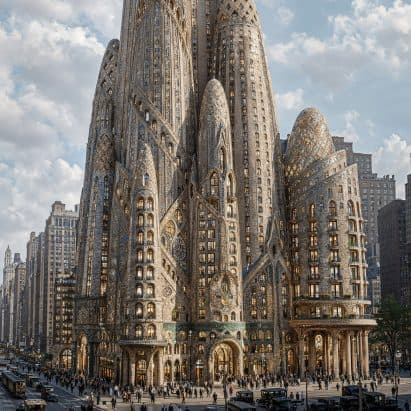
What If Gaudí Had Built in New York? AI Artist Thierry Lechanteur Has the Answer
New York City's skyline is one of the most iconic in the world — a jagged crown of steel, glass, and concrete that has defined modern architecture for over a century. But what if that skyline had looked radically, organically, unmistakably different? What if, rising among the angular towers of Manhattan, there stood a sinuous, nature-inspired skyscraper conceived by the mind of Antoni Gaudí? Thanks to the work of Belgian AI artist Thierry Lechanteur, we no longer have to wonder. Through a striking series of AI-generated renders, Lechanteur has visualised Gaudí's long-lost Hotel Attraction — a project the Catalan master designed for New York in the early twentieth century that was never built — giving the world a haunting glimpse of an alternative architectural history.
The Story Behind Gaudí's Hotel Attraction
Antoni Gaudí, best known for Barcelona's extraordinary Sagrada Família and the dreamlike Park Güell, was not a man who confined his imagination to a single city. In 1908, two American businessmen approached Gaudí with a commission to design a grand hotel for New York City. The resulting concept, known as Hotel Attraction, was breathtaking in its ambition. Gaudí envisioned a tower rising approximately 360 metres — which would have made it, at the time, one of the tallest structures on earth — crowned with a distinctive parabolic spire and clad in the kind of organic, flowing forms that had become his architectural signature.
The design was unlike anything being built in America at the time. Where the emerging skyscrapers of New York celebrated verticality through rigid steel frames and neoclassical or Gothic ornament, Gaudí's Hotel Attraction would have introduced an entirely different visual language: one rooted in nature, spirituality, and the structural logic of the catenary arch. The project never moved beyond the drawing board, leaving it as one of architecture's great "what ifs." Original sketches and drawings survived, but for over a century, the building existed only as lines on paper and fragments of historical imagination.
How Thierry Lechanteur Brought the Vision to Life
Enter Thierry Lechanteur, an AI artist who has built a reputation for using artificial intelligence tools to resurrect unbuilt, lost, or forgotten architectural visions. Working from Gaudí's surviving drawings and a deep study of the architect's visual vocabulary — the undulating stone surfaces, the bone-like columns, the mosaic-encrusted spires — Lechanteur fed historical references and stylistic cues into AI image generation tools to produce a series of photorealistic renders of Hotel Attraction as it might have appeared standing in the Manhattan skyline.
The results are extraordinary. In Lechanteur's images, the tower rises above the streets of New York with an otherworldly presence, its curved silhouette utterly unlike the surrounding grid of rectangular towers. The renders depict the hotel both in isolation and in context, set against the familiar backdrop of the Manhattan skyline, making the contrast — and the lost opportunity — all the more vivid. Lechanteur himself described the project as conjuring "the ghost of an alternative New York," a phrase that captures both the melancholy and the wonder embedded in the work.
The Role of AI in Reimagining Architectural History
Lechanteur's Hotel Attraction project is part of a growing trend in which artists and architects are turning to artificial intelligence not just to design new buildings, but to explore the roads not taken in architectural history. AI image generation tools, when guided by a knowledgeable and artistically sensitive hand, offer an unprecedented ability to synthesise historical styles, structural forms, and urban contexts into convincing visual narratives.
This raises important questions about the nature of architectural representation and historical imagination. These are not blueprints. They are not academic reconstructions verified by structural engineers. They are artistic interpretations — and Lechanteur is open about that. Yet they serve a powerful cultural function, making abstract historical concepts tangible and emotionally immediate in a way that archival drawings rarely can. When you see Gaudí's tower apparently standing in Manhattan, you feel the weight of what was lost, or rather, what was never gained.
- AI tools allow artists to extrapolate from fragmentary historical sources and produce full, detailed visualisations of unbuilt projects.
- The process requires deep architectural knowledge to ensure stylistic coherence and historical plausibility.
- The results spark public interest in architectural history, making it accessible to audiences far beyond academia or the design profession.
- Such projects also prompt reflection on how cities evolve and the contingent, often accidental nature of the built environment we inhabit.
Gaudí's Legacy and the Enduring Fascination With His Unbuilt Work
Antoni Gaudí died in 1926, struck by a tram in Barcelona, leaving the Sagrada Família famously unfinished — a project that continues to be built to this day based on his models and drawings. His career was defined as much by the projects he completed as by the visions he never realised. Hotel Attraction was not the only major commission that slipped away from him, but it is arguably the most tantalising, precisely because of where it was meant to stand.
New York in the early twentieth century was the proving ground of architectural modernity. The city was erecting the frameworks of what tall building design would mean for the next hundred years. Had Hotel Attraction been built, it might have introduced a competing strain of organic modernism into that conversation — one rooted not in industrial rationalism but in the curves and rhythms of the natural world. Whether that would have altered the course of architectural history is impossible to know, but it is irresistible to imagine.
Why This Project Matters Today
Lechanteur's visualisation of Hotel Attraction arrives at a moment when both architecture and artificial intelligence are subjects of intense public debate. Questions about what AI can and should create, and how it should relate to human creativity and historical knowledge, are live and contested. Projects like this one offer one compelling answer: that AI, wielded thoughtfully, can serve as a tool of cultural memory and imaginative restoration rather than mere novelty or automation.
For architecture enthusiasts, historians, and anyone who has ever stood before the Sagrada Família and felt the full force of Gaudí's vision, these images are more than aesthetically striking — they are a reminder of how much the built world is shaped by accident, economics, and timing rather than purely by genius. The ghost of Hotel Attraction haunts Manhattan's skyline not because it failed, but because it was never even given the chance to try. Thanks to Thierry Lechanteur and the remarkable capabilities of contemporary AI, we can finally see what that chance might have looked like.