
Homebuilder Confidence Falls Again in June 2026
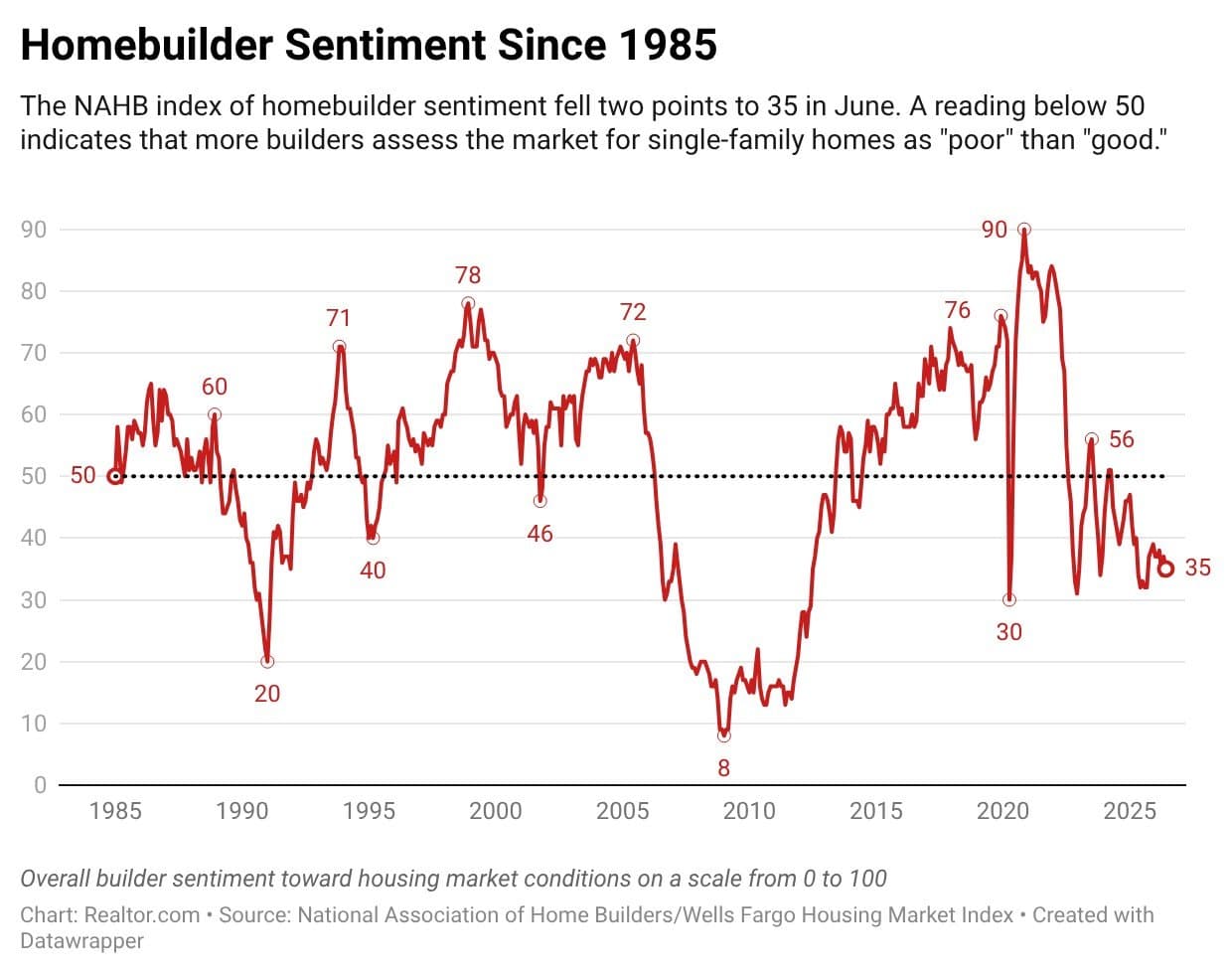
After a brief and hopeful uptick in May, homebuilder sentiment has reversed course, sliding two points to a reading of 35 in June 2026, according to the latest National Association of Home Builders (NAHB)/Wells Fargo Housing Market Index (HMI). The June reading extends what has become one of the most prolonged stretches of builder pessimism in recent memory — 14 consecutive months below 40 — a streak not recorded since the foreclosure crisis of 2011 and 2012. For prospective homebuyers, builders, and real estate professionals, the data paints a sobering picture of a housing sector caught between stubborn affordability barriers and a structural supply shortage that shows little sign of easing.
What the NAHB Housing Market Index Actually Measures
The NAHB/Wells Fargo Housing Market Index is one of the most closely watched gauges of sentiment in the residential construction sector. Released monthly, the index surveys home builders on current sales conditions, expected sales over the next six months, and buyer traffic in new-home developments. Scores are compiled on a scale from 0 to 100, with any reading below 50 indicating that more builders view market conditions as poor rather than good. A score of 35 doesn't just reflect caution — it reflects an industry that is broadly struggling to find a footing in a challenging economic environment.
The Dual Pressure of High Mortgage Rates and Rising Costs
Two forces continue to dominate the conversation among homebuilders: persistently elevated mortgage rates and the rising cost of building materials. Together, these headwinds are creating a difficult equation for both builders and buyers.
Elevated Mortgage Rates Suppress Buyer Demand
Mortgage rates remain a central villain in the housing market story of 2026. Higher borrowing costs have priced a significant portion of would-be buyers out of the market, reducing foot traffic in new home communities and weakening demand for new construction. When buyers can't qualify for or afford the monthly payments on a new home, builders are left holding unsold inventory, which in turn discourages new development starts. This demand-side pressure is compounding an already fragile situation for the industry.
Material Costs Keep Squeezing Builder Margins
On the supply side, the cost of building materials continues to climb, eating into builder profit margins and forcing difficult decisions about project viability. From lumber and concrete to fixtures and finishes, the price of constructing a home remains well above historical norms. For smaller and mid-size builders in particular, these cost pressures can make the difference between breaking ground on a new development and shelving it indefinitely. The result is fewer new homes being built at a time when the country desperately needs more supply.
America's Housing Shortage: A 1.2 Million Home Deficit
The current malaise in builder sentiment doesn't exist in a vacuum. The United States is grappling with a widely documented housing shortage that NAHB Chairman Bill Owens estimates at approximately 1.2 million homes. This deficit has been building for years, driven by a combination of underbuilding following the 2008 financial crisis, population growth, and zoning restrictions that limit where and how densely new housing can be constructed.
"With the nation short about 1.2 million homes, builder sentiment will remain soft until barriers are eased and conditions improve for home building," said Owens. His remarks underscore a critical point: the current slump in builder confidence is not just a reflection of market cycles — it is also a symptom of deeper, structural constraints that policy interventions may be necessary to address.
What Lawmakers Could Do to Help
Industry leaders are increasingly calling on Congress to take concrete steps to ease the burden on homebuilders and stimulate new residential construction. NAHB Chairman Owens specifically pointed to several pieces of pending legislation as potential game-changers for the industry.
- The 21st Century Road to Housing Act: A major housing package currently before the Senate that aims to reduce regulatory hurdles and expand housing supply at the national level.
- The CONSTRUCTS Act: Legislation designed to address the persistent construction labor shortage that has hampered the industry's ability to ramp up production even when economic conditions permit.
- The Energy Choice Act: A proposal to prevent state and local governments from banning natural gas in newly built homes, which builders argue would add flexibility and reduce construction costs in certain markets.
Whether Congress acts on these measures — and how quickly — will play a meaningful role in determining how long the current downturn in builder confidence persists.
What This Means for the Housing Market in 2026
The implications of prolonged low builder confidence extend well beyond the construction sector. When builders pull back on new projects, the supply of available homes tightens further, which puts upward pressure on home prices even as demand softens. This creates a paradox where affordability worsens even in a cooling market — buyers face high prices on existing homes and limited new construction options, while sellers are reluctant to list and give up their lower locked-in mortgage rates.
For prospective buyers, the current environment underscores the importance of working with knowledgeable real estate professionals who can navigate a complex and fast-moving landscape. Opportunities do exist, particularly in markets where builders are offering incentives such as mortgage rate buydowns or closing cost assistance to move inventory. Buyers who are financially prepared and flexible on location may find pockets of relative value even as headline conditions remain challenging.
Looking Ahead: When Will Builder Confidence Recover?
Most housing economists and industry observers agree that a meaningful and sustained recovery in builder confidence will require a combination of factors: a notable decline in mortgage rates, stabilization or reduction in material costs, and meaningful progress on the regulatory and legislative fronts. Until those conditions align, readings below 50 on the HMI are likely to remain the norm rather than the exception.
The 14-month streak of sub-40 sentiment readings is a stark reminder that the U.S. housing market is navigating an exceptionally difficult period — one shaped by forces that no single policy lever can fully resolve. For builders, buyers, and policymakers alike, the June 2026 NAHB data is a call to action: the conditions that are suppressing new home construction are real, measurable, and consequential, and they demand thoughtful, coordinated responses at every level of government and industry.