
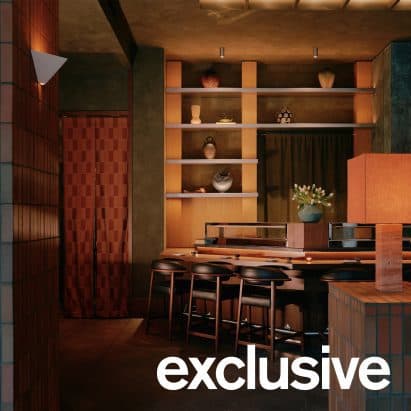
Islyn Studio Brings Neo-Noir Urbanism to Uchi DC's Japanese Restaurant Interior
When New York-based design firm Islyn Studio was tasked with creating the interiors for Uchi DC, the team didn't simply reach for the usual repertoire of Japanese restaurant aesthetics. Instead, they looked outward — to the monumental stone facades of Washington DC's New Formalist architecture and the atmospheric glow of late-night Tokyo — to forge something altogether more unexpected. The result is a dining environment that pulses with what the studio has described as "neo-noir urbanism," a concept that marries cinematic shadow with urban sophistication in one of the capital's most anticipated restaurant openings.
What Is Neo-Noir Urbanism in Interior Design?
The term "neo-noir urbanism" may sound like something pulled from a film studies lecture, but in the context of Uchi DC, it translates into a very tangible spatial language. Neo-noir as a visual genre is defined by dramatic contrasts between light and dark, a brooding atmosphere, and an underlying tension between beauty and edge. When applied to interior design — particularly in a hospitality setting — it means leaning into deep tones, carefully controlled lighting, layered textures, and a sense of place that feels simultaneously intimate and cinematic.
Islyn Studio has channeled this aesthetic into every corner of Uchi DC, creating a space that feels as if it exists somewhere between a high-end Tokyo izakaya and the marble-clad halls of a mid-century DC government building. The tension between those two references is precisely what gives the space its character.
Drawing Inspiration from Washington DC's New Formalist Architecture
Washington DC is a city defined by its architecture. From the neoclassical grandeur of the National Mall to the Brutalist concrete of the J. Edgar Hoover Building, the capital has always worn its civic ambition on its sleeve. It is New Formalism, however — that mid-20th-century movement that blended classical forms with modernist simplicity — that caught Islyn Studio's eye.
New Formalist buildings, found throughout DC and exemplified by structures like the Kennedy Center, are characterized by their use of repetitive arched or columnar forms, clean geometric lines, and a sense of monumental scale achieved through relatively restrained ornamentation. They feel both ancient and thoroughly modern at once. Islyn Studio has translated this sensibility into Uchi DC's interiors through strong geometric frameworks, an emphasis on materiality, and a spatial rhythm that recalls the ordered grandeur of civic architecture without ever feeling stiff or institutional.
The result is a dining room with a backbone — a structural confidence that grounds what could otherwise feel like a purely atmospheric exercise in mood lighting. Guests sense the weight of the space even before they consciously register its architectural references.
Late-Night Tokyo as a Design Blueprint
If Washington DC's New Formalism provides the bones of Uchi DC's design, then late-night Tokyo supplies the flesh. Japan's capital after dark is a world unto itself — a city of neon-lit alleyways, intimate counter-seating bars, and the kind of concentrated sensory experience that makes every meal feel like a ritual. Islyn Studio has drawn on this nocturnal energy to infuse Uchi DC with warmth, intimacy, and a sense of hushed intensity.
This Tokyo influence manifests in the restaurant's approach to scale and enclosure. Rather than opening up the space into the kind of soaring, see-and-be-seen dining room that many high-profile restaurant openings favor, the designers have created zones of intimacy within the larger whole. Lighting plays a critical role here — pools of warm light define individual dining areas, while darker transitions between spaces create a sense of journey and discovery as guests move through the restaurant.
Materials, too, carry the Tokyo imprint. Textures are tactile and considered, evoking the worn wood of a beloved ramen counter or the brushed metal of a precision sushi bar. Nothing feels gratuitously luxurious, yet everything communicates care and intentionality — qualities that are quintessentially Japanese in their design philosophy.
Islyn Studio's Design Philosophy at Work
Founded in New York, Islyn Studio has built a reputation for hospitality and residential interiors that resist easy categorization. Their work tends to sit at intersections — between eras, between cultures, between moods. Uchi DC is a particularly strong expression of this approach, demonstrating the studio's ability to hold two very different sets of references in productive dialogue without allowing either to dominate.
This is no small feat. Restaurant interiors that attempt to blend cultural references risk producing spaces that feel confused or superficial. What elevates Islyn Studio's approach at Uchi DC is the depth of the conceptual framework underlying the design choices. Neo-noir urbanism isn't simply a mood board descriptor; it is a genuine design brief that has generated consistent decisions across architecture, lighting, materials, and furniture.
Uchi DC in Context: A Restaurant Brand with Design Ambitions
Uchi DC represents Islyn Studio's second collaboration with the Uchi restaurant brand, underlining a relationship built on shared ambitions around design-led dining experiences. The Uchi brand, known for its innovative Japanese-inspired cuisine, has long understood that the physical environment is as integral to the dining experience as the food itself. Inviting Islyn Studio to shape the Washington DC outpost signals a commitment to design as a genuine differentiator in a city with an increasingly competitive restaurant landscape.
- The design draws on DC's New Formalist architectural heritage for structural gravitas and geometric precision.
- Late-night Tokyo aesthetics inform the restaurant's approach to intimacy, lighting, and material texture.
- The overarching concept of neo-noir urbanism ties these references into a cohesive, cinematic spatial experience.
- Islyn Studio's approach prioritizes depth of concept over surface-level decoration, resulting in an interior that rewards extended engagement.
- Uchi DC marks the second collaboration between Islyn Studio and the Uchi restaurant group, reflecting a mature and productive design partnership.
Why Neo-Noir Restaurant Design Matters Right Now
The emergence of neo-noir aesthetics in upscale restaurant design reflects a broader cultural shift. After years dominated by bright, Instagram-optimized interiors — blush pinks, exposed Edison bulbs, whitewashed walls — diners and designers alike are gravitating toward spaces with more psychological depth. Darkness, properly deployed, creates intimacy. It slows the pace of a meal and encourages conversation. It signals that a restaurant is interested in experience rather than mere visibility.
Uchi DC, as shaped by Islyn Studio, is a confident statement in favor of that kind of depth. It is a space that earns its atmosphere through rigorous design thinking rather than shortcut aesthetics. In combining the civic weight of Washington DC's architectural legacy with the sensory precision of Tokyo's nighttime dining culture, the studio has created a restaurant that is firmly rooted in its location while reaching toward something more universal — the timeless appeal of a beautifully made place that makes you want to linger long after the last course has been cleared.