
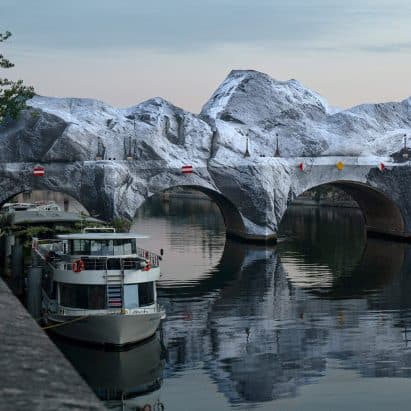
JR's Monumental Inflatable at Pont Neuf Hits a Windswept Roadblock
Paris has long served as a canvas for some of the world's most ambitious public art installations, and French artist JR — the internationally celebrated street artist and photographer known for his large-scale paper paste-ups — was set to add another unforgettable chapter to that story. His latest project, a massive inflatable structure titled La Caverne du Pont Neuf, was scheduled to open at the iconic Pont Neuf bridge in the heart of the French capital. However, strong winds have caused damage to the installation, pushing back its public opening and leaving Paris's art community eagerly waiting.
What Is La Caverne du Pont Neuf?
La Caverne du Pont Neuf, which translates to "The Cave of the New Bridge," is a site-specific inflatable architectural installation designed by JR in collaboration with a team of engineers and architects. The structure is conceived as an immersive, cave-like environment that visitors can physically enter and explore — a bold departure from the flat, two-dimensional paste-up murals that first brought JR global recognition.
The installation is positioned at Pont Neuf, Paris's oldest standing bridge, which crosses the Seine River and sits between the Île de la Cité and the city's Left and Right Banks. The symbolic choice of location is no accident: Pont Neuf has historically been a gathering point for Parisians and visitors alike, making it an ideal venue for a public art experience intended to engage the broadest possible audience.
JR has described the project as an exploration of memory, history, and the hidden layers beneath a city's surface — themes consistent with his broader artistic practice, which often investigates forgotten or overlooked communities and spaces. The inflatable's cave-like form plays on the idea of an underground world lurking beneath one of Paris's most famous landmarks, inviting viewers to step inside and reimagine what lies below the stones they walk upon every day.
Wind Damage Causes Opening Delays
In the days leading up to the installation's scheduled public debut, strong winds swept through Paris and inflicted damage on the inflatable structure. Inflatable architecture, while visually striking and highly flexible in terms of form, is inherently vulnerable to adverse weather conditions — particularly high winds, which can stress the material membranes, compromise the structural anchoring systems, and risk deflation or tearing.
The team behind La Caverne du Pont Neuf confirmed that repairs were necessary before the installation could safely open to the public. While specific details about the extent of the damage were not fully disclosed, the delay underscored the logistical and technical challenges of staging a large-scale inflatable artwork in an exposed, open-air urban environment alongside one of the world's most visited rivers.
Fans of JR's work and Paris art enthusiasts who had been anticipating the opening were understandably disappointed, though the artist's team moved quickly to reassure the public that the installation would open as soon as the repairs were completed and safety could be guaranteed.
JR: A Brief Portrait of the Artist
For those unfamiliar with JR's practice, understanding the scale of ambition behind La Caverne du Pont Neuf requires some context. JR rose to international prominence through projects like Women Are Heroes, which celebrated women in communities affected by conflict and poverty across Africa, India, Brazil, and Cambodia, and Inside Out, a global participatory project that invited ordinary people to post large-scale photographic portraits in their own communities.
His work has appeared on the walls of favelas in Rio de Janeiro, on the streets of New York, across the border fence between the United States and Mexico, and on the facades of the Louvre Museum in Paris — where his 2016 installation created the illusion that the museum's famous glass pyramid was sinking into the surrounding courtyard. That project, like many of his others, went viral and demonstrated his unique ability to merge photography, architecture, and public space into experiences that resonate far beyond the art world.
With La Caverne du Pont Neuf, JR moves further into three-dimensional, inhabitable space — a natural evolution for an artist who has consistently pushed the boundaries of what street art can be and where it can exist.
The Growing Role of Inflatable Architecture in Public Art
La Caverne du Pont Neuf is part of a broader trend in contemporary art and design that embraces inflatable structures as a medium for large-scale public engagement. Inflatable architecture offers several compelling advantages:
- It can be erected and dismantled relatively quickly compared to traditional built structures, making it ideal for temporary installations in sensitive urban or heritage environments.
- It allows artists and architects to create forms that would be structurally impossible or prohibitively expensive to realize in conventional materials.
- Its soft, rounded aesthetic contrasts dramatically with the hard stone and metal of most urban environments, creating an immediate and arresting visual impact.
- It is inherently accessible and non-threatening in appearance, which encourages a broad cross-section of the public to engage with it.
However, as JR's project demonstrates, inflatable structures also carry real vulnerabilities. Weather resilience is a significant engineering concern, particularly for installations sited in open, riverside locations where wind speeds can be unpredictable and powerful.
What Visitors Can Expect When the Installation Opens
Once La Caverne du Pont Neuf is repaired and ready to receive the public, visitors will be able to enter the inflatable structure and experience it from the inside — an immersive environment designed to evoke the sensation of moving through a subterranean cave beneath the ancient stones of Pont Neuf. JR's installations typically incorporate his signature photographic imagery, and this project is expected to be no different, with large-scale printed visuals lining the interior walls of the structure.
The installation is intended as a free and open public experience, consistent with JR's longstanding commitment to making art accessible to everyone regardless of socioeconomic background. Given the artist's global following and the prominent location of Pont Neuf, La Caverne du Pont Neuf is expected to attract significant foot traffic once it officially opens.
Paris as a Stage for Ambitious Public Art
The temporary delay caused by wind damage does little to diminish the significance of what JR is attempting at Pont Neuf. If anything, the challenges of staging such an ambitious project in one of the world's most iconic urban landscapes only underscore the audacity of the vision. Paris has a rich tradition of hosting transformative public art installations — from Christo and Jeanne-Claude's wrapping of the Pont Neuf itself in 1985 to the annual FIAC outdoor art fair along the Champs-Élysées — and La Caverne du Pont Neuf looks set to earn its place among that legacy.
Art lovers, architecture enthusiasts, and Paris visitors are advised to keep a close eye on official updates from JR's team for the revised opening date. When the cave beneath the bridge finally opens its inflatable doors, it promises to be one of the most talked-about cultural events in the French capital this year.