
Louisville's Housing Market Is Heating Up — But Not in the Way You'd Expect
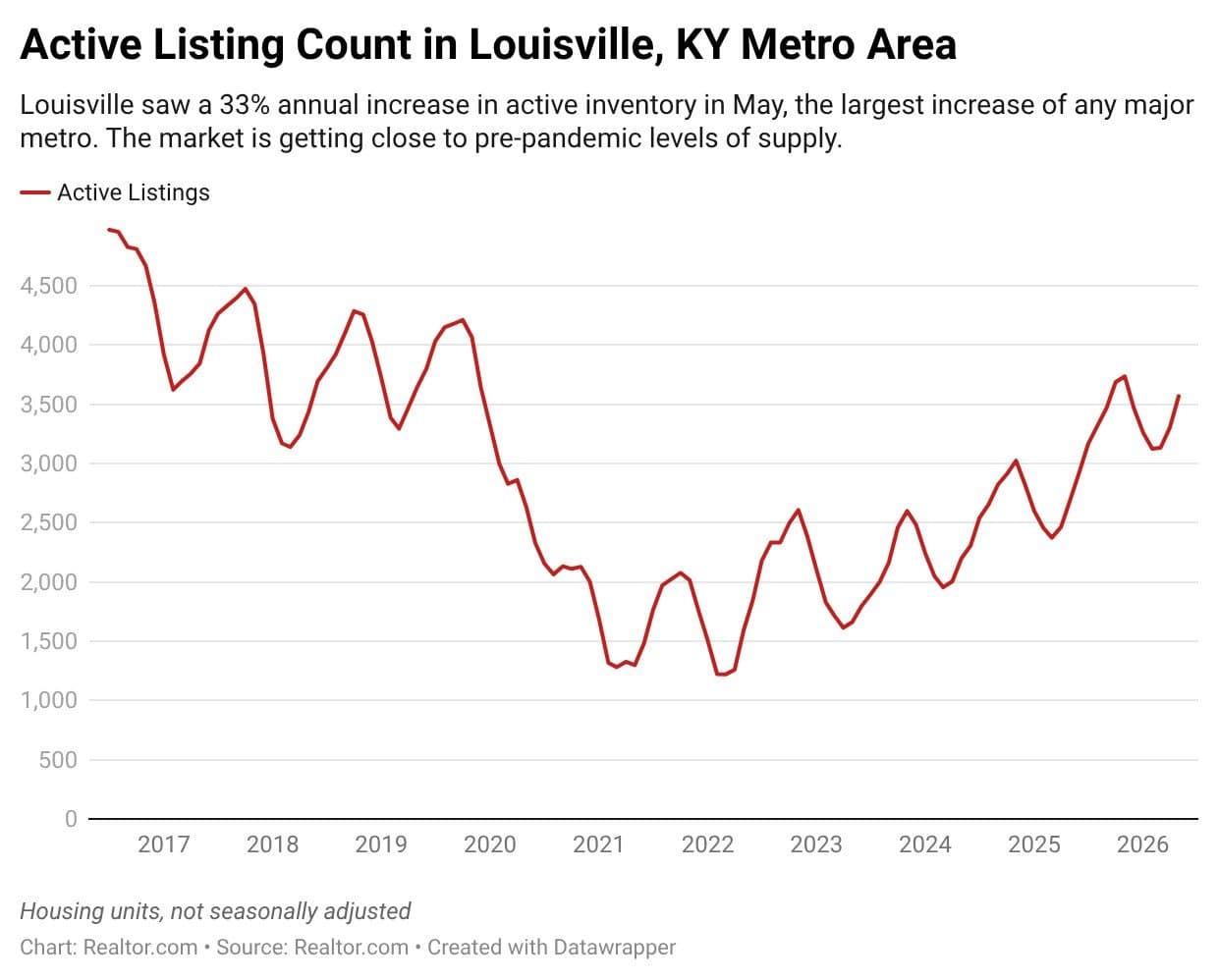
When most people think of Louisville, Kentucky, they picture horse racing, bourbon, and the legendary Kentucky Derby. But right now, the city is making headlines for something entirely different: a dramatic surge in homes hitting the market. According to the Realtor.com May 2026 housing report, Louisville posted the highest year-over-year inventory increase of any major metropolitan area in the United States, with available homes rising a staggering 32.7% compared to the same period last year.
To put that number in perspective, the national inventory increase during the same period was just 2.2%, and the broader South region managed only a 0.3% uptick. Louisville isn't just outpacing its neighbors — it's lapping the entire country. So what exactly is driving this surge, and what does it mean if you're buying or selling a home in the Louisville area? Let's break it all down.
What's Behind the Inventory Explosion in Louisville?
Real estate experts are pointing to a healthy and long-overdue market correction rather than a cause for alarm. According to Realtor.com senior economist Jake Krimmel, the surge in available homes represents a return to pre-pandemic norms rather than a signal of economic distress or a collapsing market.
"It looks like the market is in balance with a recent run-up and normalization in both supply and demand," Krimmel explained. "The market is getting more active compared to last year without big price swings, which is a great sign."
During the pandemic-era housing boom, inventory across the country dried up dramatically. Sellers held back, buyers competed furiously, and home prices skyrocketed in markets large and small. Now, in cities like Louisville, sellers who have been sitting on the sidelines are finally stepping back in — and doing so with confidence. The result is a healthier, more balanced marketplace where both buyers and sellers can operate without the extreme pressure that defined the post-pandemic years.
Home Prices Are Slightly Down — But Demand Remains Strong
One of the most telling indicators of a well-functioning housing market is the relationship between supply and demand. When inventory rises sharply, many observers worry that prices will tumble and buyer interest will evaporate. In Louisville, that simply hasn't happened.
Yes, the median list price in Louisville did dip slightly — down about 2% year-over-year to $319,900. That modest softening is entirely consistent with a market that is rebalancing after years of outsized price growth. But here's the number that really matters: pending home sales in Louisville are actually up 5% year-over-year.
"Buyers didn't disappear when more homes came online," Krimmel noted. That's a critical distinction. In a distressed market, rising inventory typically signals waning buyer demand — homes pile up because no one wants them. In Louisville, the opposite is true. More homes became available, and buyers showed up to purchase them. That dynamic points to a genuine, organic recovery in market activity rather than a slowdown.
What This Means for Homebuyers in Louisville
If you've been waiting for the right moment to buy a home in Louisville, the current market conditions offer some of the most favorable circumstances in recent memory. Here's what today's buyers can expect:
- More choices: With inventory up nearly 33%, buyers have significantly more homes to consider than they did a year ago. The days of making a rushed offer on the first available home are fading fast in Louisville.
- Slightly softer prices: The 2% dip in median list prices — bringing the typical home to around $319,900 — means buyers are entering the market at a slightly more affordable price point than in previous months.
- Less competition: Greater inventory naturally reduces the intense bidding wars that plagued many Louisville neighborhoods during the height of the seller's market. Buyers can take a bit more time to evaluate their options and negotiate terms.
- Stable market signals: The lack of dramatic price swings, combined with rising pending sales, suggests the Louisville market is on solid footing — a reassuring sign for buyers who worry about purchasing at the peak.
What This Means for Home Sellers in Louisville
Sellers returning to the Louisville market are doing so in an environment that, while more competitive than a year ago, is still fundamentally healthy. Here's what sellers should keep in mind:
- Price your home strategically: With more inventory on the market, buyers have options. Overpricing is a greater risk today than it was two years ago. Homes priced accurately and competitively are still moving — as evidenced by the 5% rise in pending sales.
- Presentation matters more: In a balanced market, buyers are less likely to overlook cosmetic issues. Investing in staging, professional photography, and minor repairs can make a meaningful difference in how quickly your home sells.
- The buyers are out there: Despite the inventory surge, demand has not collapsed. Qualified, motivated buyers are actively searching for homes in Louisville — which means well-positioned listings are still finding willing purchasers.
Louisville in a National Context: Why This Market Stands Out
The Louisville housing market's performance is particularly striking when viewed against the national backdrop. While most major metros are experiencing only marginal inventory changes, Louisville's 32.7% surge puts it in a category of its own. This could reflect a combination of factors unique to the city: a growing local economy, an influx of remote workers attracted by Louisville's relative affordability, and a wave of longtime homeowners finally feeling comfortable enough to list after years of hesitation.
Louisville's median list price of $319,900 also keeps the city well within reach for a broad range of buyers, particularly compared to coastal metros where median prices often exceed $600,000 or more. That affordability advantage, paired with increasing supply, could make Louisville one of the most attractive mid-sized housing markets in the country heading into the second half of 2026.
The Bottom Line: A Market Finding Its Footing
Louisville's 33% inventory surge is big news — but it's good news. The data tells the story of a market that is rebalancing thoughtfully, with sellers returning, buyers staying engaged, and prices remaining relatively stable. For anyone considering a move to or within Louisville, the current conditions represent a window of opportunity that may not last forever.
As Jake Krimmel put it, the market is getting more active without big price swings. In the world of real estate, that's about as close to a best-case scenario as it gets. Whether you're a first-time buyer, a move-up seller, or a real estate investor, Louisville deserves a serious look right now.