
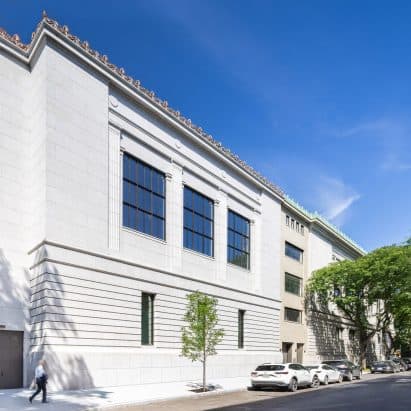
RAMSA Completes the Tang Wing at the New-York Historical Society
Robert A.M. Stern Architects (RAMSA) has completed the Tang Wing, a major new addition to the New-York Historical Society museum on Central Park West in Manhattan. Dedicated to exploring the story of American democracy, the extension represents one of the most carefully considered museum expansions in New York City in recent years — a project that demanded both architectural sensitivity and a deep respect for one of the city's most beloved cultural landmarks.
The completion of the Tang Wing marks a significant milestone not only for the institution, which is the oldest museum in New York City, but also for the broader conversation about how contemporary architects should approach the challenge of expanding historic buildings. RAMSA, the firm founded by Robert A.M. Stern and known for its commitment to contextual, classically informed design, has delivered a building that manages to feel both new and entirely at home alongside its historic neighbor.
Designing in Dialogue: Contextual Architecture on Central Park West
Few architectural commissions in New York City carry as much pressure as an addition to a landmark building on Central Park West. The New-York Historical Society's original Beaux-Arts structure, designed by York and Sawyer and completed in 1908 with later additions through the mid-twentieth century, presents a stately limestone facade that has defined this stretch of the Upper West Side for more than a century. Any new addition had to respond to this legacy without mimicking it superficially or clashing with it aggressively.
RAMSA approached the challenge by designing the Tang Wing as a respectful continuation of the existing building's classical vocabulary. The firm employed limestone cladding, carefully proportioned windows, and a massing strategy that steps down in scale as it moves away from the historic structure, ensuring that the original building retains its visual primacy along the streetscape. The result is an addition that reads as coherent and purposeful — an expansion, not an interruption.
This philosophy of contextual sensitivity has long been central to RAMSA's practice. In an era when many architectural firms seek to contrast boldly with historic surroundings as a statement of contemporary identity, RAMSA has consistently argued that the most respectful — and ultimately the most successful — approach is to work within and extend an existing architectural language rather than repudiate it. The Tang Wing is perhaps the firm's most prominent recent demonstration of this conviction.
The Tang Wing and the Story of American Democracy
The Tang Wing is not simply a gallery expansion; it is a purpose-built home for the New-York Historical Society's landmark initiative dedicated to the history and ongoing story of American democracy. The wing provides the museum with dedicated, state-of-the-art spaces to display and interpret its extraordinary collections relating to American political history, civic life, and the long, contested struggle to define and expand democratic participation in the United States.
Inside, the architecture supports this mission through a sequence of spaces designed to move visitors through the narrative of American democratic life. Grand public rooms establish a civic character appropriate to the subject matter, while more intimate gallery spaces allow for focused engagement with individual objects, documents, and stories. The interior design reflects RAMSA's belief that architecture itself can communicate meaning — that the scale, materiality, and sequence of spaces can reinforce the significance of what is displayed within them.
The wing also incorporates flexible programming spaces, allowing the museum to host lectures, debates, educational events, and community gatherings that keep the institution's democratic mission alive as an active civic practice rather than simply a historical subject. In this sense, the Tang Wing functions as both a museum and a public forum, a space for reflection on the past and engagement with the present.
Technical Excellence and Curatorial Infrastructure
Beyond its public-facing spaces, the Tang Wing provides the New-York Historical Society with significantly upgraded infrastructure for the care and preservation of its collections. New climate-controlled storage, expanded conservation facilities, and improved loading and logistics systems ensure that the museum can meet the highest modern standards for the stewardship of its irreplaceable holdings, which include manuscripts, paintings, decorative arts, and historical artifacts spanning more than three centuries of American history.
The addition also improves circulation and accessibility throughout the museum complex, creating clearer connections between the new wing and the existing building and making the full breadth of the institution's collections more legible and navigable for visitors. Elevators, accessible entrances, and thoughtfully designed wayfinding all contribute to a more welcoming and inclusive visitor experience.
A Model for Museum Expansion in Historic Contexts
The Tang Wing arrives at a moment when institutions across the country are grappling with how to grow and modernize without losing their architectural identity or their relationship with their communities. The pressure to make bold architectural statements — to signal relevance through dramatic formal gestures — can be powerful, but it is not always the right answer, particularly for institutions whose authority rests on their deep roots in place and history.
RAMSA's approach at the New-York Historical Society offers a compelling alternative model: one in which growth is understood as continuity rather than rupture, and in which new architecture serves the institution's mission rather than competing with it for attention. The Tang Wing demonstrates that sensitivity and ambition are not mutually exclusive — that it is possible to build something genuinely new and forward-looking while also honoring what came before.
Looking Ahead: The New-York Historical Society's Future
With the completion of the Tang Wing, the New-York Historical Society enters a new chapter in its more than two-hundred-year history. The expanded museum is better equipped than ever to fulfill its mission of preserving and interpreting the history of New York and the nation, and to engage new generations of visitors with the stories and artifacts that illuminate how American democracy has been built, challenged, and renewed over time.
For RAMSA, the project adds another distinguished chapter to the firm's long record of contextual institutional architecture in New York and beyond. And for the city itself, the Tang Wing is a welcome reminder that thoughtful, humane architecture — architecture that listens as well as speaks — has a vital and enduring role to play in shaping the public life of great cities.