
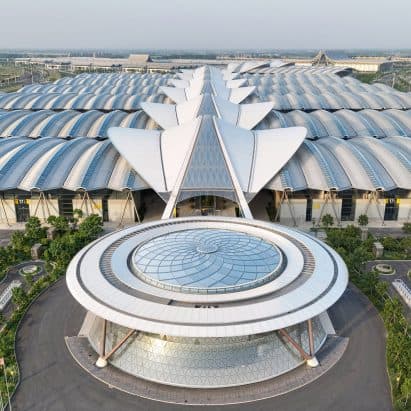
RSHP Unveils Ambitious Convention Centre in Central China Anchored by a Mile-Long Walkway
London-based architectural practice RSHP — formerly known as Rogers Stirk Harbour + Partners — has revealed its landmark design for the Central China International Convention and Exhibition Centre, a sprawling complex that takes its organizational cue from a single, unifying element: a pedestrian walkway stretching approximately one mile in length. The project represents one of the firm's most ambitious undertakings in Asia, blending monumental civic scale with a distinctly human-focused design philosophy.
Convention and exhibition centres of this magnitude are notoriously difficult to navigate. Their sheer size can render them disorienting and impersonal, prioritizing logistics over the experience of the people moving through them. RSHP's solution is elegant in its clarity — by threading a continuous, covered walkway through the heart of the complex, the design creates a legible spine from which all major functions radiate, giving visitors a constant sense of orientation and connection throughout the venue.
A Design Philosophy Rooted in Connectivity and Human Scale
RSHP has long been associated with bold structural expression and a commitment to making large-scale buildings feel accessible and transparent to the public. Projects like the Pompidou Centre in Paris — co-designed by Richard Rogers and Renzo Piano — established the practice's reputation for turning architecture inside out, exposing structure and services to celebrate the act of inhabitation. The Central China International Convention and Exhibition Centre continues in this tradition, using the mile-long walkway not merely as a circulation route but as a social and architectural statement.
The walkway functions as the project's primary organizing principle. Rather than dividing the complex into separate, siloed buildings connected by service roads or enclosed corridors, RSHP has conceived the entire development as a coherent urban landscape. Exhibition halls, conference rooms, banquet facilities, and support spaces are all arranged in relation to this central promenade, ensuring that the journey through the building is itself a meaningful experience rather than a logistical necessity.
This approach also responds to the growing expectation that large civic and commercial buildings must serve as genuine places — spaces where people want to linger, gather, and engage — rather than simply functional containers for scheduled events. The walkway creates opportunities for informal interaction, spontaneous encounters, and a sense of civic life that distinguishes the centre from more conventional convention facilities.
Scale, Structure, and the Central China Context
The Central China International Convention and Exhibition Centre is located in one of China's most dynamic and rapidly developing regions. Central China has seen significant investment in infrastructure and public facilities over recent decades, with convention and exhibition centres playing a key role in attracting international business, trade fairs, and cultural events. A venue of this scale and architectural ambition signals the region's aspirations on a global stage.
At approximately one mile in length, the walkway alone underscores the sheer enormity of the project. Convention centres of comparable size — such as the National Exhibition and Convention Center in Shanghai or the Shenzhen World Exhibition and Convention Center — have set a high bar for programmatic complexity and visitor capacity. RSHP's design responds to this context by prioritizing clarity and wayfinding, ensuring that even first-time visitors can navigate the complex with confidence.
The structural approach is also likely to reflect RSHP's characteristic preference for expressive, legible engineering. The practice has consistently favoured structural systems that are honest about how a building stands up and how it functions, often celebrating columns, trusses, and roof systems as architectural features in their own right rather than concealing them behind decorative cladding.
Sustainability and the Future of Large-Scale Convention Architecture
Large convention and exhibition centres present considerable sustainability challenges. Their energy demands are substantial, their use patterns are often irregular, and their sheer footprint can have significant implications for local urban environments. A well-considered design strategy is therefore not just an aesthetic concern but a practical and environmental imperative.
RSHP's walkway-centred approach has inherent sustainability benefits. By creating a coherent internal street rather than a series of separate structures, the design reduces duplicated circulation infrastructure and encourages more efficient movement of people and goods throughout the complex. A continuous covered route can also be designed to harness natural light and ventilation, reducing reliance on artificial systems and contributing to a more comfortable internal environment across all seasons.
The project also reflects a broader shift in how architects and clients are thinking about convention and exhibition facilities. Where earlier generations of these buildings were designed primarily around the needs of exhibitors and event organisers — prioritising loading access, floor load capacity, and column-free spans — contemporary projects increasingly factor in the quality of the visitor experience, the relationship between the building and its surrounding urban fabric, and the long-term adaptability of the spaces themselves.
RSHP's Growing Presence in China and Asia
The Central China International Convention and Exhibition Centre adds to a significant portfolio of work that RSHP has developed across Asia in recent years. The practice has completed and designed projects in China, South Korea, and beyond, engaging with some of the most complex and large-scale briefs in contemporary architecture. Each project has allowed the firm to refine and evolve its signature approach — combining rigorous structural logic with a genuine commitment to the public realm and the quality of everyday experience.
The mile-long walkway at the heart of this new convention centre is perhaps the clearest expression yet of what RSHP believes large architecture can and should do: not overwhelm the individual, but guide, connect, and inspire them. In a building that could easily feel like a city in itself, that single organizing gesture makes all the difference.
What This Project Means for Convention Centre Design Globally
As cities around the world continue to invest in large-scale convention and exhibition infrastructure, the Central China International Convention and Exhibition Centre offers a compelling model for how ambition and human sensitivity can coexist. The use of a mile-long walkway as a primary design strategy is a bold and instructive choice — one that will likely influence how architects and developers approach similar projects in the years ahead. RSHP has once again demonstrated that the largest buildings need not be the least human, and that clarity of concept, expressed through a single powerful move, can give even the most complex programme a genuine sense of place.