
Where Art Meets Function: SCAD's Most Inspiring Student Projects
Every year, the Savannah College of Art and Design (SCAD) produces some of the most forward-thinking graduates in the creative world. From interior design to industrial product development, SCAD students consistently push the boundaries of what design can be. This year's showcase is no exception, with a remarkable collection of student projects that blend fine art traditions with contemporary design sensibilities. Among the most talked-about pieces is a body of furniture work directly inspired by the luminous world of stained glass — a concept that bridges centuries of craftsmanship with the needs of modern living spaces.
Stained Glass as a Design Language for Furniture
Stained glass has long been celebrated as one of humanity's most visually arresting art forms. Its ability to transform light into color, to fracture the ordinary into something transcendent, has decorated cathedrals, civic buildings, and private homes for more than a thousand years. Now, SCAD students are translating that same visual grammar into three-dimensional, functional furniture objects — and the results are nothing short of breathtaking.
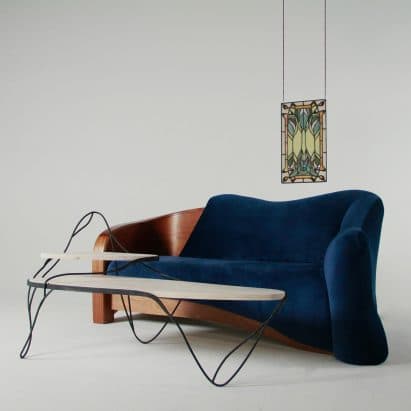
The project "Refracted Mind" by student Avery Gardner stands as a centerpiece of this stained glass-informed approach. Gardner's work draws on the geometric precision and prismatic color theory inherent to traditional stained glass artistry, translating lead lines and colored panes into the structural logic of furniture form. The pieces carry an ethereal quality — surfaces that seem to interact with light in ways that shift depending on the viewer's position and the ambient illumination in the room. This is furniture that does not just occupy space; it animates it.
What makes this design direction particularly compelling from an SEO and design industry perspective is its relevance to current interior design trends. Maximalist aesthetics, the revival of Art Nouveau references, and a broader cultural appetite for craftsmanship-infused interiors have all contributed to a renewed interest in stained glass motifs. Gardner's work arrives at precisely the right cultural moment.
SCAD's Design Philosophy: Interdisciplinary Thinking in Action
One of SCAD's most distinctive strengths as an institution is its encouragement of interdisciplinary thinking. Students are not siloed into narrow specializations; instead, they are actively pushed to draw connections between disciplines — between architecture and textile, between graphic design and spatial experience, between historical craft and contemporary manufacturing techniques.
This philosophy is clearly evident across the broader range of projects featured in this year's showcase. Other student works on display explore themes including:
- Sustainable material innovation, with students developing furniture and objects from reclaimed and bio-based materials that challenge conventional production norms.
- Sensory design for neurodiverse users, applying research-based approaches to create environments and objects that support a wider range of cognitive and sensory experiences.
- Digital fabrication combined with hand craft, using CNC routing, laser cutting, and 3D printing as tools that complement rather than replace traditional making skills.
- Cultural storytelling through object design, with several students drawing on their personal heritage and community histories to inform the conceptual foundations of their work.
Together, these projects paint a picture of a generation of designers who are not content to produce objects in a cultural vacuum. They are asking bigger questions — about identity, sustainability, accessibility, and beauty — and using design as the vehicle through which to explore those questions.
Why SCAD Continues to Lead in Design Education
Founded in 1978, the Savannah College of Art and Design has grown from a small regional institution into one of the most respected art and design universities in the world. With campuses in Savannah, Atlanta, Hong Kong, and Lacoste, France, as well as a robust online learning platform, SCAD offers its students an unparalleled breadth of cultural exposure and professional preparation.
SCAD's approach to design education is rooted in the belief that creative professionals must be both technically skilled and conceptually rigorous. Studio practice is complemented by coursework in design history, theory, business, and professional practice. Students graduate not just with strong portfolios, but with the vocabulary and strategic thinking required to navigate the contemporary creative economy.
The school also maintains an extensive network of industry partnerships, bringing working professionals into the classroom and placing students in internships and residencies with some of the world's leading design firms, brands, and cultural institutions. This connection to professional practice means that student work, even at the thesis or capstone level, is often developed with real-world constraints and opportunities in mind.
The Broader Significance of Student Design Showcases
Design school showcases like the one SCAD contributes to through platforms such as Dezeen School Shows serve a vital function in the broader design ecosystem. They introduce emerging talent to a global audience of professionals, collectors, journalists, and design enthusiasts. For students, exposure through these platforms can be genuinely career-defining — a single well-received project can lead to press coverage, gallery representation, or industry recruitment.
For the wider design community, these showcases offer a crucial window into where the field is heading. The themes, materials, processes, and aesthetic sensibilities that students are exploring today will shape the interiors, products, and public spaces of tomorrow. In that sense, paying attention to student work is not merely an act of admiration for youthful talent — it is a form of design forecasting.
Looking Ahead: The Future of Craft-Informed Design
The stained glass-inspired furniture emerging from SCAD is part of a broader movement in contemporary design that takes historical craft traditions seriously as sources of innovation rather than nostalgia. As the design industry continues to grapple with questions of sustainability, cultural meaning, and the role of human making in an increasingly automated world, the kind of thoughtful, research-led, craft-informed work that SCAD students are producing offers a genuinely hopeful direction.
Whether you are a design professional, an educator, a collector, or simply someone who cares about the built environment, keeping an eye on SCAD's graduating talent is well worth your attention. The next generation of design leaders is already at work — and if this year's showcase is anything to go by, the future of design is in very capable hands.