
Supreme Court Rules Auction Price Can Count as Just Compensation in Tax Foreclosure Cases
In a landmark unanimous decision, the United States Supreme Court has delivered a ruling that will significantly affect homeowners facing property tax foreclosure across the country. The case, Pung v. Isabella County, addressed one of the most contested questions in the ongoing battle against home equity theft: how much money is a homeowner owed when their home is seized and sold by a local government over unpaid taxes?
The court's answer was both definitive on one front and deliberately open-ended on another — and understanding both sides of that ruling could be critical for any homeowner worried about losing their property to a tax sale.
What Is Home Equity Theft and Why Does It Matter?
Home equity theft occurs when a local government seizes a home over an unpaid tax debt — sometimes as small as a few hundred or a few thousand dollars — sells the property at a tax foreclosure auction, and keeps the entire proceeds rather than returning the surplus to the homeowner. In many cases, homeowners lose tens or even hundreds of thousands of dollars in built-up equity, receiving nothing beyond the cancellation of their tax debt.
Advocates have fought to end this practice for years, arguing it violates the Fifth Amendment's requirement that the government pay "just compensation" whenever it takes private property. Several states have changed their laws in response to public pressure and court challenges, but the legal framework governing what homeowners are owed has remained unsettled — until now.
What the Supreme Court Decided in Pung v. Isabella County
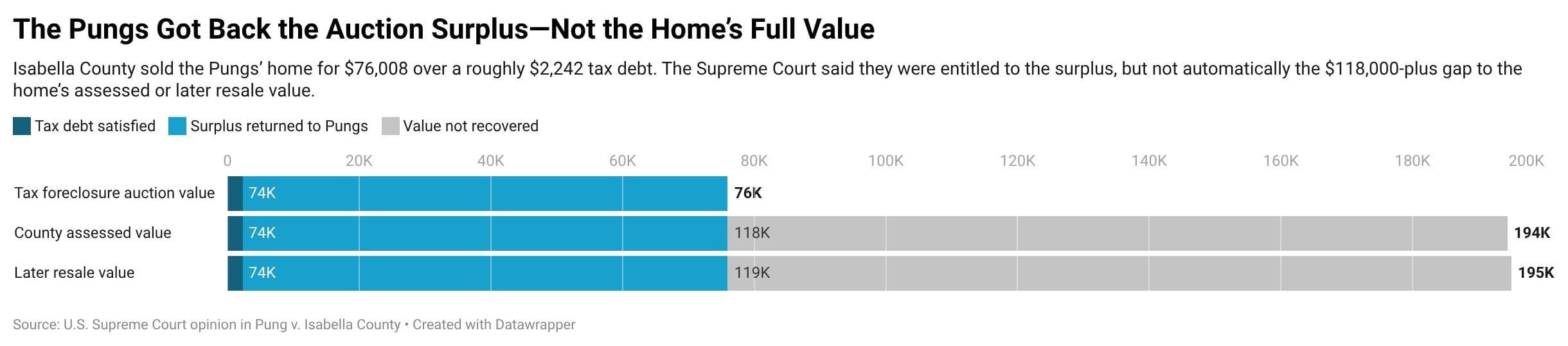
In a unanimous opinion authored by Justice Samuel Alito, the court held that the Constitution generally measures just compensation after a tax sale by the price the home actually fetches at auction — not by the higher amount it might have commanded in a conventional open-market real estate transaction.
This means homeowners whose properties are foreclosed and sold at a tax auction cannot automatically claim the difference between the auction sale price and an independent appraisal, a listing estimate, or a later resale price simply because the home changed hands through a foreclosure proceeding. If a home sells for $80,000 at a tax auction but was independently appraised at $200,000, the government is not automatically on the hook for the $120,000 difference under this ruling.
"The proper baseline for measuring 'just compensation' following a tax sale is the auction sale price, not the property's hypothetical fair market value," Justice Alito wrote, "at least when the sale is fairly conducted in light of the country's history of tax sales."
That final clause — "at least when the sale is fairly conducted" — is where the legal story becomes more complicated, and more hopeful for homeowner advocates.
The Critical Question the Court Left Unanswered
While the court settled the baseline compensation question, it deliberately stopped short of defining what makes a tax foreclosure sale "fair" in the first place. This omission was not accidental — it leaves open a potentially significant legal avenue that could shape the next phase of litigation around home equity theft.
If a tax sale is determined to have been conducted unfairly — whether due to lack of proper notice, limited competition among bidders, artificially low reserve prices, or other procedural shortcomings — it is now an open question whether homeowners could still argue that the auction price does not represent constitutionally adequate compensation, and that fair market value should apply instead.
This creates a two-tiered framework going forward. Homeowners and their attorneys will now need to scrutinize not just whether they received any proceeds, but whether the sale process itself met standards of fairness that the Supreme Court has yet to fully define. For advocates fighting home equity theft, that unresolved question is a new front in the legal battle.
What This Means for Homeowners Facing Property Tax Foreclosure
If you are behind on your property taxes or facing foreclosure, this ruling has several practical implications worth understanding.
- You cannot automatically claim fair market value. If your home sells at a tax auction for less than it is worth on the open market, the Supreme Court has made clear that the auction price is generally the legal measure of what you are owed — not the higher appraised or market value.
- The fairness of the sale still matters. Whether the auction was conducted properly, whether you received adequate notice, whether the process allowed for fair competitive bidding — these factors could determine whether you have additional legal recourse. Document everything related to your foreclosure process.
- State laws still vary widely. Several states have already reformed their tax foreclosure laws to require governments to return any surplus proceeds above the tax debt to the homeowner. If you live in one of those states, those protections remain in place regardless of this federal ruling.
- Legal counsel is essential. Given the complexity of this ruling and the open questions it leaves behind, anyone facing a tax foreclosure should consult a real estate attorney who understands both federal constitutional law and the specific rules in their state.
The Broader Impact on the Fight Against Home Equity Theft
Advocacy groups and property rights organizations have called the decision a setback, and on one level it clearly is. The ruling forecloses the argument that homeowners are automatically entitled to full fair market value simply because a tax auction fetched less than a conventional sale might have. That argument had been one of the movement's most powerful tools.
However, legal experts note that the court's refusal to define what constitutes a fair sale creates genuine strategic opportunity. Future litigation will almost certainly test the boundaries of that caveat, with advocates arguing that the structural features of many tax auction systems — including limited advertising, restricted bidder pools, and compressed timelines — make them inherently unfair and therefore unable to produce a constitutionally valid compensation price.
In other words, the fight is not over. It has simply moved to new terrain.
How to Protect Yourself from Home Equity Theft
Regardless of how courts continue to develop this area of law, the most effective protection against home equity theft begins long before a foreclosure auction ever takes place.
- Stay current on your property taxes and set up payment reminders or automatic payments if possible.
- If you fall behind, contact your local tax authority immediately — many counties offer payment plans, hardship deferrals, or exemption programs for eligible homeowners.
- Monitor any notices that arrive from your county or local government carefully, as tax foreclosure proceedings often begin with formal written notices that carry legal deadlines.
- Check whether your state has passed surplus proceeds laws that require the government to return equity above the tax debt to you if your home is sold.
- Consult a housing counselor or real estate attorney early, before the situation becomes urgent.
The Bottom Line
The Supreme Court's decision in Pung v. Isabella County narrows one major legal pathway for homeowners seeking compensation after a tax foreclosure sale, but it also preserves an important and as-yet undefined question about what makes such a sale fair. For millions of American homeowners — particularly seniors, low-income families, and others who have built significant equity in their homes over decades — the stakes in this ongoing legal battle could not be higher. Staying informed, staying proactive about property taxes, and understanding your rights under both federal and state law remain your most powerful tools.