
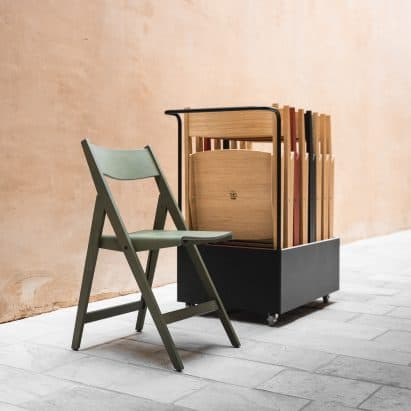
Theo Folding Chair: Matteo Thun and Benedetto Fasciana Redefine Functional Elegance for Plank
In the world of contemporary furniture design, few challenges are as deceptively complex as the folding chair. A piece that must collapse and expand with ease, hold up to daily use, and still look beautiful enough to remain on display rather than hidden in a closet — this is the brief that Matteo Thun and Benedetto Fasciana tackled head-on with the Theo folding chair for Italian manufacturer Plank. The result is a design that distills decades of craft knowledge and forward-thinking aesthetic sensibility into a single, quietly remarkable object.
A Design Collaboration with Deep Roots
Matteo Thun is one of Europe's most respected and prolific designers, known for work that consistently bridges the gap between industrial precision and warm, humanistic form. A founding member of the Memphis Group and a long-time collaborator with some of the most prestigious names in Italian and international design, Thun brings a rigorous philosophy to every project: that good design must serve people first, and announce itself second.
Benedetto Fasciana, his creative partner on this project, shares a similar commitment to restraint and purpose. Together, the duo has developed a design language for the Theo chair that feels both fresh and entirely considered. Nothing about the chair is gratuitous. Every curve, joint, and material choice has been weighed against the fundamental question of whether it genuinely improves the object or merely decorates it.
Plank, the South Tyrolean manufacturer that commissioned the piece, has long been associated with exactly this kind of disciplined, craft-forward production. Founded in the 1950s and based in the Bolzano area of northern Italy, Plank produces furniture that sits at the intersection of traditional woodworking knowledge and contemporary design ambition. Their roster of collaborators — which includes names like Patrick Norguet, Jasper Morrison, and now Thun and Fasciana — reflects a consistent commitment to work that endures.
What Makes the Theo Chair Stand Out
The Theo folding chair positions itself as something of a rarity: a folding chair that does not compromise on comfort, appearance, or structural integrity in the name of practicality. Folding furniture has historically carried something of a stigma in design circles, associated more with emergency seating solutions than with considered interiors. Theo works deliberately against that assumption.
The chair's profile is clean and upright, with a lightness that belies its solidity. The frame uses natural materials in a way that feels warm and approachable without veering into rusticity. The proportions are generous enough for genuine comfort over extended sitting, yet refined enough to hold their own in formal dining settings, lounge environments, or the kind of contemporary residential interiors where design objects are chosen with care.
The folding mechanism itself is handled with notable elegance. Rather than being the chair's most visible feature — as is often the case with folding furniture, where hinging hardware becomes unavoidable visual noise — the mechanism on Theo is integrated smoothly into the overall structure. When open, the chair reads simply as a well-designed chair. When folded, it collapses into a slim, stackable profile that can be stored vertically against a wall or tucked into a small footprint without effort.
Materials and Craftsmanship
True to Plank's heritage, the Theo chair is produced with close attention to material quality. The use of wood — a material that Plank has worked with throughout its history — brings a tactile warmth that distinguishes Theo from folding chairs produced in purely industrial materials. Wood grain, finish, and form are treated here not as background details but as integral contributors to the chair's overall character.
This approach reflects a broader trend in high-end furniture design toward what might be called conscious materiality — a renewed appreciation for the origin, texture, and lifecycle of the materials used to make objects. In an era where consumers are increasingly attentive to sustainability and provenance, a folding chair built from carefully sourced natural materials with craft-level production standards makes a different kind of statement than its mass-market counterparts.
Versatility as a Core Value
One of the most compelling arguments for the Theo chair is its genuine versatility. A well-designed folding chair occupies an unusual and valuable niche in the furniture ecosystem: it can serve as everyday seating, supplement capacity for events and gatherings, and disappear tidily when not needed. For urban homes where space is at a premium, for hospitality environments that need flexible seating arrangements, and for contract settings that require pieces durable enough for repeated use, Theo answers each use case without visible compromise.
- Suitable for both residential and contract use across hospitality, dining, and office environments
- Space-saving folding mechanism allows for compact storage without sacrificing structural quality
- Natural material palette ensures the chair complements a wide range of interior styles
- Designed to maintain its aesthetic appeal whether in use or stored in a visible location
- Crafted under Plank's quality-controlled production processes in northern Italy
The Broader Context: Italian Design in 2026
The debut of the Theo chair arrives at a moment when Italian furniture design is navigating its own complex evolution. The industry — centred largely around the Salone del Mobile ecosystem in Milan — continues to assert the primacy of craft and concept-led work even as global manufacturing pressures intensify. Plank's decision to invest in a collaboration with Thun and Fasciana, and to bring the resulting piece to market as a considered, premium folding chair, reflects confidence in an audience that still values the things that have always made Italian design compelling: rigour, beauty, and the sense that a real person thought carefully about the object before it was made.
A Folding Chair Worth Taking Seriously
The Theo folding chair is, in the most direct sense, a piece of furniture that takes its job seriously. It folds, it is comfortable, it is beautiful, and it is made well. In a category often dominated by afterthoughts and compromises, that combination is rarer than it should be. Matteo Thun, Benedetto Fasciana, and Plank have produced something that earns its place in a thoughtful interior — not despite being a folding chair, but simply as a very good one.
For those looking to invest in flexible, design-led seating that does not require sacrificing aesthetic values, the Theo chair represents a compelling option and a worthy addition to Plank's distinguished catalogue.