
Trump Abruptly Cancels Major Housing Bill Signing Ceremony
In a stunning last-minute reversal, President Donald Trump announced Wednesday that he would not sign the widely anticipated bipartisan housing legislation that Congress had just passed after months of painstaking negotiations. Less than two hours before the scheduled signing ceremony for the 21st Century Road to Housing Act, Trump called off the event entirely, shocking lawmakers on both sides of the aisle who had gathered to celebrate what many viewed as a rare and meaningful legislative victory.
What Is the 21st Century Road to Housing Act?
The 21st Century Road to Housing Act is a sweeping bipartisan housing package designed to directly address the affordability crisis that has gripped American households for years. After months of careful negotiation between Democrats and Republicans, Congress passed the bill earlier this week, marking a significant moment of cross-party cooperation on one of the most pressing domestic issues facing American families.
The legislation contains 45 distinct provisions aimed at cutting housing costs and expanding access to affordable homes across the country. Among its most notable elements are constraints on institutional investors, a measure intended to reduce the aggressive purchasing of residential properties by large corporations and investment funds — a practice widely blamed for driving up home prices and squeezing out first-time buyers. Additional provisions in the bill target zoning reform, housing supply expansion, and financing accessibility, making it one of the most comprehensive housing policy packages in recent memory.
For millions of Americans struggling with record-high rents and home prices that have remained stubbornly elevated even as mortgage rates fluctuate, the bill represented genuine hope. Real estate professionals, housing advocates, and everyday homebuyers had been watching the legislation closely, anticipating that a presidential signature would mark the beginning of meaningful relief.
Why Did Trump Cancel the Signing?
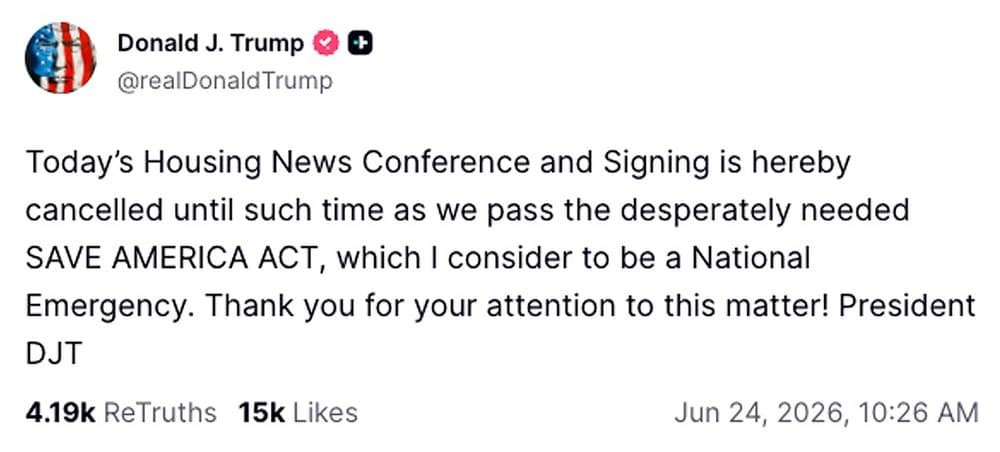
The abrupt cancellation came with a pointed political condition. Trump announced on his Truth Social platform that he would only sign the housing package after Congress passes the Safeguard American Voter Eligibility (SAVE) Act — an election security measure that Trump and many Republicans have been aggressively promoting ahead of the midterm elections.
"Today's Housing News Conference and Signing is hereby cancelled until such time as we pass the desperately needed SAVE AMERICA ACT, which I consider to be a National Emergency," Trump wrote in his post, referring to the bill colloquially as the "SAVE America Act."
The decision to link two entirely separate pieces of legislation — one focused on housing affordability and the other on voter eligibility — immediately sent shockwaves through Washington. Lawmakers who had spent months crafting and negotiating the housing bill expressed visible frustration at the eleventh-hour reversal. The move effectively held one of the most consequential housing bills in years hostage to a separate political priority, creating uncertainty about when, or even whether, the housing legislation would ultimately be signed into law.
The Political Fallout: Bipartisan Frustration
The cancellation drew sharp reactions from members of Congress on both sides of the aisle. The 21st Century Road to Housing Act had been celebrated as an example of what Washington could accomplish when lawmakers set aside partisan differences to tackle a real problem affecting real people. Its sudden derailment — not through legislative defeat but through an unexpected presidential demand — frustrated both Democratic and Republican sponsors who had invested significant political capital in the bill's passage.
Housing policy advocates were equally alarmed. Organizations focused on affordable housing, homeownership access, and rental market reform had viewed the bill's passage as a watershed moment. The prospect of an indefinite delay — tied not to any flaw in the housing legislation itself but to an unrelated electoral security debate — raised serious concerns about the bill's ultimate fate.
For the real estate industry, which had cautiously welcomed the bill's provisions on institutional investor constraints and supply-side reforms, the news introduced a fresh layer of uncertainty into an already volatile market environment.
What the SAVE Act Is and Why It Matters to Trump
The Safeguard American Voter Eligibility Act is an election security bill championed by Trump and Republican allies that centers on voter registration verification and eligibility requirements. Its proponents argue it is necessary to ensure the integrity of American elections, particularly ahead of the midterms. Critics, however, contend the measure could create barriers to voter registration and disproportionately affect eligible citizens who lack certain documentation.
By declaring the SAVE Act a "National Emergency" and making it a prerequisite for the housing bill signing, Trump signaled that election security remains his top legislative priority — even at the cost of delaying broadly supported housing relief for American families.
What Happens Next for the Housing Bill?
The immediate path forward for the 21st Century Road to Housing Act remains unclear. The bill sits in legislative limbo, passed by Congress but unsigned by the president, awaiting a political development — passage of the SAVE Act — that is far from certain in the current congressional environment.
Several key questions now hang over the situation. Will Congress move quickly on the SAVE Act to unlock the housing bill's signing? Will bipartisan support for the housing legislation hold under the pressure of prolonged delay? And what does this reversal signal about the administration's broader approach to housing policy during a period when affordability remains a top concern for American voters?
What This Means for the Housing Market
For prospective homebuyers, renters, and real estate professionals, the uncertainty is palpable. The 21st Century Road to Housing Act's 45 provisions had offered a concrete roadmap for addressing some of the structural issues behind the country's housing affordability crisis — from institutional investor activity to zoning barriers and financing gaps. Its delayed signing means those reforms remain on paper rather than in practice, at least for now.
- First-time homebuyers hoping for relief from institutional investor competition will need to wait longer for any policy-driven change in that dynamic.
- Renters facing rising costs will see no immediate policy intervention from this legislation.
- Real estate investors and developers face continued regulatory uncertainty as the bill's provisions remain unsigned and therefore unenforceable.
- Housing advocates must now recalibrate their expectations and advocacy strategies around an unpredictable signing timeline.
The cancellation of the 21st Century Road to Housing Act signing ceremony is more than a political footnote — it is a significant moment that underscores just how fragile legislative progress on housing can be, even when broad bipartisan consensus exists. As Washington waits to see whether the SAVE Act advances and what conditions ultimately lead to a housing bill signing, millions of Americans continue to navigate a housing market that desperately needs the kind of structural reform this legislation was designed to deliver.