
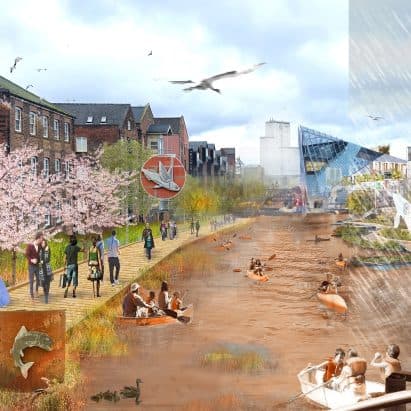
University of Sheffield Architecture Students Address Hull's Growing Flood Crisis
Each year, architecture school shows across the United Kingdom offer a compelling window into the minds of the next generation of designers. This year, the University of Sheffield's school show has drawn particular attention for the ambition and urgency embedded in many of its student projects. Among the most striking is a proposal that directly confronts one of England's most pressing environmental challenges: the rising sea levels threatening the city of Hull.
Hull, officially known as Kingston upon Hull, is widely regarded as one of the UK cities most vulnerable to flooding and climate-related water hazards. Sitting at the confluence of the River Hull and the Humber Estuary, the city has long grappled with the realities of its low-lying geography. As climate change accelerates sea level rise and increases the frequency of extreme weather events, the question of how Hull can adapt and survive has become one of urgent architectural and urban importance. It is precisely this question that University of Sheffield students have chosen to tackle head-on.
What Makes Hull So Vulnerable to Rising Sea Levels?
Understanding the scale of the challenge helps to appreciate just how significant these student proposals are. Hull is one of the lowest-lying cities in the United Kingdom, with large portions of its urban fabric sitting at or even below sea level. The city experienced catastrophic flooding in 2007, when more than 8,600 homes and 1,300 businesses were affected in a single summer storm event. That disaster served as a wake-up call, but the longer-term threat of sea level rise means that event could be dwarfed by future floods if meaningful action is not taken.
Climate scientists project that sea levels around the Humber Estuary could rise significantly over the coming decades, driven by the global warming of ocean waters and the melting of polar ice caps. For a city like Hull, already operating at the margins of safe habitation in terms of flood exposure, even modest increases in sea level represent a serious existential risk to property, infrastructure, and community life. Architects, planners, and urban designers therefore have a critical role to play in imagining adaptive futures for such places.
University of Sheffield's School Show: A Platform for Climate-Focused Design
The University of Sheffield has long maintained a reputation as one of the UK's leading architecture schools, known for fostering socially engaged and technically rigorous design thinking. This year's school show continues that tradition, presenting a diverse range of projects that respond to real-world challenges with creativity and intellectual depth.
The proposal addressing Hull's sea level crisis stands out not only for the urgency of its subject matter but also for the sophistication of its approach. Rather than relying on conventional hard engineering solutions — the familiar walls, barriers, and embankments that have traditionally defined flood defence — the project explores softer, more integrated strategies that work with natural processes rather than against them. This reflects a broader shift in contemporary urban design thinking, which increasingly favours resilience and adaptation over pure resistance.
Key Strategies in the Hull Flood Resilience Proposal
While the full details of the project continue to generate discussion in architectural circles, several key principles appear to define the student proposal's approach to Hull's flood challenge.
- Living infrastructure: The proposal incorporates green and blue infrastructure — wetlands, tidal parks, and managed water corridors — that absorb and manage floodwater while simultaneously creating new public spaces and ecological habitats within the urban fabric.
- Amphibious and floating architecture: Drawing on precedents from the Netherlands and other flood-prone regions, the project explores building typologies that can rise and fall with water levels rather than standing rigidly against them, fundamentally reimagining what it means to inhabit a flood-prone urban environment.
- Community-centred design: Recognising that flood resilience is not purely a technical problem, the proposal engages deeply with Hull's existing communities, ensuring that adaptive strategies serve the people who live there rather than displacing them in the name of climate defence.
- Phased urban transformation: Rather than proposing a single dramatic intervention, the scheme imagines a phased, incremental transformation of Hull's waterfront neighbourhoods, allowing the city to evolve gradually in response to changing conditions over time.
Why Student Architecture Projects Matter for Real Urban Challenges
It would be easy to dismiss student proposals as purely theoretical exercises, disconnected from the messy realities of policy, funding, and political will. But history repeatedly demonstrates that visionary student work plants the seeds of ideas that eventually reshape professional practice and public policy. Many of the most influential approaches to urban resilience, sustainable housing, and climate-adaptive design began their lives as experimental academic projects before finding their way into mainstream architecture and planning.
The University of Sheffield has a particularly strong track record in this regard. Its graduates regularly go on to lead significant practices and public institutions, carrying with them the values and design approaches they developed during their studies. A project that thoughtfully engages with Hull's sea level challenge today could inform the thinking of a generation of practitioners who will be designing real buildings and masterplans for vulnerable cities in the decades to come.
A Broader Vision: Architecture as Climate Action
The Hull proposal is just one among several projects in this year's University of Sheffield school show that engage directly with environmental crisis and climate resilience. Taken together, these projects reflect a generation of architecture students who understand that their discipline carries a profound responsibility in an era of accelerating climate change.
Architecture has sometimes been criticised for prioritising aesthetic novelty over social and environmental utility. The work being shown at Sheffield this year suggests a different kind of priority: one where beauty and ingenuity are placed firmly in the service of human and planetary wellbeing. For cities like Hull — sitting on the front line of climate risk — that kind of architectural thinking could not be more necessary or more timely.
Looking Ahead: Hull's Architectural Future
Hull has already shown considerable resilience and innovation in recent years, most notably during its tenure as UK City of Culture in 2017, which catalysed significant investment and a renewed sense of civic pride. That cultural energy, combined with the kind of visionary design thinking being developed at institutions like the University of Sheffield, offers genuine reason for optimism about the city's capacity to adapt and thrive in the face of rising waters.
As climate projections grow more urgent and the window for meaningful adaptation narrows, projects like the one presented at this year's Sheffield school show remind us that architecture, at its best, is not just about buildings. It is about imagining — and helping to build — futures worth inhabiting, even in the most challenging of circumstances.