
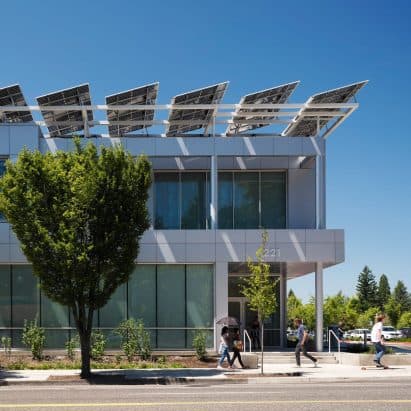
Portland's Vacant Supermarket Gets a Second Life as a Library Operations Center
In a compelling example of adaptive reuse architecture, Portland-based firm Hennebery Eddy Architects has transformed a long-vacant supermarket into a fully functioning library facility for Multnomah County. The project, officially known as the Multnomah County Library Operations Center, demonstrates how underutilized commercial spaces can be reimagined to serve vital civic functions — all while reducing the environmental footprint that comes with new construction.
As cities across the United States grapple with rising numbers of vacant retail spaces left behind by the decline of brick-and-mortar shopping, Portland's approach offers a thoughtful template. Rather than demolishing a structurally sound building and starting from scratch, Multnomah County and Hennebery Eddy chose to work with what was already there — and the results are quietly remarkable.
Why Adaptive Reuse Makes Sense for Public Infrastructure
Adaptive reuse — the process of repurposing an existing building for a new function — has gained significant traction in architectural and urban planning circles over the past decade. For public institutions like libraries, the benefits are substantial. Reusing an existing structure typically reduces construction waste, lowers carbon emissions associated with new materials, and often proves more cost-effective for taxpayers than ground-up development.
Supermarkets, in particular, present an appealing canvas for conversion. Their large, open floor plates, robust structural systems, and prominent ground-level locations within established neighborhoods make them logistically well-suited for reprogramming into civic or community uses. The Multnomah County project capitalizes on all of these inherent characteristics, allowing the design team to allocate budget toward functional upgrades and interior quality rather than structural overhaul.
Beyond economics, there is a symbolism at play. A building that once served as a hub of daily community life — a place where neighbors met and essential goods were exchanged — is now being reborn as an institution dedicated to knowledge, culture, and public service. Few architectural narratives carry that kind of resonance.
About the Multnomah County Library Operations Center
The Multnomah County Library system is one of the most heavily used public library systems in the entire United States, consistently ranking among the top systems nationally for per-capita circulation. Managing such a vast operation requires significant back-end infrastructure: processing facilities for incoming and outgoing books, administrative offices, storage for the county's expansive collection, and workspace for the staff who keep everything running smoothly.
The new Operations Center consolidates many of these behind-the-scenes functions under one roof. By housing book processing, cataloging, distribution logistics, and administrative support in a single, purpose-adapted facility, the county improves operational efficiency while freeing up space within its branch libraries for public-facing programming and services.
Hennebery Eddy's design respects the industrial character of the original supermarket shell while introducing elements that speak to the building's new civic identity. The vast open floor plan — once lined with grocery aisles — now accommodates sorting and processing workflows, while reconfigured areas support collaborative office environments for library staff.
Hennebery Eddy's Design Approach
Hennebery Eddy Architects, founded in Portland in 1991, has built a reputation for thoughtful, context-sensitive design that responds to the Pacific Northwest's unique combination of environmental values, cultural identity, and urban density challenges. The firm's portfolio spans civic, educational, commercial, and residential projects, and their approach to the Operations Center reflects a consistent emphasis on sustainability, material honesty, and human-centered space-making.
For the supermarket conversion, the architects preserved much of the existing structure's bones while introducing strategic interventions to improve daylighting, ventilation, and interior comfort. Large-scale retail buildings like supermarkets are often notoriously dim and artificially lit — optimizing light quality was therefore a key design priority. The team introduced skylights and clerestory glazing to bring natural daylight deeper into the floor plate, reducing reliance on artificial lighting and improving the working environment for staff.
Material choices throughout the project reflect a commitment to durability and authenticity. Exposed structural elements, polished concrete floors, and carefully selected finishes give the space an honest, unpretentious quality that aligns with the practical nature of the building's operations function. Nothing is overly decorative, yet the result feels considered and dignified — appropriate for a facility serving one of the country's premier public library systems.
Sustainability and the Future of Retail Conversion
From a sustainability standpoint, the Multnomah County Library Operations Center aligns with a broader national conversation about what to do with America's surplus retail real estate. Analysts have estimated that the United States has significantly more retail square footage per capita than any other country in the world, and the ongoing contraction of the retail sector means that vacant or underutilized commercial properties are only expected to increase in coming years.
Architects, urban planners, and policymakers are increasingly looking at these empty boxes not as problems but as opportunities. Libraries, schools, health clinics, affordable housing, and community centers are all potential candidates for retail conversion. The Hennebery Eddy project in Portland adds a compelling real-world precedent to that growing body of evidence.
A Model Worth Replicating
The transformation of a vacant Portland supermarket into the Multnomah County Library Operations Center is more than an interesting architectural story — it is a practical demonstration of values. It shows that sustainability and civic investment are not mutually exclusive goals. It proves that thoughtful design can extract new meaning and function from structures others might have written off. And it illustrates what is possible when local government, architects, and communities share a commitment to making the most of what already exists.
- The project repurposes existing retail infrastructure rather than contributing to construction waste.
- It consolidates library back-end operations, improving efficiency for one of the busiest library systems in the country.
- The design by Hennebery Eddy Architects prioritizes natural light, material honesty, and functional clarity.
- The conversion model offers a scalable template for other municipalities facing similar retail vacancy challenges.
As cities continue to confront the twin pressures of climate responsibility and constrained public budgets, projects like the Multnomah County Library Operations Center point toward a more resourceful, imaginative approach to urban infrastructure. Portland has long positioned itself at the forefront of progressive urban design, and this adaptive reuse project adds another chapter to that ongoing story.