
What Makes Gaudí's Style So Unique?
More than a century after his death in 1926, Antoni Gaudí remains one of the most recognizable and studied architects in history. His buildings are instantly identifiable — rippling facades, soaring organic towers, mosaic-covered surfaces that seem to breathe and move. Yet pinning down exactly what makes Gaudí's style so unique requires a deeper look at the man himself: his influences, his philosophy, his technical innovations, and his unshakeable spiritual conviction. As Dezeen's Gaudí Centenary series explores, the answer is far more layered than it might first appear.
Rooted in Nature: Gaudí's Greatest Teacher
From the very beginning of his career, Gaudí turned not to other architects for inspiration, but to the natural world. He believed that nature was the greatest architect of all, and he spent years studying how plants, animals, bones, and geological formations achieve both beauty and structural efficiency simultaneously. This obsession with organic form became the cornerstone of his entire design philosophy.
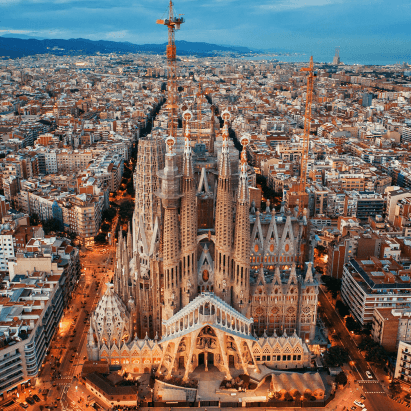
Rather than forcing straight lines and rigid right angles onto his buildings — the standard approach of his era — Gaudí embraced curves, branching columns, and parabolic arches that mirrored the way trees distribute weight or the way a skeleton supports a body. His columns, famously seen in the interior of the Sagrada Família basilica in Barcelona, branch outward near the top like a forest canopy, distributing load in a way that is both visually stunning and structurally sound.
This approach was not merely decorative. Gaudí understood that the forms found in nature have been optimized over millions of years of evolution, and he sought to translate that wisdom directly into stone, brick, and tile. The result was architecture that felt alive in a way no building had felt before.
The Catalan Modernisme Movement and Its Influence
Gaudí did not emerge in a vacuum. He came of age during a period of intense cultural and artistic revival in Catalonia known as the Renaixença — a nationalist movement that sought to reassert Catalan identity through art, language, and architecture. The broader European current of Art Nouveau was also in full swing, rejecting the rigid historicism of the 19th century in favor of organic, flowing forms and handcrafted detail.
Catalan Modernisme, the local expression of this movement, provided Gaudí with both a community and a creative framework. Yet even within this vibrant scene, he stood apart. Where many of his contemporaries drew on the natural world for decorative motifs, Gaudí used nature as a structural and spatial logic. He was not simply applying organic patterns to the surface of buildings — he was rethinking architecture from the inside out.
Faith as Architecture: The Spiritual Dimension
No discussion of Gaudí's style is complete without addressing his deep Catholic faith. In the latter decades of his life, Gaudí became increasingly devout, and his spirituality became inseparable from his architecture. He famously dedicated the final years of his life entirely to the Sagrada Família, living in the workshop on-site and refusing almost all other commissions.
For Gaudí, building the Sagrada Família was not a professional project — it was a form of prayer. Every structural decision, every sculptural detail, every tower and spire was conceived as an act of devotion and a theological statement rendered in stone. The basilica's facades tell biblical stories, its towers represent apostles and evangelists, and its geometry encodes symbolic meaning at every scale.
This fusion of spiritual intent and architectural form gave his work a quality of total commitment that is rare in any art form. His buildings do not merely reference religious themes — they are, in his own words, the "last great Christian temple."
Technical Innovation: Gaudí the Engineer
One of the most underappreciated aspects of Gaudí's genius is his role as a structural innovator. Long before computer modeling existed, Gaudí developed ingenious physical methods to calculate the complex geometries his designs required. His most famous technique involved hanging weighted chains from a model to find the natural catenary curves that arches would take if built in compression — then flipping the model upside down to reveal the ideal structural form.
This method, known as the hanging chain or catenary model, allowed him to design arches, vaults, and columns with extraordinary structural efficiency. It was a form of analog computation, and it placed Gaudí decades ahead of his contemporaries in structural thinking.
He also pioneered the use of trencadís — a mosaic technique using broken ceramic tiles — which allowed him to cover complex curved surfaces with color and pattern in a way that traditional tilework could not. This technique became one of his most iconic visual signatures, visible across Park Güell, Casa Batlló, and the Sagrada Família.
A Style That Cannot Be Categorized
Ultimately, what makes Gaudí's style so unique is precisely that it resists easy categorization. He drew from Gothic architecture, Moorish ornament, Art Nouveau, structural engineering, biology, geology, and Catholic mysticism — and synthesized them into something entirely his own. He was not an eclectic imitator but a genuine original, one who used every tool at his disposal to pursue a single, unified vision of architecture as a living, spiritual, and deeply human art form.
As the world marks the centenary of his death, Gaudí's influence continues to grow. His buildings attract millions of visitors every year, his techniques inspire contemporary architects and engineers, and his completed works — as well as the still-unfinished Sagrada Família — stand as enduring proof that architecture, at its greatest, can be unlike anything that came before.
Key Elements That Define Gaudí's Architectural Style
- Organic forms inspired by nature — branching columns, parabolic arches, and surfaces modeled on biological structures.
- Trencadís mosaic technique — broken ceramic tile work that brings color and texture to complex curved surfaces.
- Structural innovation — use of catenary arch models and hyperbolic paraboloids for efficient, expressive construction.
- Deep spiritual intention — every design element in his major works carries theological and symbolic meaning.
- Catalan identity — a proud expression of regional culture woven into the fabric of every building.
- Total synthesis — the seamless integration of structure, ornament, light, color, and meaning into a single unified whole.
Gaudí did not simply design buildings. He invented a language of architecture that the world is still learning to read — and that is why, one hundred years on, his style remains utterly and incomparably his own.