
The World's Most Famous Architect Who Changed Almost Nothing
Antoni Gaudí is, by almost any measure, one of the most celebrated architects in human history. His buildings draw millions of visitors to Barcelona every year. The Sagrada Família is one of the most photographed structures on the planet. His face is reproduced on souvenirs, his name appears on luxury hotels, and in 2026 the centenary of his death has prompted retrospectives, exhibitions, and tributes around the world. And yet, if you walk through almost any modern city — London, Tokyo, Dubai, New York — you will find almost nothing that looks remotely like a Gaudí building. For an architect of such towering fame, his influence on the trajectory of global architecture is remarkably, almost puzzlingly, thin. Why?
A Genius Without Disciples
The most enduringly influential architects in history tend to share one crucial quality: they trained or inspired a generation of followers who carried their ideas outward into the world. Frank Lloyd Wright had his Prairie School. Le Corbusier's ideas seeded entire urban planning movements across continents. Mies van der Rohe's curtain-wall modernism became the default language of the corporate skyscraper. Gaudí, by contrast, left almost no school behind him. He was famously secretive about his methods, preferring intuition and on-site improvisation to documented theory. He did not write manifestos. He did not teach in any formal or sustained way. His working methods were deeply personal, often residing entirely within his own mind or embedded in hanging chain models that only he knew how to fully interpret.
When Gaudí died after being struck by a tram in 1926, much of the knowledge required to continue his buildings died with him. The Sagrada Família, still under construction a century later, has had to rely on painstaking reconstruction of his intentions from fragments, photographs, and surviving models. An architectural vision that cannot be readily taught, documented, or reproduced is one that struggles to propagate.
Too Rooted in Place to Travel
Gaudí's architecture was not merely personal — it was also profoundly local. His work grew out of Catalan Modernisme, a cultural and political movement specific to the region of Catalonia at a particular moment in history. His buildings were saturated with references to Catalan identity, medieval Christian symbolism, and the specific textures and colours of the Spanish Mediterranean landscape. The ceramic tile fragments, the ochre sandstone, the references to local flora and fauna — all of it was deeply site-specific in ways that made it difficult to transplant.
Other architectural movements that achieved global spread — the International Style being the most obvious example — did so precisely because they were placeless. A Miesian glass box looks equally at home in Chicago, Hong Kong, or Frankfurt because it deliberately refuses any relationship with local culture or material. Gaudí's buildings, by contrast, are almost impossible to imagine anywhere other than Barcelona. Their beauty is inseparable from their context, and that inseparability is both their great strength and a key reason they produced no international school.
The Wrong Moment in History
Timing also played a decisive role. Gaudí's most important buildings were completed in the late nineteenth and early twentieth centuries, precisely when the architectural establishment across Europe and North America was consolidating around the principles of modernism. The ornament-stripping rationalism of figures like Adolf Loos, the structural honesty of the early Bauhaus, and the machine aesthetic of Le Corbusier were all ascendant during the decades when Gaudí's fame might otherwise have spread.
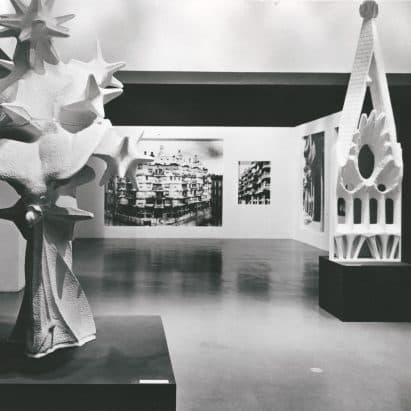
To orthodox modernists, Gaudí looked like a brilliant eccentric — a throwback to Gothic fantasy at a moment when the future belonged to the grid, the flat roof, and the rejection of historical decoration. The major institutions of architectural education, criticism, and publication during the mid-twentieth century were largely hostile or indifferent to his approach. It was not until MoMA held a retrospective exhibition of his work in 1957 that international critical attention began to shift, and by then the modernist canon was firmly established. Gaudí became an admired curiosity rather than a founding influence.
Admired But Not Imitated
There is a distinction, often overlooked, between being admired and being influential. Gaudí has always attracted enormous admiration. Architects from Frank Lloyd Wright to Le Corbusier himself visited his buildings and expressed astonishment at what they found. Yet admiration did not translate into imitation, because his methods were simply too difficult and too expensive to replicate. His structural innovations — the use of catenary arches, parabolic vaults, and complex ruled surfaces — required extraordinary craftsmanship and extended construction timelines that were incompatible with the economics of twentieth-century building. His ornamental systems demanded skilled artisans working slowly with expensive materials at a moment when the construction industry was moving rapidly toward standardization and prefabrication.
The architects who did attempt to absorb his lessons — figures working in organic or biomorphic traditions — tended to do so in diluted or heavily mediated ways. You can trace faint echoes of Gaudí in the work of designers like Friedensreich Hundertwasser or certain parametric architects of the twenty-first century, but these are echoes rather than lineages.
What Gaudí's Legacy Actually Looks Like
Perhaps the most honest way to understand Gaudí's legacy is to accept that it operates in a different register from conventional architectural influence. He did not change how buildings are designed or built at a systemic level. What he did instead was expand the collective imagination of what architecture could be — proving that a building could be as complex, organic, and emotionally overwhelming as a living organism or a geological formation.
In the age of computational design and digital fabrication, some of his structural intuitions are finally becoming accessible to a wider range of architects. Parametric modeling can now generate the kinds of complex curved geometries that Gaudí could only achieve through years of painstaking physical experimentation. In this sense, his influence may be arriving late — a century after his death rather than in his lifetime.
- Gaudí left behind no formal school or body of written theory to transmit his ideas
- His architecture was too culturally and geographically specific to travel easily beyond Catalonia
- The rise of modernism created an intellectual climate hostile to his ornamental approach
- The cost and craft demands of his methods made imitation economically impractical
- New digital fabrication tools may finally be making his structural logic reproducible
Gaudí remains, a century after his death, an architect of extraordinary singularity. His buildings are irreplaceable, his vision was genuinely visionary, and his public fame shows no sign of fading. But fame and influence are different things, and the story of why this particular genius resisted replication tells us as much about how architectural movements actually spread as it does about the man himself. He was, perhaps, simply too much himself to become anyone else's model.