
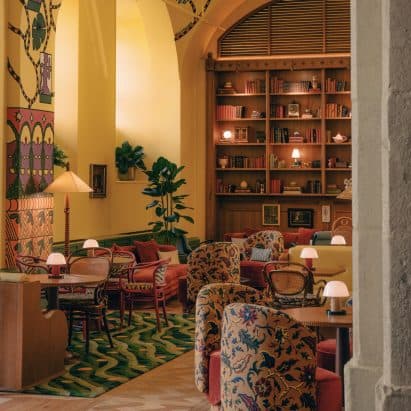
Where Vienna's Artistic Legacy Meets Modern Aparthotel Living
Vienna has long been a city that wears its artistic heritage on its sleeve. From the gilded dome of the Secession Building to the sinuous lines of the Stadtbahn stations designed by Otto Wagner, the Austrian capital is practically wallpapered in the visual language of a movement that shook the art world at the turn of the twentieth century. Now, that same language is finding a new home inside the Wilde Vienna Fleischmarkt aparthotel, a property that draws deliberately and lovingly on Secessionist references to create a stay that feels rooted in place rather than dropped from a global design template.
In an era when many hotels feel interchangeable — the same muted palettes, the same abstract prints sourced from the same trend decks — the Wilde Vienna takes a more committed approach. Its interiors speak specifically to where they are, weaving motifs, materials, and moods that could only make sense in this city, on this particular stretch of the Fleischmarkt in Vienna's first district.
What Is the Vienna Secession and Why Does It Matter for Hotel Design?
To appreciate what the Wilde Vienna is doing, it helps to understand the movement it is drawing from. The Vienna Secession was founded in 1897 by a group of Austrian artists, architects, and designers — among them Gustav Klimt, Koloman Moser, and Josef Hoffmann — who broke away from the conservative Vienna Künstlerhaus in pursuit of a more radical, total vision of art. Their motto, "To every age its art, to art its freedom," announced an ambition that went far beyond painting. The Secessionists wanted to dissolve the boundaries between fine art, craft, and everyday life, producing buildings, furniture, textiles, jewelry, and graphics that felt unified in spirit.
The visual signatures of the movement — sinuous organic lines, geometric ornament, gold leaf detailing, stylized natural forms, and a deep commitment to craftsmanship — became the defining aesthetic of fin-de-siècle Vienna. More than a century later, those same signatures retain a remarkable power to communicate luxury, culture, and a sense of place. For a hospitality brand looking to differentiate itself in one of Europe's most design-literate cities, they are an obvious but genuinely rewarding source of inspiration.
The Fleischmarkt Location: History Built into the Address
The Wilde Vienna Fleischmarkt benefits from a location that already carries considerable cultural weight. The Fleischmarkt — literally "meat market" — is one of Vienna's oldest streets, running through the first district close to the Danube Canal and within easy walking distance of landmarks including the Stadtpark, the Ringstrasse, and the Secession Building itself. Staying on the Fleischmarkt puts guests inside the living texture of historic Vienna rather than in a sanitized hotel corridor beyond its edges.
That context matters enormously when a property leans into local design references. The Secessionist motifs that run through the Wilde Vienna's interiors are not decorative borrowings applied to a generic shell — they are a response to the built environment immediately outside the front door, a conversation between the aparthotel and the century-old city that surrounds it.
Secessionist Motifs Inside the Wilde Vienna
The interiors of the Wilde Vienna Fleischmarkt translate the Secessionist spirit through a contemporary lens rather than attempting a period reproduction. This is an important distinction. A literal recreation of a Klimt-era interior would feel like a museum exhibit; what the Wilde Vienna pursues instead is an atmosphere — a mood informed by Secessionist sensibility without being trapped by it.
- Geometric ornamental patterns appear across surfaces including wall coverings and soft furnishings, recalling the grid-based detailing that Hoffmann and the Wiener Werkstätte made their trademark in the years following the original Secession movement.
- Rich, warm color palettes featuring deep greens, burnished golds, and earthy ochres echo the jewel-toned canvases of Klimt and the chromatic confidence that defined the period's decorative arts.
- Artisanal material choices — tactile textiles, handcrafted ceramic details, carefully selected timber finishes — honor the Secessionist insistence that everyday objects deserve the same attention as gallery art.
- Botanical and organic motifs, another Secessionist hallmark, surface in printed fabrics and graphic elements, referencing the movement's fascination with the natural world as a source of ornamental language.
The result is an aparthotel that reads as distinctly Viennese from the moment a guest crosses the threshold, without ever feeling costume-like or self-conscious.
The Aparthotel Format: Design Meets Practicality
The Wilde brand — part of the Staycity Group — has built its identity around the aparthotel concept, which combines the space and self-sufficiency of a serviced apartment with the amenities and aesthetic care of a boutique hotel. For guests spending more than a night or two in Vienna — whether for work, an extended city break, or relocation — the format offers a meaningful upgrade over a standard hotel room. Proper kitchen facilities, generous living areas, and the ability to establish something resembling a daily routine make a measurable difference to the quality of a longer stay.
At the Wilde Vienna Fleischmarkt, the Secessionist design language does important work within this format. It prevents the aparthotel from sliding into the functional but characterless territory that serviced apartments can sometimes occupy. Every space — kitchen, bedroom, living area — is treated as an opportunity to reinforce the visual identity of the property, so that the design sensibility feels continuous rather than applied only in the lobby for first impressions.
Why Vienna Is the Perfect City for This Approach
Vienna rewards design ambition. Its residents and visitors are accustomed to environments of genuine quality — the city's coffeehouses, its public buildings, its museums, and its concert halls all set a high bar for spatial experience. A hotel that engages seriously with the local design tradition is not merely flattering its guests; it is meeting a genuinely elevated expectation.
The Secessionist movement also has a particular resonance for contemporary travelers because it was, at its core, about integration. The Secessionists believed that architecture, interiors, and objects should work together as a unified whole — a philosophy that maps naturally onto the holistic thinking of the best modern hospitality design. In that sense, the Wilde Vienna Fleischmarkt is not simply borrowing an aesthetic from the past. It is applying a philosophy that the past perfected, and finding that it still works.
A New Benchmark for Place-Specific Hotel Design
The Wilde Vienna Fleischmarkt aparthotel makes a quiet but confident argument: that the most memorable hotel experiences are those that could not exist anywhere else. By weaving Secessionist references through its interiors — thoughtfully, contemporarily, and with evident craft — the property gives guests something that no amount of generic luxury can provide: a genuine sense of being somewhere specific, somewhere with a story, and somewhere that takes its own history seriously.
For travelers seeking Vienna aparthotels that go beyond comfortable accommodation to offer a design experience genuinely rooted in the city, the Wilde Vienna Fleischmarkt is a property well worth seeking out. It is, in the truest Secessionist spirit, a space where art and life have been invited to coexist.