
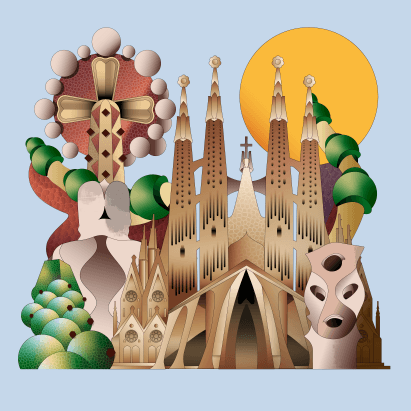
Gaudí Centenary: The World Remembers a Visionary Architect
One hundred years after his death, Antoni Gaudí remains one of the most celebrated and recognizable architects in the history of the built world. To mark the centenary of his passing, design publications, cultural institutions, and architecture enthusiasts around the globe are turning their attention back to the man who transformed the skyline of Barcelona and permanently altered the course of modern architecture. This week, Dezeen launched its dedicated Gaudí Centenary series, a comprehensive editorial tribute examining every dimension of his remarkable career, philosophy, and ongoing influence. It is a timely reminder of just how profoundly one person's creative vision can reshape an entire discipline.
Who Was Antoni Gaudí?
Born in 1852 in Reus, Catalonia, Antoni Gaudí i Cornet showed an early and intense interest in nature, which would go on to define every structure he ever designed. Studying at the Barcelona School of Architecture, he graduated in 1878, and his director reportedly remarked that the degree had been awarded "to a genius or a madman." History has long since delivered its verdict on which of those labels was correct.
Gaudí was a deeply spiritual man whose Catholic faith became inseparable from his architectural practice. He believed that nature was God's greatest work and that true architecture should mirror its organic forms, structures, and geometries. This belief manifested in everything from the branching columns inside the Sagrada Família to the mosaic-covered rooftop terraces of Casa Batlló. Where his contemporaries drew from historical styles or emerging industrial aesthetics, Gaudí looked to leaves, bones, honeycombs, and caves.
The Masterworks That Define a Career
No discussion of Antoni Gaudí is complete without an exploration of the extraordinary buildings he left behind. Concentrated primarily in Barcelona, his works are now UNESCO World Heritage Sites and draw millions of visitors each year.
The Sagrada Família
Perhaps the most famous unfinished building in the world, the Basílica de la Sagrada Família has been under continuous construction since 1882. Gaudí took over the project in 1883 and devoted the final decades of his life entirely to it. When he died in 1926, the structure was far from complete, yet he had left behind such detailed plans, models, and notes that construction has continued for a full century since. The basilica is expected to reach completion in the coming years, a milestone that has taken on added significance given the centenary of its chief architect's death.
Park Güell
Commissioned by industrialist Eusebi Güell and built between 1900 and 1914, Park Güell was originally intended as a residential garden city. The project was never commercially successful, but the park it became is one of the most beloved public spaces in Europe. Its winding mosaic benches, iconic dragon staircase, and gingerbread gatehouses feel like something drawn from a fairy tale — which is precisely the effect Gaudí intended.
Casa Batlló and Casa Milà
Along Barcelona's prestigious Passeig de Gràcia, two of Gaudí's domestic masterpieces stand side by side in spirit if not in stone. Casa Batlló, remodeled between 1904 and 1906, features a façade of shimmering ceramic tiles and bone-like balconies that reference the legend of Saint George and the dragon. Casa Milà, known locally as La Pedrera, is a towering apartment building with an undulating stone exterior and a rooftop populated by warrior-like chimney sculptures that have inspired artists, filmmakers, and designers for generations.
Gaudí's Philosophy: Nature as the Supreme Architect
What set Gaudí apart from every other architect of his era was his insistence on structural solutions borrowed directly from the natural world. He pioneered the use of catenary arches and hyperbolic paraboloids long before computer modeling made such forms easy to calculate. He built intricate hanging chain models — known as funicular models — to determine the ideal shapes for his arches and vaults, essentially designing structures upside down and then inverting them.
This approach was not merely aesthetic. Gaudí believed that a structure shaped by natural forces would be inherently more stable, more efficient, and more beautiful than one constrained by conventional geometry. The result was architecture that appeared to grow rather than to have been constructed — buildings that felt alive in a way that no other movement of the period could claim.
The Tragic End and the Lasting Legacy
Gaudí's death on 10 June 1926 was as dramatic as his life. He was struck by a tram on the Gran Via de les Corts Catalanes in Barcelona. Because he was poorly dressed and carried no identification, passersby initially mistook him for a beggar. He died three days later without regaining consciousness, and was buried in the crypt of the Sagrada Família — the church to which he had given everything.
In the century since, his reputation has only grown. He has influenced architects, product designers, sculptors, and animators worldwide. His approach to biomimicry anticipated debates in sustainable architecture by nearly a hundred years. Today, as the field grapples with how to build in harmony with nature rather than in opposition to it, Gaudí's methods feel less like historical curiosities and more like a road map.
Why the Gaudí Centenary Matters Today
Anniversaries can sometimes feel like mere ceremonial gestures, but the Gaudí Centenary carries genuine cultural and architectural weight. In a moment when architecture is being asked to respond urgently to climate change, to rethink materials and structural logic, and to reconnect with the natural world, revisiting the work of a man who never departed from those principles is more than nostalgic — it is instructive.
The editorial series launched this week by Dezeen brings together criticism, photography, historical analysis, and contemporary perspectives to ask what Gaudí's legacy means right now. It invites a new generation of architects and design lovers to look again at the organic curves, the hand-laid mosaics, and the soaring vaults of his buildings not as relics of a distant past but as an ongoing conversation about how humans should build.
Visiting Gaudí's Barcelona
For those inspired by the centenary to experience his work in person, Barcelona remains the essential destination. The following works are all open to visitors and collectively offer one of the most concentrated experiences of architectural genius anywhere in the world:
- Sagrada Família — Still under construction but fully visitable, with its interior and towers offering one of architecture's most breathtaking interior spaces.
- Park Güell — A public park with a ticketed monumental zone that includes the famous mosaic terrace and dragon staircase.
- Casa Batlló — Now a museum offering immersive technology-enhanced tours of Gaudí's extraordinary remodel.
- Casa Milà (La Pedrera) — Open year-round with exhibitions, roof terrace access, and a dedicated Gaudí space in the attic.
- Palau Güell — Gaudí's early major commission, a palace in the Raval neighbourhood that showcases his developing brilliance.
A Century Later, the Vision Endures
Antoni Gaudí spent his life designing buildings that he knew would outlast him by centuries. In the case of the Sagrada Família, he reportedly told those who questioned the slow pace of construction that his client — God — was in no particular hurry. One hundred years after his death, that patience seems entirely justified. His buildings stand not only as monuments to individual genius but as proof that architecture, at its most ambitious, can transcend the age that produced it and speak meaningfully to every age that follows. The Gaudí Centenary is not simply a farewell to the past; it is a welcome back to a way of thinking about the built environment that the present urgently needs.