
David Hockney and California: A Love Story That Shaped Modern Art
When revered British artist David Hockney passed away peacefully at his longtime London home at the age of 88, the art world lost one of its most luminous and enduring voices. Hockney, born into what he himself described as a "radical working-class family" in the Yorkshire town of Bradford, rose to become one of the greatest artists of the 20th century. Yet for all his British roots, it was California—specifically Los Angeles—that ignited his most celebrated creative era and left an indelible mark on both his life and his legacy.
His story is not merely one of artistic brilliance. It is the story of a man who found freedom, identity, and boundless inspiration in the sun-drenched landscapes of the American West—and who transformed even the humblest of spaces into something that would be remembered for generations.
From Bradford to Beverly Hills: How California Called to Hockney
Hockney's journey to California was not a direct one. He first traveled to the United States in 1961, the year after he came out as gay at the age of 23. That initial trip took him to New York City, a visit that sparked a profound and lifelong love affair with America. For Hockney, the United States represented something deeply personal: a country where his sexuality felt far less repressed than in his native Britain, where homosexual acts between men remained illegal until 1967.
New York proved to be a powerful source of creative inspiration, and Hockney returned to the city multiple times over the following years. But it was his first visit to Los Angeles in 1963 that would prove to be the true turning point in his career. Something about Southern California—the light, the leisure, the unapologetic pleasure of everyday life—spoke directly to Hockney's sensibility as an artist. He was captivated almost immediately.
What he found in Los Angeles was a visual culture unlike anything he had encountered in Europe. The swimming pools, the palm trees, the sprawling modernist homes, the flat golden light that seemed to make even ordinary scenes shimmer—all of it became raw material for an artistic vision that was uniquely his own.
Defining the Los Angeles Aesthetic Through Art
Hockney's early California paintings, executed in a bold, pop art-inflected style, are widely credited with helping to define the Los Angeles aesthetic for audiences around the world. Works like A Bigger Splash and his iconic swimming pool series did not just capture a place—they created a mythology around it. Through his eyes, Southern California became a symbol of modernity, freedom, and sensual pleasure, rendered in vivid blues, yellows, and whites that seemed to pulse with warmth even on the coldest gallery wall.
According to The Guardian, Hockney's work quite literally helped shape how people imagined and understood Los Angeles—both those who lived there and those who had never set foot in the city. His canvases became a kind of visual shorthand for a certain California dream, one that was aspirational and intimate at the same time.
The Humble L.A. Home That Became a Living Work of Art
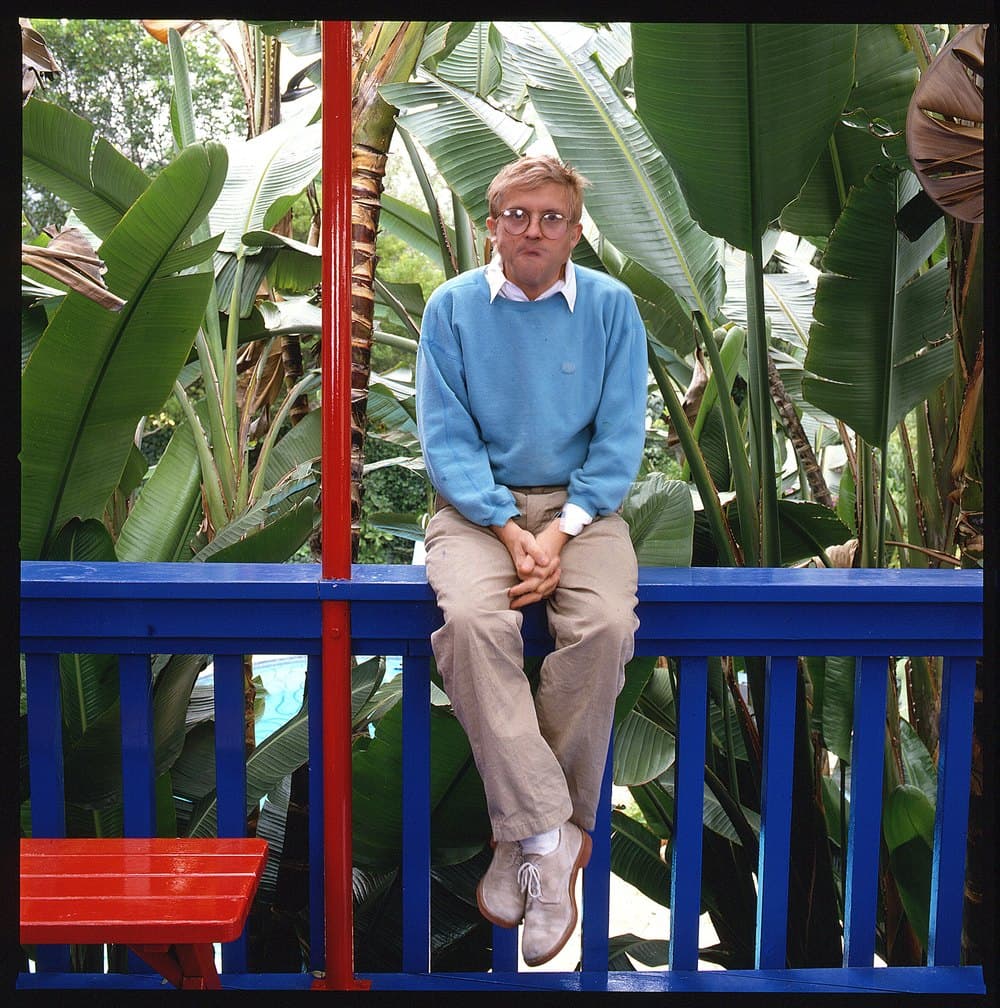
Perhaps one of the most fascinating chapters in Hockney's California story is what he did with a modest Los Angeles home that he purchased for just $181,000. In a city and an art world defined by excess, Hockney's approach to this property was characteristically thoughtful and deeply personal. Rather than seeking out a grand estate or a showcase residence, he transformed this unassuming space into something that reflected his artistic philosophy in every detail.
Hockney approached the home the way he approached a canvas—with intention, color, and a refusal to accept the ordinary. The property became a living extension of his art, a place where the boundaries between everyday life and creative expression dissolved entirely. Walls, gardens, and interiors were treated as opportunities for visual exploration, turning what might have been a simple residence into a destination that embodied his unmistakable aesthetic.
This approach to living and making art in the same space was deeply consistent with who Hockney was as a person. He never separated life from art; for him, the two were always inseparable. His California home was proof of that philosophy made tangible.
A Legacy Rooted in Place and Freedom
What made Hockney's connection to California so enduring was not simply the beauty of the landscape, though that was certainly part of it. It was the freedom he found there—the freedom to be himself, to love openly, to explore his identity through his work without the weight of the legal and social restrictions that had shadowed his early life in England.
California gave Hockney permission to paint joy, and he did so with an honesty and exuberance that resonated across cultures and generations. His works remain among the most recognized and beloved in the world, hanging in major museums and private collections alike.
Remembering David Hockney: Artist, Californian, Icon
David Hockney continued to paint until the very end of his life, a testament to an artistic drive that never dimmed. He passed away peacefully at his London home, but his spirit—restless, joyful, brilliantly curious—will always belong in part to California.
- Hockney first visited California in 1963 and was immediately captivated by its light and lifestyle.
- His swimming pool paintings helped define the global image of Los Angeles.
- He purchased and transformed a modest $181,000 L.A. home into a living artistic statement.
- California represented personal freedom for Hockney at a time when being gay was still criminalized in the U.K.
- He continued creating art until his death at age 88, cementing a legacy that spans more than six decades.
For art lovers, architecture enthusiasts, and California dreamers alike, Hockney's story is a reminder that the places we love shape not just the art we make, but the people we become. His California was not just a setting—it was a declaration. And that declaration will continue to hang on gallery walls, printed on posters, and painted in the memories of everyone who ever looked at one of his shimmering blue pools and felt, for just a moment, completely free.