
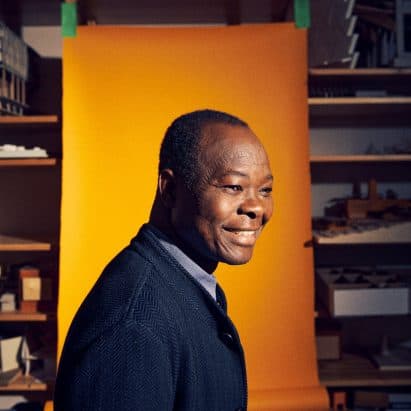
A Voice That Built More Than Walls
There are architects who design buildings, and then there are architects who reshape the very conversation around what architecture is for. Diébédo Francis Kéré belongs firmly in the second category. Born in Gando, a small village in Burkina Faso with no electricity or running water, Kéré grew up to become the first African architect to win the Pritzker Architecture Prize — widely considered the Nobel Prize of the built environment. In a candid new interview tied to the release of a major monograph on his work, Kéré reflects on his path with characteristic humility and quiet determination: "I still say to myself, 'I have achieved a lot.'"
That simple statement carries enormous weight. It is the kind of remark that only makes sense when you understand where it comes from — not from arrogance, but from a man who genuinely did not take his own success for granted at any stage of his remarkable life.
From Gando to the Global Stage
Diébédo Francis Kéré was born in 1965 as the eldest son of the village chief of Gando. Because of his position in the family, he was the first child in his community sent away to receive a formal education — an opportunity that was both a privilege and a sacrifice, separating him from everyone he loved at a young age. He eventually made his way to Germany, where he studied architecture at the Technische Universität Berlin, graduating in 2004.
But Kéré did not wait for his diploma to start changing lives. Before he had even finished his degree, he had already mobilised his local community back in Gando, raised funds through a self-founded association, and built the Gando Primary School — a structure that became an instant landmark in sustainable, community-driven design. The school used compressed laterite bricks sourced locally and featured an innovative raised corrugated roof that allowed hot air to circulate upward and away, keeping the interior cool without any mechanical systems. It won the Aga Khan Award for Architecture in 2004, the same year Kéré graduated.
That project set the template for everything that followed: architecture rooted in local materials, local knowledge, and genuine community participation, delivered with a formal intelligence that commands respect on the world stage.
The Philosophy Behind the Practice
Understanding Kéré's architecture requires understanding his worldview. He does not approach design as an exercise in individual expression. Instead, he sees architecture as a collective act — something that belongs to the people who will use it long after the architect has moved on. This philosophy is not theoretical for Kéré; it is deeply autobiographical.
Growing up in a place where the community gathered under a large tree for shade, conversation, and decision-making, Kéré absorbed the idea that shared space is the most important space. His buildings consistently return to this principle. Whether he is designing a school in Burkina Faso, a parliament building in Benin, a serpentine pavilion in London, or a master plan for a major urban institution, Kéré's spaces almost always invite gathering, shade, airflow, and human connection at their core.
- The use of local and natural materials — particularly laterite, clay, and timber — reduces both cost and carbon footprint while keeping construction knowledge within the community.
- Passive cooling strategies drawn from vernacular African building traditions make his structures thermally comfortable in harsh climates without reliance on energy-intensive systems.
- Community participation in the building process is not just a feel-good addition; it is a deliberate strategy that transfers skills, creates ownership, and ensures long-term maintenance.
- His work bridges the so-called divide between "developing world" architecture and high-design global practice, demonstrating that these categories are largely artificial.
Building Stories: The Book and Its Significance
The new monograph associated with this interview represents a significant moment of documentation for Kéré's body of work. Architecture books can sometimes feel like vanity projects — glossy collections of images that strip buildings from their context. But a publication rooted in Kéré's storytelling approach promises something richer: an account of process, community, struggle, and meaning alongside the finished photographs.
Kéré has always been an exceptional communicator. His lectures and talks are legendary in architecture circles — warm, funny, deeply personal, and profoundly moving. The title phrase, "I have achieved a lot," captures something essential about the spirit he brings to every public engagement: a gratitude that never tips into complacency, and a self-awareness that never loses its ambition.
Legacy, Influence, and What Comes Next
Winning the Pritzker Prize in 2022 placed Kéré in the permanent canon of architectural history. But his influence extends beyond accolades. He has fundamentally shifted the conversation about what global architecture can and should look like — whose knowledge counts, which climates and communities deserve serious design attention, and how sustainability can be achieved through wisdom rather than technology alone.
A new generation of architects across Africa and the wider Global South cites Kéré as proof that it is possible to build with integrity for your own community while also participating fully in international design discourse. His practice, Kéré Architecture, continues to take on projects of increasing scale and ambition, all while maintaining the ethical commitments that defined its very first building.
Why Diébédo Francis Kéré Matters Now More Than Ever
At a moment when architecture is being asked hard questions about its environmental impact, its social relevance, and its relationship to colonial histories, Kéré's entire career reads like a roadmap for a more honest profession. He did not need to retrofit ethics onto a successful practice — ethics were always the foundation.
His reminder to himself — "I have achieved a lot" — is, in the end, an invitation to all of us to measure achievement differently: not in prizes or publications, but in schools that educated generations of children who might otherwise have learned in the heat and the dust, in communities that built something together and in doing so built something in themselves. That is the story Diébédo Francis Kéré keeps telling, one building at a time.