
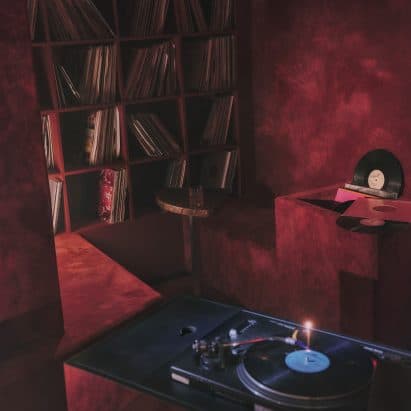
Inside Dive: Golem's Velvet-Clad Subterranean Bar in Marylebone, London
London's bar scene has never shied away from bold design statements, but the recently completed Dive bar in Marylebone pushes the concept of immersive interior experience into genuinely new territory. Designed by London-based design studio Golem, this subterranean cocktail bar wraps its walls, floors, and surfaces in deep velvet — a material choice that does far more than look luxurious. According to Golem, the velvet is intended to "retain the imprint of bodies," making every guest who passes through a passive contributor to the space's ever-evolving texture and atmosphere.
The result is one of the most talked-about bar interiors to emerge from central London in recent memory, and a compelling case study in how thoughtful material selection can completely redefine the relationship between a space and the people who inhabit it.
Who Is Golem? The Design Studio Behind the Vision
Golem is a London-based multidisciplinary design studio with a reputation for producing interiors that feel emotionally charged and conceptually rigorous in equal measure. Rather than defaulting to the polished minimalism or industrial chic that dominates so many contemporary hospitality spaces, Golem consistently pursues ideas rooted in materiality, memory, and human presence. Their portfolio spans residential, retail, and hospitality sectors, but it is in the latter that their philosophy tends to resonate most powerfully — largely because bars and restaurants are spaces defined by the accumulation of human experience over time.
With Dive, Golem was given an opportunity to push this philosophy to its logical extreme, designing a space that quite literally bears the marks of its visitors.
The Concept: A Space That Remembers You
The central idea behind Dive is both poetic and surprisingly functional. Velvet, as a textile, is uniquely sensitive to touch and pressure. When a hand brushes against it, when a shoulder leans into a wall panel, or when feet repeatedly cross a velvet-lined floor, the pile of the fabric shifts and flattens, leaving a visible trace of that contact. Over time, these traces accumulate, creating a kind of material memory — a record of the bodies that have moved through the space.
Golem has leaned into this quality deliberately, framing it not as wear and tear but as an intentional design feature. The velvet surfaces at Dive are expected to change in appearance as the bar grows older and busier, becoming richer and more layered in texture with each passing week. In this sense, the interior is never truly finished — it continues to evolve in response to its patrons, making the guests themselves unwitting co-authors of the space's aesthetic.
This is a radical departure from conventional hospitality design, where interiors are typically engineered to look as pristine and unchanged as possible for as long as possible. Dive inverts that logic entirely, celebrating impermanence and human contact as core design values.
The Interior: What Velvet Does to a Basement Space
Descending into Dive, visitors encounter an environment that is immediately, almost disorienting, soft. The usual hard edges and reflective surfaces of a cocktail bar are absent. In their place, velvet-upholstered wall panels absorb both light and sound, creating an acoustic intimacy that is rare in London's often noisy bar scene. The floor, too, departs from the standard polished concrete or timber that defines so many basement venues, instead offering the unusual sensation of walking on a textile surface that gives slightly underfoot.
The color palette Golem has chosen works in close dialogue with the material. Deep, saturated tones — the kinds of rich, dark hues that velvet renders with particular depth — reinforce the subterranean, almost cave-like quality of the space without making it feel oppressive. Carefully considered lighting, likely warm and low in intensity, would further enhance the velvet's ability to play with shadow and sheen, so that the same wall panel can appear entirely different depending on the angle from which you approach it or the direction in which the pile has been disturbed.
Why Velvet Is Having a Moment in Interior Design
It would be a mistake to read Dive purely as a novelty. Velvet has been steadily reclaiming its position as a serious interior design material over the past several years, moving well beyond its associations with either retro kitsch or formal grandeur. Contemporary designers have recognized that velvet offers something increasingly rare in an age of hard, cold, screen-dominated surfaces: genuine tactility. It invites touch. It responds to the body. It changes with use.
- Velvet absorbs sound effectively, making it a practical choice for intimate hospitality spaces where conversation is central to the experience.
- Its light-absorbing and light-reflecting qualities simultaneously give it a visual depth that few other materials can match at the same price point.
- As a textile with historical associations spanning opulence, bohemia, and underground culture, velvet carries connotational richness that suits a bar named, pointedly, Dive.
- The material's responsiveness to human contact makes it particularly well-suited to spaces designed around social gathering, where the presence of people is the whole point.
Dive in the Context of London's Evolving Bar Design Scene
London remains one of the world's most fertile cities for ambitious bar and restaurant design, with a hospitality culture that tends to reward conceptual boldness and reward operators willing to invest seriously in atmosphere. In that context, Dive arrives at an interesting moment. After years in which the dominant aesthetic trend leaned toward exposed brick, Edison bulbs, and reclaimed timber, there is a growing appetite among both designers and the public for interiors that feel genuinely distinctive — spaces with a clear point of view that goes beyond surface-level styling.
Golem's Dive bar answers that appetite with conviction. By centering its entire design logic on a single material and a single, philosophically interesting idea about what spaces do when humans inhabit them, the studio has created something that feels both of its moment and slightly outside of time — a bar that will look different, and arguably better, the more it is used.
Visiting Dive Bar in Marylebone
Dive is located in Marylebone, one of central London's most characterful and design-literate neighborhoods, home to a cluster of independent boutiques, galleries, and hospitality venues that consistently attract a discerning audience. The bar's subterranean location positions it perfectly within the neighborhood's layered urban fabric, offering an escape from the street-level bustle that feels genuinely earned once you descend into Golem's velvet-lined interior.
For anyone with an interest in interior design, material culture, or simply in the experience of drinking cocktails somewhere genuinely unlike anywhere else in London, Dive represents exactly the kind of destination that makes the city's hospitality scene worth paying attention to. It is, in the best possible sense, a space that leaves its mark on you — and asks you, in return, to leave yours on it.